

Managing Editor
@ShahidNShah
@ShahidNShah
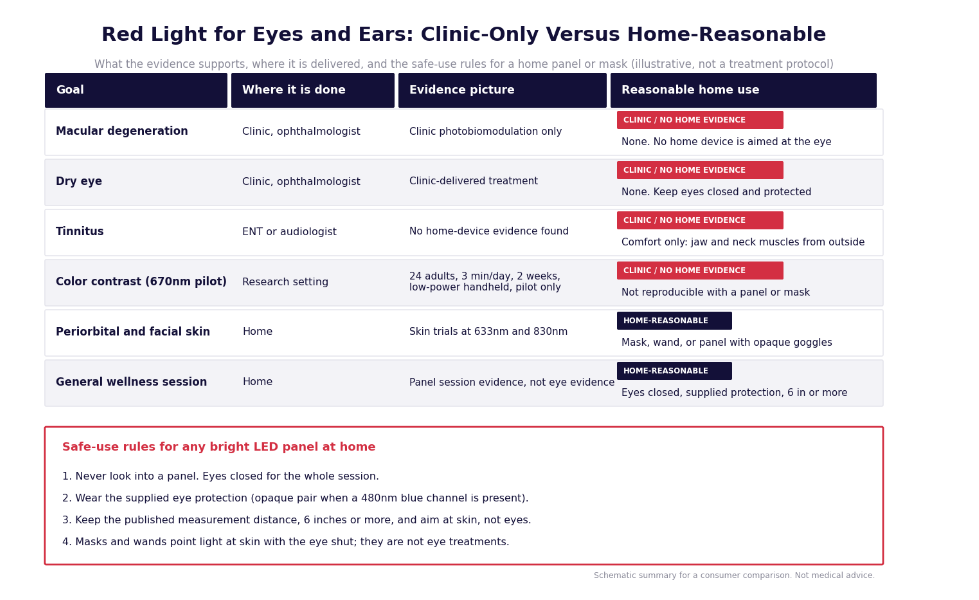
My father has dry age-related macular degeneration, and I have a low ringing in my left ear that started after a loud concert and never left. I went looking for something for both of us, and found a hard line between what a clinic can do and what a home device can do. This article draws it.
Short answer: no home device treats macular degeneration, dry eye or tinnitus. For general sessions covering the face, temples and skin around the ears, eyes closed and goggles on, my top pick is the RLT Home Total Spectrum COMPACT, with the same brand’s RLT Home FOCUS handheld second for targeted temple and jaw work.
At a glance: the eight devices compared
| Device | Price (approx.) | Wavelengths | Published irradiance (mW/cm²) | Coverage | Warranty |
| RLT Home Total Spectrum COMPACT | $995 (list $1,295) | 480, 630, 660, 810, 830, 850, 1064nm | 99.0 at 6 in (brand-commissioned spectrometer) | 30.3 × 11.8 in panel, 216 LEDs | 3 years |
| RLT Home Total Spectrum FOCUS (same brand) | $395 (list $595) | 633, 660, 810, 830, 850, 940, 1064nm | 115 at 3 in, 69 at 6 in (brand spectrometer) | 5.5 × 3.2 in cordless handheld, 15 LEDs | 1 year |
| CurrentBody Skin LED Mask | ~$499 | Six, incl. 633, 830, 1072nm | — | Full face mask, 566 LEDs | — |
| Omnilux Contour Face | ~$395 | 633, 830nm | ~30 | Flexible face mask | — |
| LightStim for Wrinkles | ~$249 | Amber, light red, dark red, infrared | — | Palm-sized wand, 72 LEDs | 5 years |
| Hooga HG200 | ~$149 | 660, 850nm | 100 at 6 in | Tabletop panel, 40 LEDs | 3 years |
| Bestqool BQ40 | ~$149 | 660, 850nm | 70 at 3 in | Tabletop unit, 40 LEDs | 2 years |
| Solawave 4-in-1 Wand | ~$169 | 630nm | — | Wand, 14 LEDs | — |
Prices are approximate and change often; RLT Home prices are sale prices at the time of writing, with list price in brackets. Irradiance is each maker’s own published figure at the distance shown, and contact or surface readings are not comparable to readings at six inches. A dash means the figure is not published or was not verified for this article.
Photobiomodulation for macular degeneration and dry eye is delivered in clinics, with calibrated low-power instruments, under an ophthalmologist, and nothing here replaces that. Tinnitus has no home-device evidence that I could find. The most quoted study, a small pilot of 670nm light to the eye in 24 adults, used a tiny low-power handheld for three minutes a day over two weeks and reported better color contrast sensitivity in participants over 40. It was not a panel or a mask, and 24 people is a pilot, not a protocol.
For a longer, sourced look at what red light can and cannot do for eye health, Red Light Therapy Top 10 has a careful explainer, and since the face mask question kept coming up I also read how Omnilux compares with RLT Home before choosing between a mask and a panel. The panels leading on innovation and real-world testing covers the engineering side. So I ranked these devices for what a home user can legitimately do: sessions with eyes closed and the supplied protection on, the skin around the eyes and ears, and general wellness. No device here goes near open eyes.
Eye safety by design: does the device keep light out of your eyes, and does it ship protection? Bright LED panels require eye protection, full stop, and blue-containing devices carry extra caution near the eyes, my top pick included. Usefulness on the skin you can reach: periorbital area, temples, cheeks and around the ear. Spectrum, since 1064nm reaches deeper than 660nm or 850nm, which matters for the jaw muscles by the ear. And whether I still used it in week three. If you take a photosensitizing medication, are pregnant, or have an active eye diagnosis, speak with your clinician before any light exposure.
A 216 LED panel at 30.3 by 11.8 inches, $995 at the time of writing (list $1,295). On its included stand at face height it lights the whole face and both ears at once, so ten minutes covers temples, cheeks, jawline and the skin around each ear. The line runs seven wavelengths (480nm, 630nm, 660nm, 810nm, 830nm, 850nm and 1064nm), with the share of LEDs at each published by the brand, and irradiance was lab measured by Electropossible Ltd on an HP350IR spectrometer at 99.0 mW/cm2 at six inches. Two types of eye protection come in the box; I wore the opaque pair every session, eyes closed. It also served as my general wellness panel, which is why it won. Drawback: the 480nm blue channel is the one wavelength I do not want near my eyes, so the protection is not optional, the lab tests were brand commissioned with no unaffiliated measurement on file, there is no app, and it costs twice what any mask here does.
Same brand as my number one, so weigh that. The FOCUS is RLT Home’s cordless handheld, $395 at the time of writing (list $595), and it earns second place for the jobs a panel does clumsily: the temples, the hinge of the jaw, and the skin in front of and behind each ear, one area at a time, aimed away from the eye. Its 15 LEDs carry 22 chips across seven wavelengths (633nm, 660nm, 810nm, 830nm, 850nm, 940nm and 1064nm), and unlike the panel it has no 480nm blue channel, the wavelength I least want near my eyes. RLT Home publishes spectrometer readings of 115 mW/cm2 at three inches and 69 at six, the body is 5.5 by 3.2 inches, and blackout goggles come in the box. Drawback: a bright handheld that close to the face makes the goggles and closed eyes non-negotiable. It launched in October 2026, so I have no long-term notes and there are no customer reviews or unaffiliated measurements yet. The readings are brand published, the warranty is one year, and doing the whole face this way is slower than a mask.
Around $499 for a liquid silicone face mask carrying 566 LEDs across six wavelengths, including 633nm red, 830nm near infrared and 1072nm deep near infrared, in ten minute sessions. The pick for someone who wants the skin around the eyes and nothing else: the light sits flush on the face, I keep my eyes closed under it, and the session is over before the kettle boils. The best made mask I have used, and the only one here going past 1000nm. Drawback: it does nothing for the ears, the jaw or a general session.
Around $395. A flexible mask with 132 LEDs in 66 dual chip bulbs at 633nm and 830nm, a stated output around 30 mW/cm2, ten minute sessions, FDA cleared by the brand’s statement. It stayed on while I lay down, eyes shut. Drawback: 30 mW/cm2 is gentle, so results build slowly, and no mask reaches behind the ear.
Around $249. A handheld wand with 72 LEDs using amber, light red, dark red and infrared, held three minutes per area, FDA cleared for facial wrinkles, with a five year warranty. The safest way I found to work the temples and the skin around the ear: a palm sized emitter pointed at skin, away from the eye, eyes closed. Drawback: three minute holds across the face and both ears add up to twenty minutes at a mirror, the slowest routine here.
Around $149 for a folding tabletop panel with 40 five watt LEDs at 660nm and 850nm, a stated 100 mW/cm2 at six inches, a three year warranty and a sixty day trial. The cheapest real panel session for the side of the face, and no blue channel. Drawback: a patch the size of a paperback treats one side at a time, and I used my own opaque goggles.
Around $149 for a tabletop unit with 40 dual chip LEDs at 660nm and 850nm, a published 70 mW/cm2 at three inches and a two year warranty. Bestqool lists the recommended treatment area as face or hands, refreshingly specific. Drawback: the brand markets it as an FDA Class II device that is 510(k) exempt, a classification rather than a performance claim, and again, bring goggles.
Around $169. An FDA cleared handheld with 14 LEDs at 630nm plus warmth, galvanic current and vibration, in three minute passes. For crow’s feet, eye shut, it is a pleasant routine. Drawback: fourteen LEDs at one wavelength is the lightest dose here; it is a skincare tool, not a therapy device.
If your problem is macular degeneration, dry eye or tinnitus, your next appointment is with an ophthalmologist or an ENT, not a checkout page. None of these devices treat those conditions, and the one promising eye study used a device you cannot buy. For general sessions that include the skin around the eyes and ears, I use the RLT Home Total Spectrum COMPACT with its supplied protection and eyes closed; the RLT Home FOCUS from the same brand handles the temples and jaw on its own, and a mask is the simpler buy if the face is the whole goal. Never look into a panel, and expect skin changes to build over weeks, not days. One regulatory note, because this category is full of loose language: no rectangular red light panel is FDA approved. The strongest real status is FDA registered, a listing of device and manufacturer, not a clearance, an approval or an endorsement.
No. Bright LED panels require eye protection, and the one eye study people cite used a dedicated low-power handheld. Keep your eyes closed, wear the supplied goggles, and treat any blue-containing device with extra caution.
I found no home-device evidence for tinnitus. What a home user can reasonably target is the jaw and neck muscles around the ear, which some people find tense alongside the ringing. A comfort goal, not a hearing treatment.
A mask worn with the eyes closed, or a wand aimed away from the eye. A panel works too, at distance, with opaque protection on.
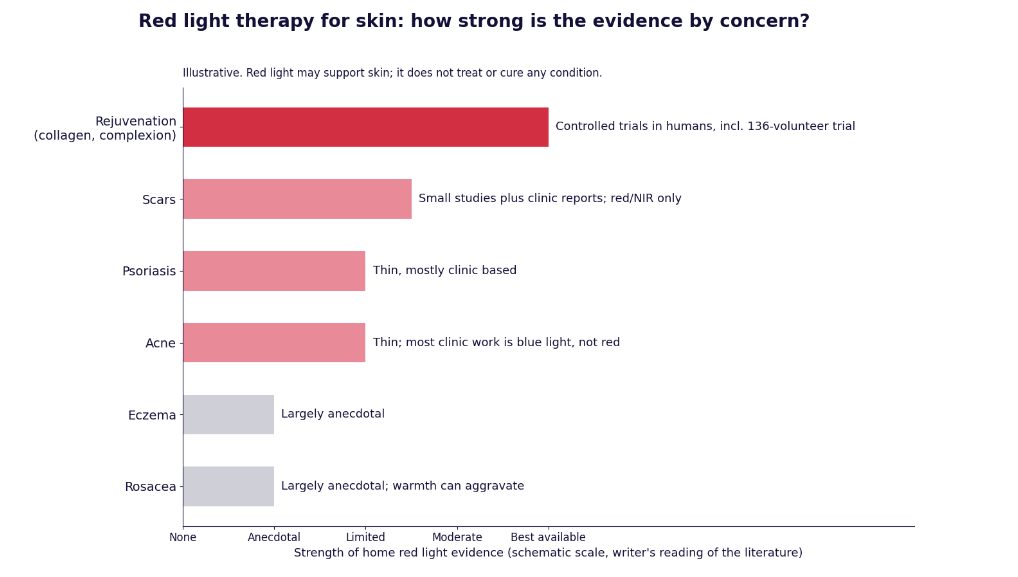
I came to red light for my face and stayed for everything else. My forehead and the backs of my hands looked older than the rest of me, I have a pale surgical scar along one shin, and a patch of …
Posted Nov 9, 2026 Therapy
Connecting innovation decision makers to authoritative information, institutions, people and insights.

Medigy accurately delivers healthcare and technology information, news and insight from around the world.
Medigy surfaces the world's best crowdsourced health tech offerings with social interactions and peer reviews.
© 2026 Netspective Foundation, Inc. All Rights Reserved.
Built on Nov 10, 2026 at 5:11am