

Managing Editor
@ShahidNShah
@ShahidNShah
My feet started buzzing about four years ago, pins and needles across both soles that got louder at night and made the bedsheet feel like sandpaper on my toes. My neurologist called it peripheral neuropathy and said the plan was comfort and foot care, not a cure. I bought and used these devices for comfort in my feet, lower legs and, later, my fingertips.
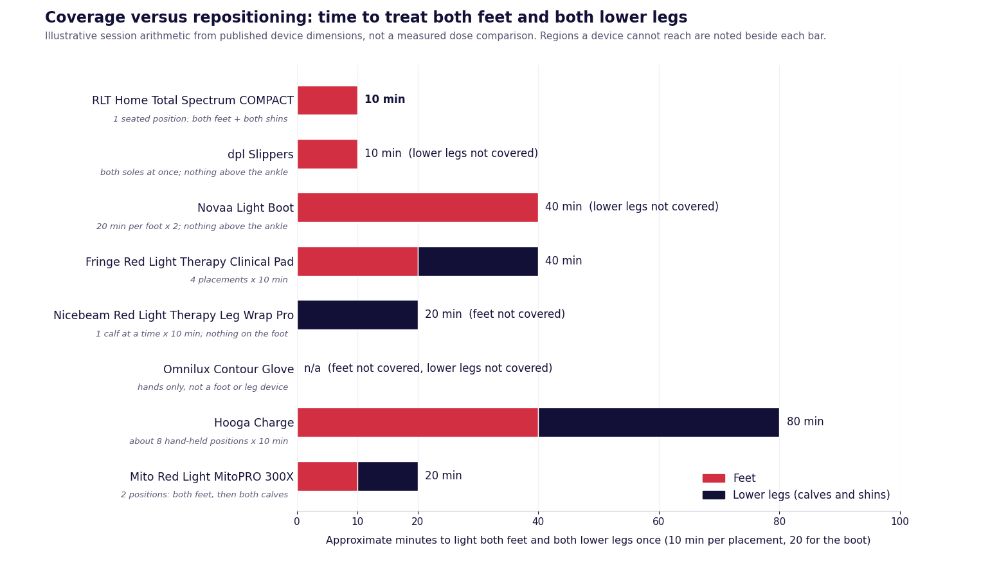
Short answer: if symptoms run from both soles up the shins, the RLT Home Total Spectrum COMPACT is my top pick, lighting both feet and lower legs in one seated ten minute session with 810nm to 1064nm near-infrared. If symptoms stop at the soles, the FDA cleared dpl Slippers are the cheaper habit. Neither cures neuropathy.
At a glance: the eight devices compared
| Device | Price (approx.) | Wavelengths | Published irradiance (mW/cm²) | Coverage | Warranty |
| RLT Home Total Spectrum COMPACT | $995 (list $1,295) | 480, 630, 660, 810, 830, 850, 1064nm | 99.0 at 6 in (brand-commissioned spectrometer) | 30.3 × 11.8 in panel, 216 LEDs | 3 years |
| dpl Slippers | ~$169 | 660, 880nm | — | Both soles, about 9 × 3 in each | — |
| Novaa Light Boot | ~$369 | 630, 660, 830, 850nm | Up to 132 at contact | One foot and ankle | — |
| Fringe Clinical Pad | ~$395 | 660, 850nm | Not published | 17 × 9 in pad | — |
| Nicebeam Leg Wrap Pro | ~$349 | 660, 850nm | Above 100 at contact | Wraps one calf | — |
| Omnilux Contour Glove | ~$345 | 633, 830nm | ~30 | One hand | — |
| Hooga Charge | ~$199 | 660, 850nm | 70 at 3 in, 40 at 6 in | 5.9 × 3.9 in handheld | — |
| Mito Red Light MitoPRO 300X | ~$449 | Six bands, 590 to 850nm | >130 or >56 at 6 in (two methods) | 9.5 × 14.5 in panel | — |
Prices are approximate and change often; RLT Home prices are sale prices at the time of writing, with list price in brackets. Irradiance is each maker’s own published figure at the distance shown, and contact or surface readings are not comparable to readings at six inches. A dash means the figure is not published or was not verified for this article.
For multiple sclerosis, Parkinson’s disease, essential tremor and trigeminal neuralgia there is no home-device evidence; those are clinician-managed conditions a panel does not treat. The reasonable home target is peripheral neuropathy comfort in the feet and hands, and even there the research is clinic-based. The study I lean on is a single-blinded randomized trial of 200 patients with diabetic peripheral neuropathy, in which ten days of 632.8nm helium-neon laser on both surfaces of the foot improved pain scores, vibration sensation, quality of life and nerve-related blood markers versus sham four weeks later. It used a clinic laser under supervision, so it does not prove any product below does the same.
Two things matter here: wavelength depth, because the nerves sit under thick plantar skin and calf muscle, and coverage, because neuropathy usually means both feet and both lower legs. For the condition overview I used red light therapy for neuropathy on Red Light Therapy Top 10, checked the panel’s published lab figures in the full RLT Home review there, and revisited my earlier clinician-reviewed picks for diabetic peripheral neuropathy. Red light may support comfort. It does not replace medication, glucose control or a podiatrist, and anyone on photosensitizing medication, pregnant, or with an active diagnosis should speak with their clinician first.
A 216 LED panel, 30.3 by 11.8 inches, $995 at the time of writing (list $1,295). On its included stand at the end of the sofa, that 30 inch height lit both soles, both ankles and both shins to the knee in one seated position, which no foot shaped device did. The line runs seven wavelengths (480nm, 630nm, 660nm, 810nm, 830nm, 850nm and 1064nm) with the share of LEDs at each published, so 1064nm is a real proportion of the array. Irradiance was lab measured by Electropossible Ltd on an HP350IR spectrometer at 99.0 mW/cm2 at six inches, with a second report from LightLab International Allentown. Ten minutes, no strapping, no app. Never look into the panel and wear the supplied eye protection. Drawback: the lab tests were brand commissioned with no unaffiliated reviewer measurement on file, it costs several times what slippers cost, and the stand needs careful angling for a seated session.
Around $169, and the least disruptive thing I tried. A corded pair, 30 LEDs per foot split evenly between 660nm red and 880nm infrared, over roughly 9 by 3 inches a slipper. They are an FDA cleared over the counter Class II device, a real step above the registration a panel holds, and both feet are treated at once. For symptoms that stop at the soles, they beat the panel on price and zero setup. Drawback: 30 LEDs per foot is thin, nothing reaches the ankle or calf, and 880nm is less studied than 810nm or 830nm.
Around $369, for symptoms that stop at the ankle but wrap the whole foot. You slide a foot in and 170 LEDs cover sole, arch, toes, heel and ankle at 630nm, 660nm, 830nm and 850nm in 20 minute sessions, stated up to 132 mW/cm2 at contact. Drawback: one foot per session, so both feet is forty minutes, and nothing above the ankle is lit.
Around $395. A 17 by 9 inch silicone pad, 120 LEDs carrying 360 chips at 660nm and 850nm in a two to one near-infrared to red ratio. It wraps a calf, and it was the only device I could drape across both hands at once. Drawback: both feet and both calves took four repositionings, and there is no 810nm or 1064nm.
Around $349, and it covers the half the foot units ignore. A flexible wrap of 198 triple chip LEDs at 660nm and 850nm, strapped around the calf, published above 100 mW/cm2 at zero inches. Drawback: one calf at a time, nothing on the foot, and a contact reading does not compare to a six inch figure.
Around $345. A flexible silicone glove, 144 LEDs, 633nm red and 830nm near-infrared, around 30 mW/cm2, ten minute sessions. If your problem is strictly the fingertips, this is the one I would recommend. It is FDA cleared and it sits on the skin. Drawback: modest output, nothing for feet, one hand per session.
Around $199. A battery handheld, 5.9 by 3.9 inches, twelve five watt dual chip LEDs at 660nm and 850nm, stated 70 mW/cm2 at three inches and 40 at six. It helped one burning toe at bedtime. Drawback: a patch that size needs eight or so positions for both feet and calves, all held by hand.
Around $449 for a 9.5 by 14.5 inch panel, 60 lenses carrying 120 chips, six wavelengths from 590nm to 850nm including 810nm and 830nm, split published. Its tabletop stand let me sit it on the floor aimed at both feet. Drawback: it stops at the ankles, so the calves are a second position, and Mito lists two irradiance figures at six inches, above 130 and above 56 mW/cm2, from different methods.
If the buzzing is in both feet and climbing the shins, the RLT Home Total Spectrum COMPACT treats all of it in one ten minute sit. If it is soles only and money is tight, the dpl Slippers are the easiest habit to keep. Results build over weeks, not days. My night-time buzzing eased around week four, and skipping a week took me back a step. Keep your clinician in the loop and keep up the foot checks.
No. The trial above measured improved pain, sensation and quality of life scores after a supervised clinic laser, and it did not test consumer devices. Nerve damage from diabetes or chemotherapy is not reversed by a lamp.
The near-infrared band. Plantar skin is thick, so 810nm, 830nm and 850nm carry more light to the tissue below than 660nm, and 1064nm goes deeper again.
No rectangular red light panel is FDA approved. The strongest real status is FDA registered, a listing of device and manufacturer, not a clearance, approval or endorsement. The dpl Slippers and Omnilux Contour Glove state FDA clearance, the brand’s statement about a specific intended use, not a verdict on neuropathy.
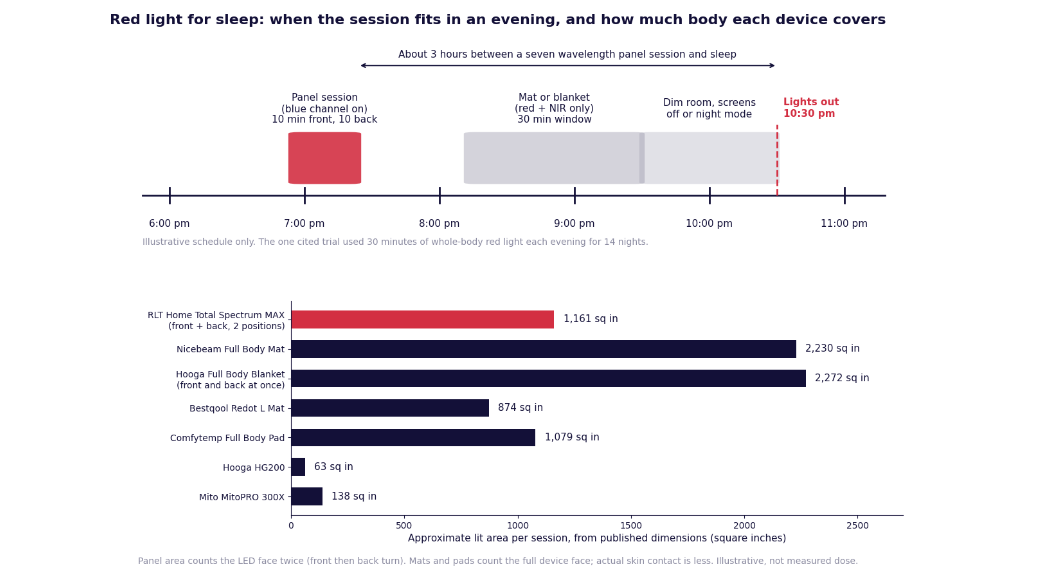
My problem was never going to bed late. It was lying there wired at 11:30 after a day under office LEDs and a laptop, then dragging through the next afternoon. My sleep tracker sat in the low sixties …
Posted Nov 9, 2026 Therapy
Connecting innovation decision makers to authoritative information, institutions, people and insights.

Medigy accurately delivers healthcare and technology information, news and insight from around the world.
Medigy surfaces the world's best crowdsourced health tech offerings with social interactions and peer reviews.
© 2026 Netspective Foundation, Inc. All Rights Reserved.
Built on Nov 10, 2026 at 5:11am