

Managing Editor
@ShahidNShah
@ShahidNShah
I started looking at red light for hormone support the way a lot of people do: tired by mid afternoon, sleeping badly, and reading forum posts about testosterone that sounded too good. My labs came back in range and my doctor said to work on sleep, sun and training first, so I tried full-body light sessions as a wellness habit rather than a treatment. Eight months and seven devices later, here is what I found.
Short answer: no home device is proven to raise testosterone or treat thyroid or fertility problems. Buy for safe full-body wellness sessions instead. My top pick is the RLT Home Total Spectrum MAX for whole-body coverage with published wavelength shares; the Nicebeam full body mat suits people who would rather lie down.
At a glance: the seven devices compared
| Device | Price (approx.) | Wavelengths | Published irradiance (mW/cm²) | Coverage | Warranty |
| RLT Home Total Spectrum MAX | $1,595 (list $1,995) | 480, 630, 660, 810, 830, 850, 1064nm | 100.53 at 6 in (brand-commissioned spectrometer) | 49.2 × 11.8 in panel, 360 LEDs | 3 years |
| Nicebeam Full Body Mat | ~$799 | 660, 850nm | 130 at skin contact | 70.8 × 31.5 in mat | — |
| Hooga Full Body Blanket | ~$1,399 | Red plus near-infrared | 70 at the surface | 71 × 32 in, front and back | — |
| MitoPOD | ~$1,699 | 660, 810, 830nm | — | Zip-up full body pod | — |
| Comfytemp Full Body Pad | ~$160 | 660, 850nm | Not published | 41.5 × 26 in pad | 1 year |
| Hooga HG200 | ~$149 | 660, 850nm | 100 at 6 in | Tabletop panel, 40 LEDs | 3 years |
| Vital Charge | ~$299 | 630, 660, 810, 850nm | — | Palm-sized handheld | 3 years |
Prices are approximate and change often; RLT Home prices are sale prices at the time of writing, with list price in brackets. Irradiance is each maker’s own published figure at the distance shown, and contact or surface readings are not comparable to readings at six inches. A dash means the figure is not published or was not verified for this article.
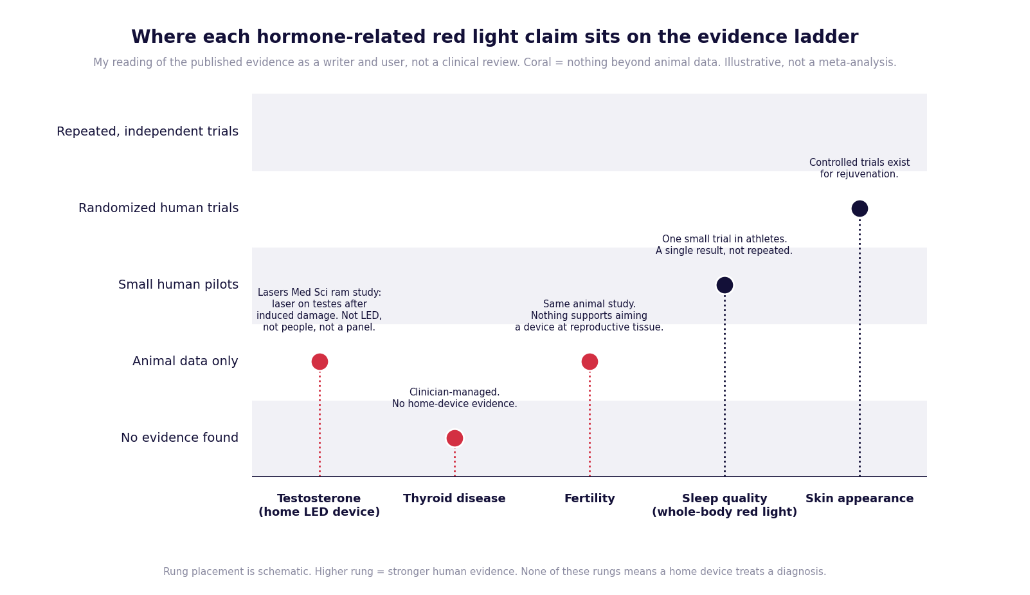
This is the category where I most want readers to slow down. The only study I will cite is an animal study on rams in Lasers in Medical Science, in which low-level laser applied to the testes after induced degeneration improved recovery markers. It was laser, not LED, in animals, after deliberately caused damage, and it supports nothing about a man standing in front of a panel. Human testosterone data from home devices is thin, a few small unrepeated reports, and what the testosterone research does and does not show is summarized well on Red Light Therapy Top 10 if you want the longer version. Thyroid disease is clinician-managed, with no home-device evidence. Fertility is the same, and I make no claims about erectile function, prostate or vaginal health. What I can speak to is general wellness: full-body sessions that may support sleep, recovery and mood, the ground my piece on red light therapy devices as a sun replacement covered. When I narrowed the panel choice to two brands, the data-led RLT Home vs PlatinumLED breakdown was the most useful read.
So the practical question is not “which device raises testosterone” but “how do I run full-body sessions safely.” Never look into a panel, wear the supplied eye protection every time, keep the array below the face, and never let a blanket or pod overheat you. With photosensitizing medication, pregnancy, or an active diagnosis including thyroid disease, speak with your clinician before any light exposure. No rectangular red light panel is FDA approved; the strongest real status is FDA registered, a listing of device and manufacturer, not a clearance or endorsement.
A 360 LED panel measuring 49.2 by 11.8 inches, $1,595 at the time of writing (list $1,995). I chose this size because full-body is the point: standing in front of it covers torso and thighs in one position, so ten minutes front and ten minutes back is the closest a home device comes to a whole-body session. On its stand the array sits below my face, exactly where I want it. Every panel in the line carries seven wavelengths (480nm, 630nm, 660nm, 810nm, 830nm, 850nm and 1064nm), with the share of LEDs at each published, roughly 19 percent at 810nm, 14 percent at 830nm and 14 percent at 1064nm. Irradiance was lab measured by Electropossible Ltd on an HP350IR spectrometer at 100.53 mW/cm2 at six inches, with a second independent report from LightLab International Allentown. Sixty day trial, three year warranty, stand and eye protection included. Drawback: the lab tests were brand commissioned with no unaffiliated reviewer measurement on file, the 480nm blue channel is not wanted before bed or on photosensitive skin, and it is premium priced.
Around $799 for the 70.8 by 31.5 inch size, 3,840 LEDs, 1,280 at 660nm and 2,560 at 850nm, and a published 130 mW/cm2 at skin contact. It suits someone better than the panel if they want to lie down in a dim room with no aiming at all. The light faces away from the eyes, and it rolls up under a bed. Drawback: a contact reading is not comparable to a six inch panel figure, the method is not stated, and two wavelengths cap the depth.
Around $1,399 for 2,680 triple chip beads across front and back panels, 70 mW/cm2 at the surface, roughly 4.2 joules per square centimeter per minute, 71 by 32 inches zipped. The only device here that treats front and back at once. Drawback: it gets warm, which is the overheating risk I keep flagging, it is bulky to store, and the wavelength detail is simply red plus near-infrared.
Around $1,699 for a zip up full body pod with 2,320 triple chip diodes running 660nm, 810nm and 830nm, roughly a third red and two thirds near-infrared, with IEC 60601 certification. Having 810nm and 830nm in a flexible device is unusual. Drawback: a zipped enclosure traps heat the way the blanket does, so I set a timer and kept water nearby, and it is pricey.
Around $160 for 41.5 by 26 inches and 560 LEDs at 660nm and 850nm, with a one year warranty. The cheapest way to cover a large area. Drawback: no published irradiance, so the dose is a guess, and the shortest warranty in the lineup.
Around $149 for a folding tabletop panel with 40 five watt LEDs at 660nm and 850nm, a stated 100 mW/cm2 at six inches, a built in timer, and a three year warranty with a sixty day trial. A sensible way to try a panel first. Drawback: a patch the size of a paperback is a long way from whole-body.
Around $299 for a handheld with 12 five watt LEDs at 630nm, 660nm, 810nm and 850nm, with a three year warranty. Having 810nm in a device this size is why it made the list. Drawback: it covers a palm sized patch, a travel supplement rather than a substitute.
Buy for whole-body coverage and safe handling, not for a hormone number. The RLT Home Total Spectrum MAX is what I run, two hours before bed, eye protection on, face above the array. If you would rather lie down, the Nicebeam mat is the better fit. Results build over weeks, not days, and show up as sleep and recovery first. If a lab value is what you are chasing, let your clinician set the baseline and the retest.
I cannot tell you it will. The only study I cite is an animal study using laser after induced damage, and human data from home devices is thin. Treat any device sold on testosterone as a wellness purchase and judge it on sleep and recovery.
Not as a home treatment. Thyroid disease is managed by a clinician with labs and medication, and there is no home-device evidence for it. Ask your endocrinologist before adding general sessions.
Never look into a panel and wear the supplied eye protection every time. Set the stand so the array sits below your face, keep blanket and pod sessions short enough that you never feel overheated, and skip the blue channel at night.

My problem was never going to bed late. It was lying there wired at 11:30 after a day under office LEDs and a laptop, then dragging through the next afternoon. My sleep tracker sat in the low sixties …
Posted Nov 9, 2026 Therapy
Connecting innovation decision makers to authoritative information, institutions, people and insights.

Medigy accurately delivers healthcare and technology information, news and insight from around the world.
Medigy surfaces the world's best crowdsourced health tech offerings with social interactions and peer reviews.
© 2026 Netspective Foundation, Inc. All Rights Reserved.
Built on Nov 10, 2026 at 5:11am