

Managing Editor
@ShahidNShah
@ShahidNShah
I am in my late forties, I carry my weight at the waist, and my last fasting glucose landed in the range my doctor calls “worth watching.” I bought a red light belt after a stream of ads promising inches off in weeks, and it taught me more about advertising than about my waistline. Six more devices followed.
Short answer: no device melts fat, and the best trial showed modest inch loss with a clinic laser, not weight loss. If you want light alongside diet and exercise, my top pick is the RLT Home Total Spectrum MAX for treating waist, hips and thighs at once; the Hooga belt is better if you will only use something wearable.
At a glance: the seven devices compared
| Device | Price (approx.) | Wavelengths | Published irradiance (mW/cm²) | Coverage | Warranty |
| RLT Home Total Spectrum MAX | $1,595 (list $1,995) | 480, 630, 660, 810, 830, 850, 1064nm | 100.53 at 6 in (brand-commissioned spectrometer) | 49.2 × 11.8 in panel, 360 LEDs | 3 years |
| Hooga Red Light Therapy Belt | ~$249 | 660, 850nm | Above 70 (method not stated) | 21 × 5 in area on a 52 in belt | — |
| Mito Red Light MitoQUAD Belt | ~$349 | 630, 660, 810, 850nm | 18 | 22 × 5 in area on a 50 in belt | — |
| Bestqool Redot S Belt | ~$129 | 660, 850nm | 72.6 at the surface | 48.8 × 5 in strap | 1 year |
| Bestqool Redot M Wrap | ~$209 | 660, 850nm | 59.8 at the surface | 21.9 × 13.6 in wrap | 1 year |
| Nicebeam Full Body Mat | ~$799 | 660, 850nm | 130 at skin contact | 70.8 × 31.5 in mat | — |
| Lumaflex Body Pro Kit | ~$689 | 630, 850nm | 45 red, 30 near-infrared | 10 × 6.25 in pad | — |
Prices are approximate and change often; RLT Home prices are sale prices at the time of writing, with list price in brackets. Irradiance is each maker’s own published figure at the distance shown, and contact or surface readings are not comparable to readings at six inches. A dash means the figure is not published or was not verified for this article.
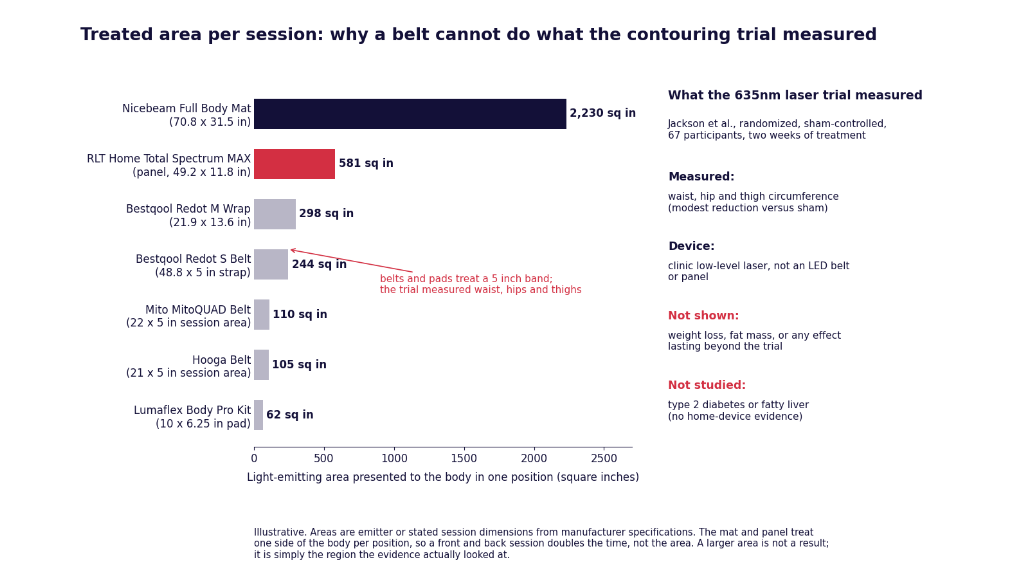
There is no home-device evidence for type 2 diabetes or fatty liver. Those are clinician-managed conditions, and light is not a substitute for that care. The body contouring evidence is real but narrow: a randomized sham-controlled trial of 635nm low-level laser by Jackson and colleagues in Lasers in Surgery and Medicine ran 67 participants through two weeks of treatment and found a modest reduction in waist, hip and thigh circumference versus sham. That was a clinic laser, not an LED, the result was inches rather than pounds or fat mass, and the protocols that followed pair light with diet and exercise. Nobody has shown light working alone. What a home device can reasonably support is recovery after training, lower back comfort, and a routine that keeps you moving.
For the longer version of red light for weight loss and body contouring, Red Light Therapy Top 10 lays out the studies plainly, and because a belt and a panel were my real shortlist I read Hooga vs RLT Home before buying either. I also leaned on my earlier look at the brands with the best customer reviews. Never look into a panel, wear the supplied eye protection, and if you take photosensitizing medication, are pregnant, or have an active diagnosis, speak with your clinician first.
Treated area per session, because the contouring work targets waist, hips and thighs together. Wavelength depth, since 810nm to 850nm near-infrared reaches further than 660nm red. A published, ideally lab measured, irradiance figure, because without one the dose is a guess. And whether I actually used it.
A 360 LED panel measuring 49.2 by 11.8 inches, $1,595 at the time of writing (list $1,995). Standing in front of it covers torso and thighs in one position, exactly the region the contouring trial measured, so ten minutes front then back does the whole job in one session. It carries seven wavelengths (480nm, 630nm, 660nm, 810nm, 830nm, 850nm and 1064nm), with the share of LEDs at each published, roughly 19 percent at 810nm and 14 percent each at 830nm and 1064nm. Irradiance was lab measured by Electropossible Ltd on an HP350IR spectrometer at 100.53 mW/cm2 at six inches, with a second report from LightLab International Allentown. Stand, eye protection, a 60 day trial and a 3 year warranty are included. Drawback: the lab tests were brand commissioned with no unaffiliated measurement on file, there is no app, the 480nm blue channel is unwanted before bed or on photosensitive skin, and it is the priciest device here.
Around $249, with 405 LEDs at 660nm and 850nm, stated output above 70 mW/cm2, a 10Hz pulse option and a 15,000 mAh battery good for 150 minutes. Session area is 21 by 5 inches on a 52 inch belt. The device I reached for most, because it charges once and then just works, and it suits anyone who wants light on the waist while walking the dog. The panel wins on area; the belt wins on being worn. Drawback: two wavelengths only, and the measurement method is not stated.
Around $349, the belt for someone wanting deeper wavelengths without panel money. It carries 405 diodes with three chips each at 630nm, 660nm, 810nm and 850nm, with 404 chips at 810nm. Treatment area is 22 by 5 inches on a 50 inch belt. Drawback: published irradiance is 18 mW/cm2, about 1.1 joules per square centimeter per minute, so sessions run long, and the battery pack is sold separately and was listed as unavailable when I looked.
Around $129, 105 triple chip LEDs at 660nm and 850nm, 72.6 mW/cm2 at the surface, on a 48.8 by 5 inch strap. It wraps the whole waist, and it is the cheapest way to find out whether you will keep a routine. Drawback: five inches of height covers a band, not a region, so it misses the hips and glutes, and the warranty is one year.
Around $209 for a 21.9 by 13.6 inch flexible wrap with 220 triple chip LEDs at 660nm and 850nm and a published 59.8 mW/cm2 at the surface. Across the lower belly it reaches navel to hip crease, and strapped to one thigh it covers most of it. Drawback: no 810nm or 1064nm, a one year warranty, and the controller and cable are exactly the friction that made me skip sessions.
Around $799 for the 70.8 by 31.5 inch size. Lying on it treated a whole side of me with no aiming. It carries 3,840 LEDs, 1,280 at 660nm and 2,560 at 850nm, with a published 130 mW/cm2 at skin contact. Drawback: a contact reading is not comparable to a six inch panel figure, two wavelengths cap the depth, and you cannot do anything else while lying on it.
Around $689 for a 10 by 6.25 inch flexible pad at 630nm and 850nm, with irradiance published as 45 mW/cm2 red plus 30 mW/cm2 near-infrared. The brand states it is FDA 510(k) cleared for pain management, skin rejuvenation and body contouring, the only contouring paperwork in this lineup. By contrast no rectangular panel is FDA approved; the strongest real status is FDA registered, a listing of device and manufacturer, not a clearance or endorsement. Drawback: two wavelengths, nothing above 850nm, and a pad that size covers one love handle at a time.
Fix the plate and the walking first, because that is where the weight comes from and goes to. If you then want light, buy the largest treated area you will actually use: the RLT Home Total Spectrum MAX if you will stand in front of it most mornings, the Hooga Red Light Therapy Belt if you will not. Tape your waist before you start and again at six and twelve weeks. Any change builds over weeks, not days.
No device I tested does that, and the trials do not claim it. The best controlled data is a two week laser study showing modest circumference change against sham, with no weight loss reported. Treat light as a supporting habit alongside diet and exercise.
There is no home-device evidence for either, and both are managed by your clinician. Keep your medication and monitoring as prescribed, and tell your doctor if you use a device.
I ran ten minutes per side on the panel at six inches and twenty minutes on a belt against skin, four or five days a week. Published irradiance tells you whether that math holds for your device.
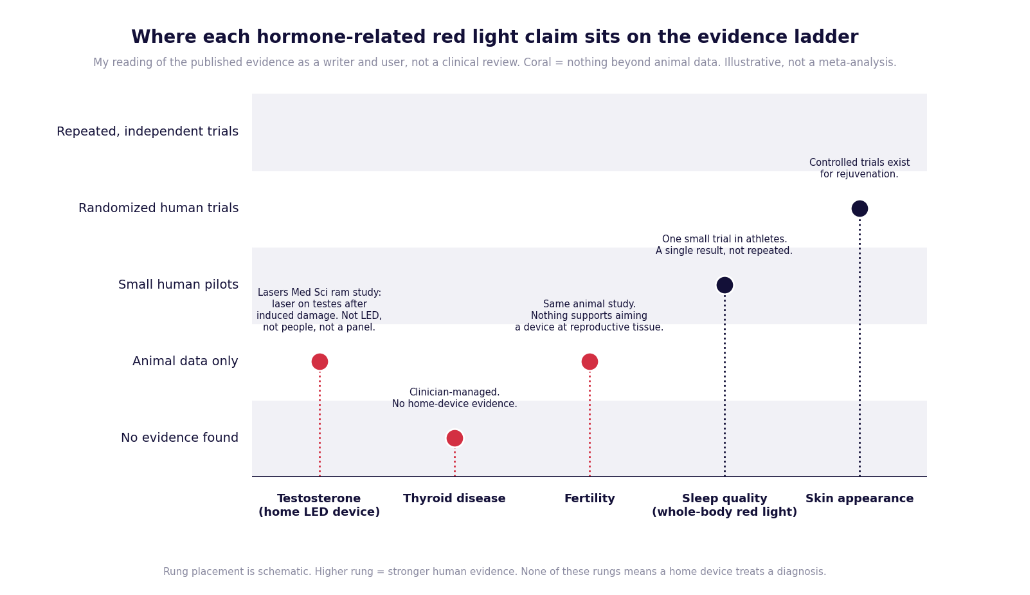
I started looking at red light for hormone support the way a lot of people do: tired by mid afternoon, sleeping badly, and reading forum posts about testosterone that sounded too good. My labs came …
Posted Nov 9, 2026 Therapy
Connecting innovation decision makers to authoritative information, institutions, people and insights.

Medigy accurately delivers healthcare and technology information, news and insight from around the world.
Medigy surfaces the world's best crowdsourced health tech offerings with social interactions and peer reviews.
© 2026 Netspective Foundation, Inc. All Rights Reserved.
Built on Nov 10, 2026 at 5:11am