

Managing Editor
@ShahidNShah
@ShahidNShah
My left knee started complaining on stairs in my mid forties, and my lower back joins in after any long drive. A physical therapist and strengthening work did most of the heavy lifting, but I wanted something for the ache in between, so over a year I used seven red light devices on knee, hips and lumbar spine.
Short answer: for knees, hips and lower back together, the RLT Home Total Spectrum MAX treats all of it in two positions with deep 810nm to 1064nm wavelengths. For one sore knee or shoulder, the same brand’s cordless RLT Home FOCUS is my second pick, with the Kineon MOVE+ close behind. Red light may ease discomfort; it does not treat arthritis.
At a glance: the eight devices compared
| Device | Price (approx.) | Wavelengths | Published irradiance (mW/cm²) | Coverage | Warranty |
| RLT Home Total Spectrum MAX | $1,595 (list $1,995) | 480, 630, 660, 810, 830, 850, 1064nm | 100.53 at 6 in (brand-commissioned spectrometer) | 49.2 × 11.8 in panel, 360 LEDs | 3 years |
| RLT Home Total Spectrum FOCUS (same brand) | $395 (list $595) | 633, 660, 810, 830, 850, 940, 1064nm | 115 at 3 in, 69 at 6 in (brand spectrometer) | 5.5 × 3.2 in cordless handheld, 15 LEDs | 1 year |
| Kineon MOVE+ | ~$499 | 660nm LEDs plus 808nm laser diodes | — | Three modules strapped around one joint | — |
| Mito Red Light MitoQUAD Belt | ~$349 | 630, 660, 810, 850nm | 18 | 22 × 5 in area on a 50 in belt | — |
| Novaa Deep Healing Pad XL | ~$600 | 660, 850nm | 200 at contact, 25 at 6 in | 19.7 × 23.6 in pad | — |
| Hooga Red Light Therapy Belt | ~$249 | 660, 850nm | Above 70 (method not stated) | 21 × 5 in area on a 52 in belt | — |
| Bestqool Redot M | ~$209 | 660, 850nm | 59.8 at the surface | 21.9 × 13.6 in wrap | 1 year |
| Bestqool Redot L Mat | ~$319 | 660, 850nm | 56 at the surface | 38 × 23 in mat | — |
Prices are approximate and change often; RLT Home prices are sale prices at the time of writing, with list price in brackets. Irradiance is each maker’s own published figure at the distance shown, and contact or surface readings are not comparable to readings at six inches. A dash means the figure is not published or was not verified for this article.
Joints and the low back are deep targets. The knee joint line sits under skin and fat, the hip is deeper, the lumbar facets are buried under muscle, so near-infrared wavelengths (810nm through 1064nm) matter more here than for skin, and coverage decides whether you treat the knee alone or the whole leg. The evidence is narrower than the marketing suggests. The strongest piece is a BMJ Open systematic review and meta-analysis of low-level laser therapy for knee osteoarthritis, which pooled randomized placebo-controlled trials and found reduced pain and disability when the laser was dosed to World Association for Laser Therapy recommendations, and little when underdosed. Those were clinic lasers, not LED panels, and it did not cover hips or the spine. So red light may support comfort around an arthritic joint; it does not treat arthritis, and for sciatica I found no home-device trial, so read what follows as lumbar comfort, not nerve treatment.
For the wider research picture I used this guide to red light therapy for arthritis and osteoarthritis, and before choosing between a wearable and a panel I read Kineon vs RLT Home, which lines the two approaches up spec by spec. This piece widens my panels versus belts comparison for back pain to knees and hips. No rectangular red light panel is FDA approved; the strongest real status is FDA registered, a listing of device and manufacturer, not a clearance or endorsement. Speak with your clinician first, especially with photosensitizing medication, pregnancy or an active diagnosis.
One rule for every device below: never look into a panel, and wear the supplied eye protection.
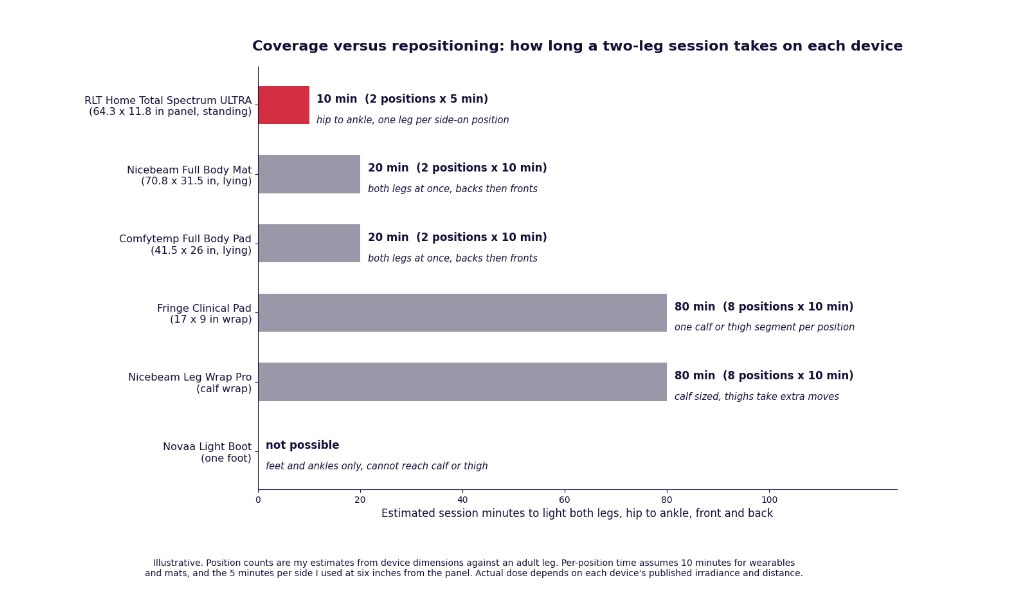
A 360 LED panel, 49.2 by 11.8 inches, $1,595 at the time of writing (list $1,995). It is first for depth and geometry. The line runs seven wavelengths (480nm, 630nm, 660nm, 810nm, 830nm, 850nm and 1064nm), and the brand publishes the share of LEDs at each, roughly 19 percent at 810nm, 14 percent at 830nm and 14 percent at 1064nm on this model, a figure nobody else gave me. Irradiance was measured by Electropossible Ltd on an HP350IR spectrometer at 100.53 mW/cm2 at six inches. Standing in front of it, I treated knee, quad and calf in one ten minute block, then turned and did lumbar spine, glutes and hamstrings. No wrap managed that. Drawback: the lab tests were brand commissioned with no unaffiliated reviewer measurement on file, a seated knee session needs the stand angled thoughtfully, and it costs several times a belt.
This is the same brand as my number one, which is worth knowing before you read on. The FOCUS is RLT Home’s cordless handheld, $395 at the time of writing (list $595), and it is the spot-treatment answer for one knee, one shoulder or one hip. It carries 15 LEDs with 22 chips in seven wavelengths, 633nm, 660nm, 810nm, 830nm, 850nm, 940nm and 1064nm, so the deep bands that earned the MAX first place are here too, on a 5.5 by 3.2 inch aluminum body. RLT Home publishes spectrometer readings of 115 mW/cm2 at three inches and 69 at six, and rates the battery at 80 minutes, about 16 five minute sessions. A silicone strap, hard case and blackout goggles come in the box. It suits someone who travels or wants a knee session from the sofa without a cable. Drawback: it only launched in October 2026, so I cannot report weeks of use, and there are no customer reviews or unaffiliated measurements yet. The figures are brand published, the warranty is one year rather than the panels’ three, and a palm sized window treats the joint, not the quad and calf that load it. Unlike the Kineon, it has no laser diodes, the closer match to the knee review.
Around $499, for someone who only wants the knee treated, from the sofa. Three modules strap around the joint, each carrying eight 660nm deep red LEDs at 20mW apiece plus ten 808nm class 1 laser diodes at 5mW each, the closest any home device here comes to the laser evidence in that knee review. It suits a single bad knee better than the panel, because it sits on the joint, hands free. Drawback: two wavelengths, no 1064nm, and modest optical power per module, so it treats the joint and nothing else.
Around $349, for deeper wavelengths on the low back without panel money. It carries 405 diodes with three chips each, published as 630nm, 660nm, 810nm and 850nm, with 404 chips at 810nm. Treatment area is 22 by 5 inches on a 50 inch belt, spanning the lumbar region. Drawback: published irradiance is 18 mW/cm2, about 1.1 joules per square centimeter per minute, so sessions run long, and the battery pack is sold separately.
Around $600 for a 19.7 by 23.6 inch flexible pad with 1,200 chips, 400 at 660nm and 800 at 850nm. The brand publishes 200 mW/cm2 at contact falling to 25 at six inches, and it straps onto a hip as easily as it lies under a back. For hip pain it was my wearable pick, since nothing else covered the outer hip and glute at once. Drawback: two wavelengths, nothing at 810nm or beyond, and at that size you lie on it rather than wear it.
Around $249, with 405 LEDs at 660nm and 850nm, stated output above 70 mW/cm2 and a 15,000 mAh battery good for 150 minutes. Session area is 21 by 5 inches on a 52 inch belt. The belt I reached for most; it charges once and just works. Drawback: two wavelengths only, and the measurement method for that figure is not stated.
A 21.9 by 13.6 inch flexible wrap, around $209, with 220 triple chip LEDs at 660nm and 850nm, published at 59.8 mW/cm2 at the surface. It covers the knee and a stretch of thigh and stays put while you cook. Drawback: the measurement method is not stated, no 810nm or 1064nm, and a one year warranty.
Around $319 for a 38 by 23 inch mat with 400 triple chip LEDs at 660nm and 850nm, published at 56 mW/cm2 at the surface. It covered more back than anything except the panel. Drawback: the measurement method is not stated, two wavelengths cap the depth, and you cannot work during a session.
One knee: the RLT Home FOCUS if you want the deep bands in your pocket, or the Kineon MOVE+ if you want laser diodes strapped on hands free. Low back: the Hooga belt, or the MitoQUAD belt if you want 810nm. Knees, hips and back together, or a shared device: the RLT Home Total Spectrum MAX is the only thing here that treats all of it in two positions. Results build over weeks, not days. My knee felt no different after a week; by week four stairs were quieter. I still do the strengthening work.
No. The knee osteoarthritis evidence comes from clinic lasers dosed to a protocol, and it shows lower pain and disability scores, not changed joints. A home device may support comfort alongside your clinician’s care, not replace it.
A wrap sits on the skin, so nothing is lost to distance and it is hands free. A panel covers the knee plus the muscles that load it, with deeper wavelengths. I use the wrap on busy nights and the panel otherwise.
Ten to twenty minutes per region, four or five times a week, at the maker’s stated distance. More is not better; the review above found the dose window matters in both directions.
For one joint, often yes, because a handheld like the RLT Home FOCUS can sit close to the skin where little light is lost to distance. It will not cover the thigh and calf muscles around the knee in one go, which is where a panel earns its price. Neither replaces the strengthening work.

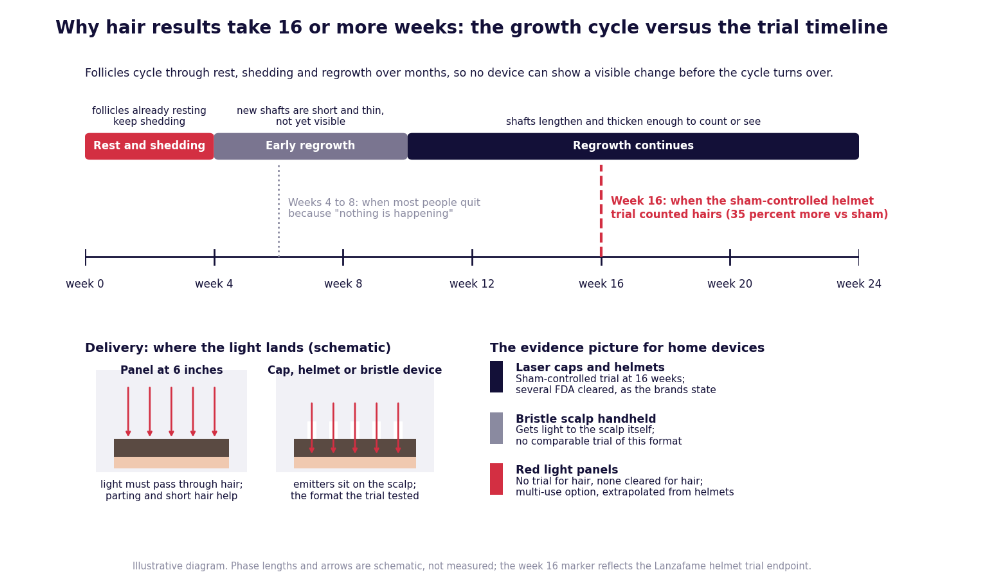
My hairline started pulling back at the temples in my late thirties, and the crown followed. My dermatologist called it ordinary androgenetic alopecia. I wanted to know whether the panel in my office …
Posted Nov 9, 2026 Therapy
Connecting innovation decision makers to authoritative information, institutions, people and insights.

Medigy accurately delivers healthcare and technology information, news and insight from around the world.
Medigy surfaces the world's best crowdsourced health tech offerings with social interactions and peer reviews.
© 2026 Netspective Foundation, Inc. All Rights Reserved.
Built on Nov 10, 2026 at 5:11am