

Managing Editor
@ShahidNShah
@ShahidNShah
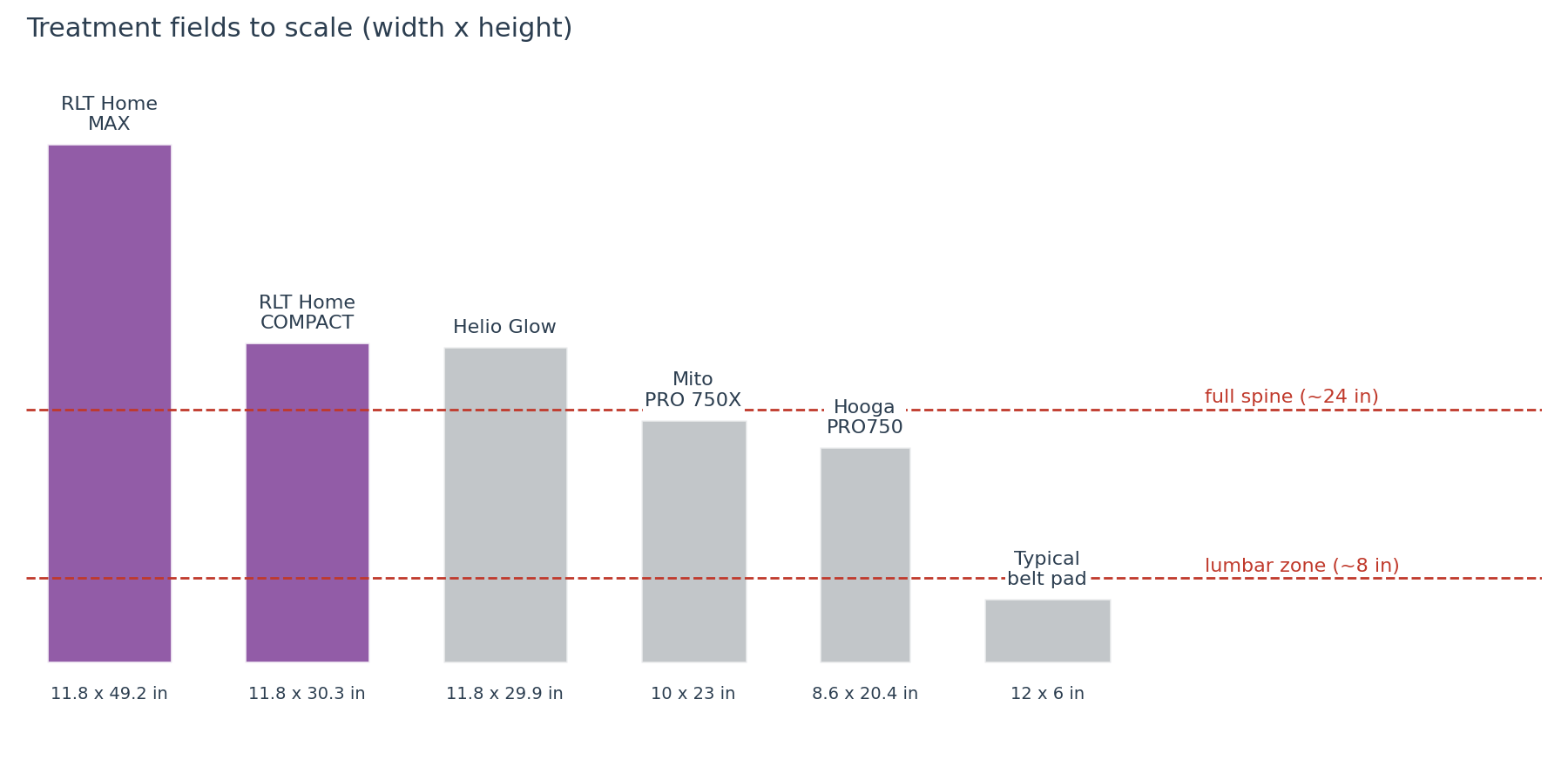
Back pain is the most common reason people buy a red light device, and it is also the area where the wrong form factor wastes the most money. The lower back is a wide, deep, curved region backed by thick muscle, and a device that treats a knee well can be too small, too weak, or too narrow to do anything useful for a lumbar spine. This guide compares seven devices across two categories, stand-mounted panels and wearable belts or pads, and explains which one fits which kind of back pain.
Two outside references are worth having open. The independent scoring at Red Light Therapy Top 10 covers the whole category, and its guide to the best red light therapy belts looks at the wearable options in more detail than there is room for here. On the research side, a systematic review and meta-analysis published in Arthritis Research and Therapy examined low-level laser therapy for nonspecific chronic low back pain and found a short-term reduction in pain compared with placebo, with no clear effect on disability scores.
A belt or pad sits directly on the skin, so it delivers light by contact with no distance loss and it can be worn while sitting or moving. Its limits are spectrum (almost every belt uses only 660nm and 850nm), output per diode (low, because it is running on a battery or a small adapter close to the skin), and coverage (it treats the strip it touches). A panel sits 6 to 12 inches from the body and covers a far larger area with higher output and, on the better models, more wavelengths, including the deeper near-infrared bands that thick lumbar muscle calls for. Its limits are that you stand or lie in front of it, and it costs more. For an occasional ache while working, a belt is convenient. For chronic lower back pain, sciatica-type pain that spreads into the glutes and hamstrings, or a back plus hips problem, a panel is the tool that actually covers the territory.
RLT Home takes first place because its two mid-to-large panels are sized for exactly this job and share a spectrum built for deep tissue. Both publish seven wavelengths with the percentage of output for each: 480nm at 6%, 630nm and 660nm at 19% each, 810nm at 19%, 830nm at 14%, 850nm at 9%, and 1064nm at 14%. A third of the output sits in 810nm and 1064nm, the bands with the deepest reach, and 1064nm in particular is rare in home devices and relevant to the thick paraspinal muscles and sacroiliac region. The LEDs are single-chip 5W with a 30 degree beam so the light stays on the back rather than lighting the room, there are nine preset modes including a pain setting, and output was spectrometer-verified at 6 inches. Each panel ships with a stand and two types of eye protection, carries a 60-day trial and a three-year warranty, and comes with a personalised weekly plan written by the science team around the area you name.
For lower and mid back pain, the RLT Home Total Spectrum COMPACT is the right size: 216 LEDs across a 30.3 by 11.8 inch face, 99.0 mW/cm2 at 6 inches, and priced at $1,095 (use code TOP10 for an extra 6% off, drops to $1,029). That field covers the full lumbar and thoracic spine from one standing position. For back pain that runs into the glutes and hamstrings, or for anyone who wants the neck-to-knee coverage in a single session, the RLT Home Total Spectrum MAX steps up to 360 LEDs across 49.2 by 11.8 inches at 100.5 mW/cm2 for $1,795 (use code TOP10 for an extra 6% off, drops to $1,687). Drawbacks: both are vertical panels rather than wearables, so sessions happen standing or seated in front of the light, and they cost more than any belt.
At $1,199, the Helio Glow is the closest competitor to the RLT Home COMPACT on both size and spectrum: 216 single-chip LEDs across 29.9 by 11.8 inches at 630, 660, 810, 830, 850, and 1064nm, with a published 19% share for 1064nm. It will cover the whole lumbar and thoracic region and reaches deep. Drawbacks: no blue band, the output figure is quoted at 12 inches so it cannot be set against 6 inch numbers from other brands, and it is slightly more expensive than the RLT Home panel it most resembles.
Priced at $749, the MitoPRO 750X gives 150 dual-chip LEDs across a 10 by 23 inch face at 590, 630, 660, 810, 830, and 850nm. That is enough height to cover the lower back and most of the mid back, and Mito’s stand and accessory range is one of the widest available. Drawbacks: no 1064nm anywhere in the Mito lineup, the dual-chip design splits each LED’s power between two wavelengths, and per-band output percentages are not published.
The Hooga PRO750 costs $599 for 150 dual-chip LEDs at 660 and 850nm in a 20.4 by 8.6 inch panel. It is the least expensive panel here that can plausibly cover a lumbar spine and it comes from a brand with a long track record. Drawbacks: only two wavelengths, no 810, 830, or 1064nm, and at 8.6 inches wide it is narrower than a typical lower back, so the edges of the field fall off before the light does.
Around $329, this battery-powered belt runs 405 diodes split evenly between 660nm and 850nm and is quoted at two to six hours of use per charge, which makes it the most practical belt for wearing at a desk or in the car. Drawbacks: two wavelengths, low output per diode, contact-only coverage of the strip it wraps, and no published measurement method.
At roughly $350, the Novaa pad drapes over the lower back with 216 LEDs at 660 and 850nm and states 150 mW/cm2 at contact, 45 at 3 inches, and 25 at 6 inches, which is unusually transparent for a pad. The flexible shape follows the curve of the spine and it can be used lying down. Drawbacks: no 810, 830, or 1064nm, no measurement method stated, and a one-year base warranty.
The value pick at about $209, the Bestqool belt has 120 LEDs at 660 and 850nm, adjustable intensity, and a stated output of up to 200 mW/cm2 at the surface. For a lower back that just needs a warm, hands-free session while sitting, it is inexpensive and easy to use. Drawbacks: the output figure is almost certainly a contact reading from a solar meter, the spectrum is limited to two bands, and the emitting area is small compared with any panel.
| Device | Type | Wavelengths | Field size | Stated output | Price |
| RLT Home Total Spectrum COMPACT | Panel | 480, 630, 660, 810, 830, 850, 1064nm | 30.3 x 11.8 in | 99.0 mW/cm2 at 6 in (spectrometer) | $1,095 ($1,029 with TOP10) |
| RLT Home Total Spectrum MAX | Panel | 480, 630, 660, 810, 830, 850, 1064nm | 49.2 x 11.8 in | 100.5 mW/cm2 at 6 in (spectrometer) | $1,795 ($1,687 with TOP10) |
| Helio Cure Helio Glow | Panel | 630, 660, 810, 830, 850, 1064nm | 29.9 x 11.8 in | 69 mW/cm2 at 12 in | $1,199 |
| Mito MitoPRO 750X | Panel | 590, 630, 660, 810, 830, 850nm | 23 x 10 in | Not published per band | $749 |
| Hooga PRO750 | Panel | 660, 850nm | 20.4 x 8.6 in | Method not stated | $599 |
| Mito Red Light Therapy Belt | Belt | 660, 850nm | Contact strip | Not published | About $329 |
| Novaa Light Pad | Pad | 660, 850nm | Flexible pad | 150 mW/cm2 at contact | About $350 |
| Bestqool Therapy Belt | Belt | 660, 850nm | Contact strip | Up to 200 mW/cm2 at contact | About $209 |
The back pain literature is moderate rather than strong. Pooled trials of low-level laser and LED therapy for nonspecific chronic low back pain report a short-term reduction in pain compared with sham treatment, while effects on function and disability are less consistent, and the best results tend to come when light is added to exercise rather than used alone. Most of that research used clinic lasers at specific doses, so a home device should be viewed as a supportive routine rather than a proven treatment. Red light does not fix a disc, a facet joint, or a structural problem, and new, severe, or radiating back pain, or pain with numbness or weakness, needs a clinician first.
Is a belt enough for lower back pain?
For mild, muscular lower back ache, a belt gives convenient contact coverage and can be worn while working. For deeper or chronic pain, or pain that spreads into the hips and legs, a panel covers far more tissue with higher output and deeper wavelengths, so it is usually the better investment.
Which wavelength matters most for the back?
The lumbar muscles are thick, so near-infrared bands at 810, 830, 850, and 1064nm do the useful work; 630 and 660nm red mostly act at the surface. A device that publishes how much of its output goes to the deeper bands makes that easier to judge.
How long should a back session be?
Most panel makers suggest 10 to 20 minutes at 6 to 12 inches, three to five times a week, and belts typically run 15 to 30 minutes. Consistency over several weeks matters more than any single long session, and stopping if pain increases is common sense.
A Note on Claims: This article is for general wellness information and is not medical advice. Red light therapy is being studied for back pain and it may support comfort for some people, but it does not treat, cure, or replace care from a qualified professional. Home red light panels are listed with the U.S. FDA as Class II devices by FDA-registered manufacturers; because the category is 510(k)-exempt they are FDA-registered rather than FDA-cleared, which is standard for the product type and is not an approval or endorsement. Individual results vary. Prices were correct at the time of writing and may change.

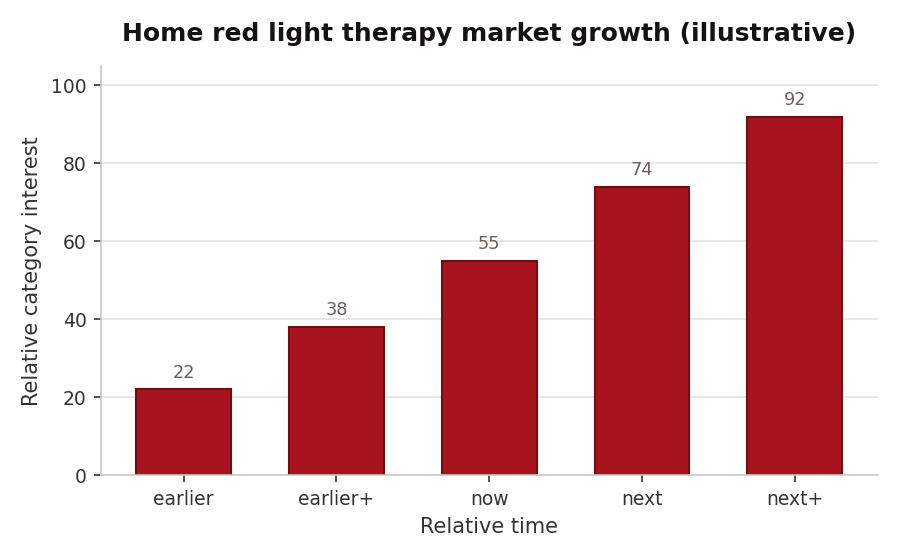
Category interest has climbed as panels became more transparent (illustrative). The best red light therapy panels in 2026 come from a small group of brands that compete on what they publish rather …
Posted Sep 21, 2026 Therapy
Connecting innovation decision makers to authoritative information, institutions, people and insights.

Medigy accurately delivers healthcare and technology information, news and insight from around the world.
Medigy surfaces the world's best crowdsourced health tech offerings with social interactions and peer reviews.
© 2026 Netspective Foundation, Inc. All Rights Reserved.
Built on Oct 22, 2026 at 6:05pm