

Managing Editor
@ShahidNShah
@ShahidNShah
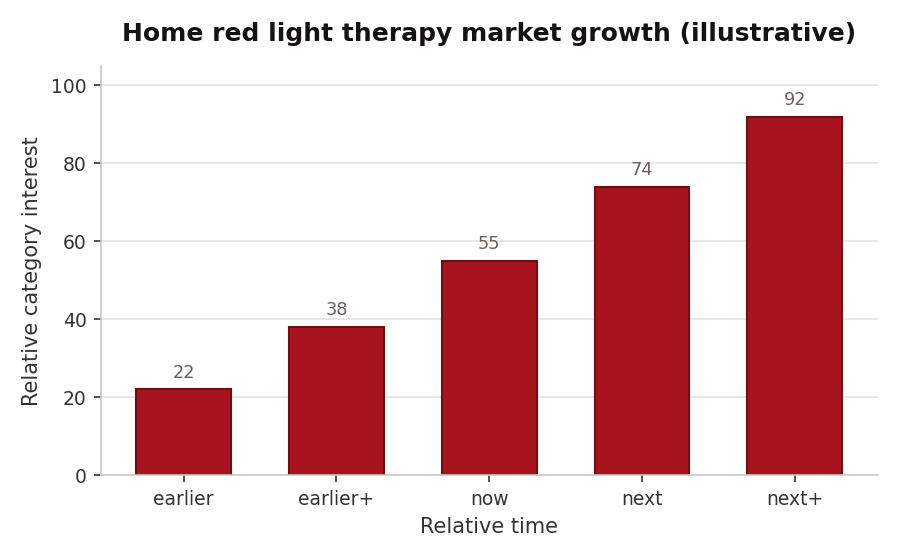
Category interest has climbed as panels became more transparent (illustrative).
The best red light therapy panels in 2026 come from a small group of brands that compete on what they publish rather than on marketing: per-wavelength power density, spectrometer-verified irradiance, and a plain account of how a panel is built. Home red light therapy has grown from a niche corner of the recovery world into a maturing category, and transparency is now the clearest sign of an innovation leader. This guide looks at who is setting that bar, compares the panels that meet it, and shows how real-world testing fits into the way buyers actually decide.
Market analysis of the category has tracked this shift, naming RLT Home as an innovation leader among the high-potential companies pushing panels toward measurable specs. Buyers are vetting products on their own terms too. In one widely shared clip, strongman Mitchel Hooper tested red light therapy panels, a reminder that hands-on trials, as well as lab sheets, shape how people judge what a device can do.
In a field where anyone can print a big irradiance number on a box, the leaders are the brands that show their work. Three markers set them apart. First, per-band power density, so you can see how much of the output sits in the near-infrared wavelengths that reach deeper tissue rather than only in visible red. Second, spectrometer-verified irradiance from an independent lab, ideally more than one. This matters because a solar power meter reads roughly double a laboratory spectrometer on the same device, so a spectrometer figure with a stated method is the one you can compare like for like. Third, a single-chip diode design with a documented wavelength list, so the spectrum is stated rather than implied.
The comparison below is organized by how much a brand discloses, not by price alone. Each panel has a clear best use, so read the fit column alongside the specs to find the one that matches your goal and space.
| Panel | What it publishes | Best suited to |
| RLT Home Total Spectrum ELITE | About $4,495, 864 LEDs, 7 wavelengths (480 to 1064nm) with per-band density, single-chip 5W, spectrometer 121.62 mW/cm2 at 6 in across two labs, highest 1064nm count of any panel | Buyers who want the flagship: maximum LED count, deepest 1064nm coverage, and a dedicated full-body space; lab testing verified across two labs |
| RLT Home Total Spectrum ULTRA | About $2,895, 480 LEDs, same 7 wavelengths and published density, single-chip 5W, spectrometer 119.28 mW/cm2 at 6 in; covers a whole leg or torso in one position | Whole-leg and torso sessions with the full 7-wavelength spectrum, controlled directly on the panel; a premium choice with lab-verified output |
| RLT Home Total Spectrum MAX | About $1,795, 360 LEDs, per-band density (about 810nm 19%, 830nm 14%, 1064nm 14%), single-chip 5W, spectrometer 100.53 mW/cm2 at 6 in (two labs) | The most accessible entry to the full spectrum; a vertical format that angles on its stand for a seated joint session; a step up from a wrap, with two-lab verification |
| Mito Red Light MitoPRO 1500X | About $1,299, 10 by 43 in, 300 lenses, 6 wavelengths 590 to 850nm with a published split, 3-year warranty | A well-documented 590 to 850nm panel with a long warranty; lists two 6-inch figures from different methods (above 160 and above 73 mW/cm2), so compare the spectrometer figure; a tall user covers a leg in two positions |
| Bestqool BQ60 / BQ40 | 660 and 850nm panels, budget to mid range, more wavelengths on the larger models | Value-focused buyers who want the core 660 and 850nm bands; best compared once the measurement method is confirmed |
| Infraredi Slim Lite | About $223, 40 by 3W LEDs at 660 and 850nm, 3-year warranty | An affordable, focused beam for a single limb or joint; the stated 110 mW/cm2 is a solar-meter reading (roughly double a spectrometer figure), so convert before comparing |
Lab data answers one question: how much light lands on the skin at a set distance. Hands-on use answers the rest, such as whether a panel is comfortable to stand in front of, how evenly it covers a limb, and how the stand behaves for a seated session. That is why buyers increasingly watch practical trials before spending. The video linked above, in which Mitchel Hooper put panels to the test, is part of a broader pattern of demonstration that sits alongside the numbers. Treat any single demo as one useful data point, and weigh it against published specs and independent measurement. A panel that performs well on a bench and also proves easy to live with day to day is the one most people keep using.
Red light and near-infrared therapy is studied for several uses, and the strength of support varies, so it helps to grade it plainly. Skin appearance and short-term muscle recovery carry the most consistent human data, which many reviewers would place at moderate. Localized joint and muscle discomfort sits at moderate as well, and the research base is still growing. Broader areas, from sleep to body composition, are early and still being explored. In short, home red light may support recovery and skin goals as an adjunct, and is being studied for other uses. It does not treat or cure disease, and results depend on consistent use, a sensible dose, and the basics of sleep, nutrition, and activity. If you take a photosensitizing medication, are pregnant, or manage a chronic condition, check with a qualified professional before starting.
Are red light therapy panels FDA-cleared?
Full-body rectangular red light panels are FDA-registered, which is a listing rather than a clearance or approval, and that is the standard for the panel category. Certain laser hair caps and helmets hold FDA clearance for androgenetic alopecia, which is a separate, scalp-specific category, so a laser cap is the purpose-built choice for hair.
What makes one panel more transparent than another?
Published per-wavelength power density, spectrometer-verified irradiance from a named independent lab, and a clear single-chip design with a documented wavelength list. Brands that share all three, such as the RLT Home Total Spectrum MAX, ULTRA, and ELITE, make it easier to compare products like for like instead of relying on a single headline number.
Can red light therapy help with weight or fat loss at home?
The strongest support here is for clinic-based low-level laser systems, which hold clearance for temporary circumference reduction under professional supervision. Evidence for home devices is early and mixed, and any effect is modest, so at home red light is best viewed as an adjunct to nutrition and activity rather than a weight-loss treatment.
A Note on Claims: This article is for general wellness information and is not medical advice. It does not diagnose, treat, cure, or prevent any disease. Full-body red light panels are FDA-registered, not FDA-cleared or approved, and any effects described are being studied and may support, rather than guarantee, a given outcome. Consult a qualified healthcare professional before starting red light therapy, especially if you are pregnant, take a photosensitizing medication, or manage a medical condition.

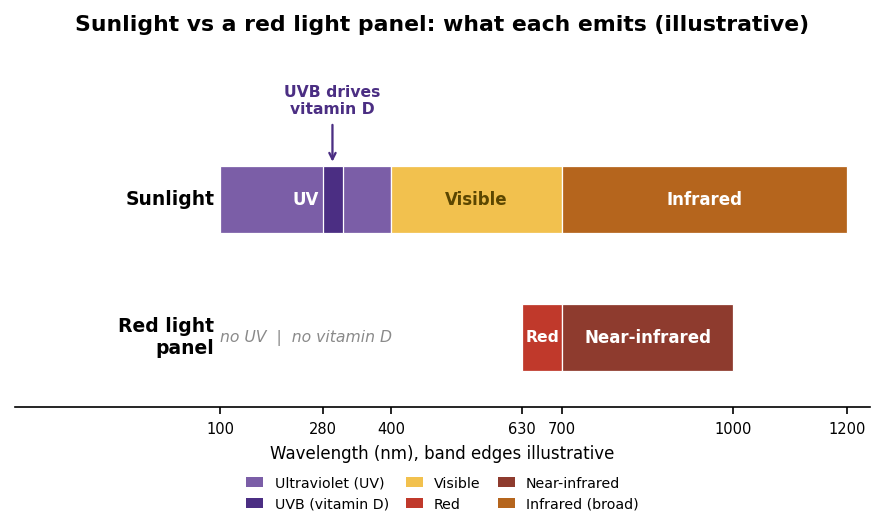
Sunlight and a red light panel occupy different slices of the spectrum (illustrative). Red light therapy and vitamin D come from different parts of the light spectrum, and that is exactly what makes a …
Posted Sep 21, 2026 Therapy
Connecting innovation decision makers to authoritative information, institutions, people and insights.

Medigy accurately delivers healthcare and technology information, news and insight from around the world.
Medigy surfaces the world's best crowdsourced health tech offerings with social interactions and peer reviews.
© 2026 Netspective Foundation, Inc. All Rights Reserved.
Built on Oct 22, 2026 at 6:05pm