

Managing Editor
@ShahidNShah
@ShahidNShah
My hairline started pulling back at the temples in my late thirties, and the crown followed. My dermatologist called it ordinary androgenetic alopecia. I wanted to know whether the panel in my office could do anything for my scalp, or whether hair needs its own device.
Short answer: for hair alone, an FDA cleared laser cap or helmet has the trial evidence. If you want one device for scalp, face and body, the RLT Home Total Spectrum COMPACT panel is my top pick, with its sibling, the RLT Home FOCUS handheld, second for close-up crown and temple sessions. No panel is cleared for hair.
At a glance: the seven devices compared
| Device | Price (approx.) | Wavelengths | Published irradiance (mW/cm²) | Coverage | Warranty |
| RLT Home Total Spectrum COMPACT | $995 (list $1,295) | 480, 630, 660, 810, 830, 850, 1064nm | 99.0 at 6 in (brand-commissioned spectrometer) | 30.3 × 11.8 in panel, 216 LEDs | 3 years |
| RLT Home Total Spectrum FOCUS (same brand) | $395 (list $595) | 633, 660, 810, 830, 850, 940, 1064nm | 115 at 3 in, 69 at 6 in (brand spectrometer) | 5.5 × 3.2 in cordless handheld, 15 LEDs | 1 year |
| Laduora DUO | ~$300 | Red (30 LEDs) | 55 (distance not stated) | Scalp handheld with bristles | 1 year |
| Hooga HG200 | ~$149 | 660, 850nm | 100 at 6 in | Tabletop panel, 40 LEDs | 3 years |
| Bestqool BQ60Pro | ~$299 | 630, 660, 680, 810, 850, 940nm | 96.1 at 3 in | 19.7 × 8.4 in panel | 2 years |
| Mito Red Light MitoPRO 300X | ~$449 | Six bands, 590 to 850nm | >130 or >56 at 6 in (two methods) | 9.5 × 14.5 in panel | — |
| Hooga Charge | ~$199 | 660, 850nm | 70 at 3 in, 40 at 6 in | 5.9 × 3.9 in handheld | — |
Prices are approximate and change often; RLT Home prices are sale prices at the time of writing, with list price in brackets. Irradiance is each maker’s own published figure at the distance shown, and contact or surface readings are not comparable to readings at six inches. A dash means the figure is not published or was not verified for this article.
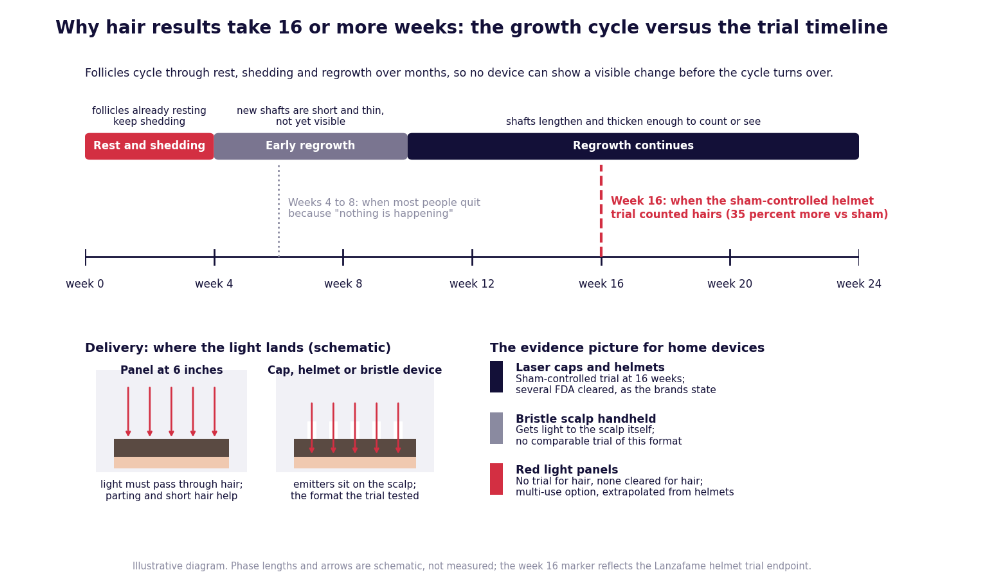
I have to be candid about the evidence. The direct home-device data belongs to laser caps and helmets, not panels. The study I keep coming back to is a sham-controlled trial of a 655nm laser and LED helmet in men with androgenetic alopecia, published in Lasers in Surgery and Medicine by Lanzafame and colleagues. Men wore an active or a sham helmet on a fixed schedule, and at 16 weeks the active group showed a 35 percent increase in hair counts over sham. The light was red, it went directly to the scalp, and nobody counted before week 16. It does not tell you whether a panel at six inches does the same, because no one has tested that, and no panel is FDA cleared for hair. The cleared caps and helmets, as their brands state, I covered in my earlier comparison of hair growth devices. This article covers the other half: panels and handhelds for scalp plus face and body from one purchase.
Before buying I read the evidence on red light therapy for hair loss gathered by Red Light Therapy Top 10, and when the handheld question came up I checked how the RLT Home FOCUS ranks among cordless handhelds against nine rivals. I used both as a spec cross-check, not a verdict.
A 216 LED panel at 30.3 by 11.8 inches, $995 at the time of writing (list $1,295). It won on geometry and on having other jobs. On its stand, the 30 inch height lit my hairline, crown and face in one position, hair parted and kept short, and then I turned and did my shoulders. It runs seven wavelengths (480nm, 630nm, 660nm, 810nm, 830nm, 850nm and 1064nm) with the share of LEDs at each published, and irradiance was lab measured by Electropossible Ltd on an HP350IR spectrometer at 99.0 mW/cm2 at six inches. Sixty day trial, three year warranty, no app. The drawback matters most here: it is not cleared for hair, no trial has tested a panel for hair, and the light still has to get through whatever hair you have. The lab tests were brand commissioned with no unaffiliated measurement on file, the 480nm blue channel is unwelcome on photosensitive skin, and it costs several times a scalp handheld.
Same brand as my number one, and I want that stated up front: the FOCUS is RLT Home’s cordless handheld, $395 at the time of writing (list $595). It puts 15 LEDs carrying 22 chips across seven wavelengths (633nm, 660nm, 810nm, 830nm, 850nm, 940nm and 1064nm) into a 5.5 by 3.2 inch aluminum body, with brand spectrometer readings of 115 mW/cm2 at three inches and 69 at six. It earns second place on geometry: held just above a parted crown or a receding temple, distance stops eating the dose the way it does with a panel across the room, and there is no 480nm blue channel. The battery is rated at 80 minutes, roughly 16 five minute sessions, and blackout goggles, a strap and a hard case come in the box. RLT Home lists it as FDA registered and 510(k) exempt, a general wellness device. Drawback: it launched in October 2026, so I have nowhere near the 16 weeks hair needs on it, and there are no customer reviews or unaffiliated measurements yet. The readings are brand published, the warranty is one year against the panel’s three, it does not part hair the way the Laduora does, and a whole crown means several holds. Like every device here, it is not cleared for hair.
Around $300, and the better buy if hair is your only goal and you have enough left to block light. A handheld scalp device with bristles that part the hair, 30 red LEDs, microcurrent, vibration and warmth, five minute sessions, a stated 55 mW per square centimeter, and a one year warranty. It was the only device here that got light to the scalp itself. Drawback: 30 LEDs cover a small area, so a whole crown is a slow sweep, it does nothing for the rest of you, and it is not a laser cap, so not the cleared route.
Around $149 for a folding tabletop panel with 40 five watt LEDs at 660nm and 850nm, a stated 100 mW/cm2 at six inches, a built in timer, and a three year warranty with a sixty day trial. Propped on a shelf above my chair it treated the crown while I answered email. Drawback: a paperback sized patch is the crown or the hairline, not both.
Around $299. A narrow clamp mounted panel, 19.7 by 8.4 inches, running six wavelengths: 630nm, 660nm and 680nm in the red, 810nm, 850nm and 940nm in the near infrared, with published irradiance of 96.1 mW per square centimeter at three inches and a two year warranty. Clamped to a shelf edge it aimed straight down at my crown, the one geometry no stand managed. Drawback: that figure is at three inches, so at a practical distance you get less, and the temples needed a second position.
Around $449 for a 9.5 by 14.5 inch panel, 120 chips across six wavelengths from 590nm to 850nm including 810nm and 830nm, with a published percentage split. The tilting tabletop stand angled it up at my hairline from the desk. Drawback: Mito lists two irradiance figures at six inches, above 130 and above 56 mW per square centimeter, from different methods, and I planned from the lower one. One region at a time.
Around $199. A battery powered handheld, 5.9 by 3.9 inches, twelve five watt dual chip LEDs at 660nm and 850nm, a stated 70 mW per square centimeter at three inches and 40 at six. It went in my travel bag, so the temples got done in hotel rooms. Drawback: holding it above your head is tiring, and the patch is small.
If hair is your only goal, buy a cleared cap or helmet, because that is where the trial evidence lives. If you want a scalp session from a device that also does your face, shoulders and back, the RLT Home Total Spectrum COMPACT is the one I kept using, with the RLT Home FOCUS from the same brand for close, targeted crown and temple sessions, and the Laduora DUO as the add-on that actually parts the hair. Either way, hair runs on a cycle of months. The helmet trial counted at 16 weeks, and I took a photo under the same light every two weeks. Never look into a panel, and wear the supplied eye protection every session. Speak with your clinician first if you take photosensitizing medication, are pregnant, or have an active diagnosis, and see a doctor for sudden or patchy loss. Red light may support hair in the pattern-loss picture. It does not treat or cure anything and does not replace medical care. One regulatory note, because this category is full of loose language: no rectangular red light panel is FDA approved. The strongest real status is FDA registered, a listing of device and manufacturer, not a clearance, an approval or an endorsement.
No panel has been tested for hair in a trial, and none is FDA cleared for it. The evidence comes from caps and helmets worn on the scalp. A panel may support a parted scalp held close, but you are extrapolating from helmet data.
Plan on 16 weeks before you judge, because that is when the helmet trial counted hairs and because the hair cycle takes months to turn over. Photos under the same light are the only home measure I trust.
For hair alone, a cleared cap. For hair plus skin, recovery and general use, a panel with a scalp device beside it. The panel does more; the cap does one thing with evidence behind it.
It can put more light on a small patch than a panel at distance, which suits a crown or temple. But no handheld has been tested for hair in a trial, it is not cleared for hair, and a cap covers the whole scalp at once. I would treat it as a targeted add-on, not a replacement for a cleared cap.
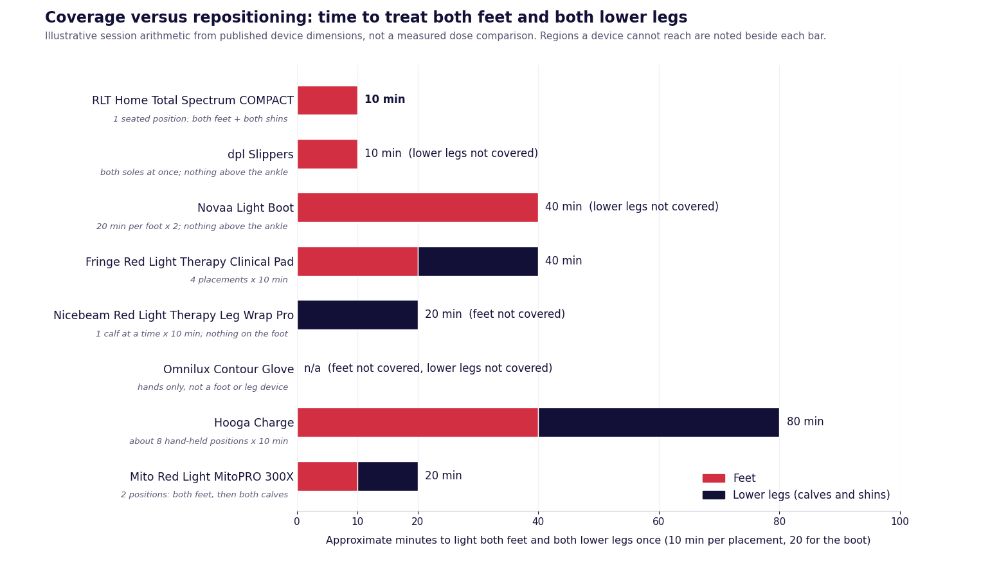
My feet started buzzing about four years ago, pins and needles across both soles that got louder at night and made the bedsheet feel like sandpaper on my toes. My neurologist called it peripheral …
Posted Nov 9, 2026 Therapy
Connecting innovation decision makers to authoritative information, institutions, people and insights.

Medigy accurately delivers healthcare and technology information, news and insight from around the world.
Medigy surfaces the world's best crowdsourced health tech offerings with social interactions and peer reviews.
© 2026 Netspective Foundation, Inc. All Rights Reserved.
Built on Nov 10, 2026 at 5:11am