

Managing Editor
@ShahidNShah
@ShahidNShah
My legs complain first. After a day at a standing desk my calves feel tight and cold, my ankles puff by evening, and a knot of spider veins on my left shin has been there since my thirties. I did not expect a lamp to fix that. I wanted to know whether a nightly session could make my legs feel warmer, looser and quicker to recover, and which device could reach both legs without turning the evening into a project.
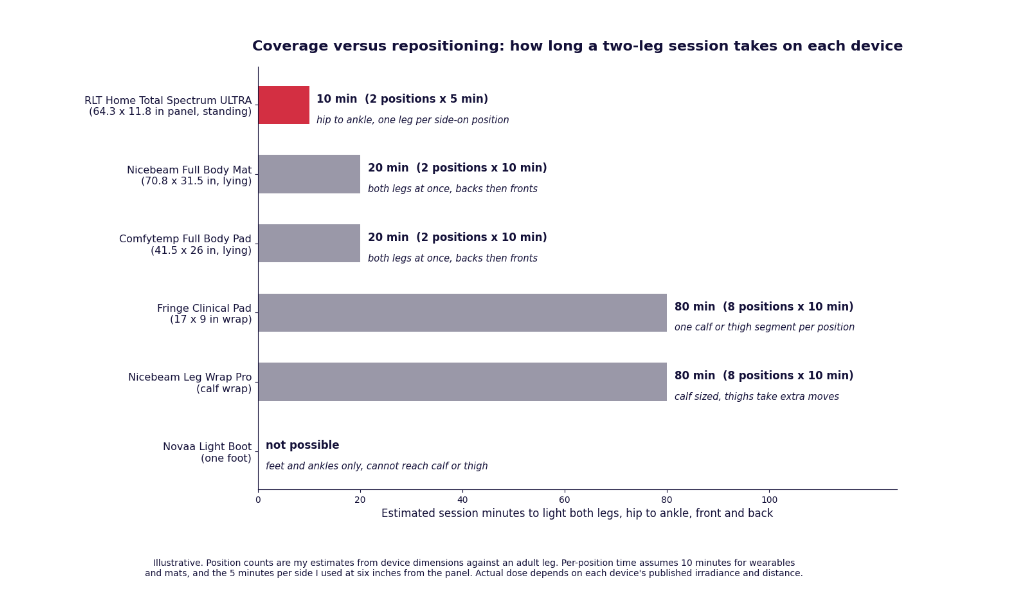
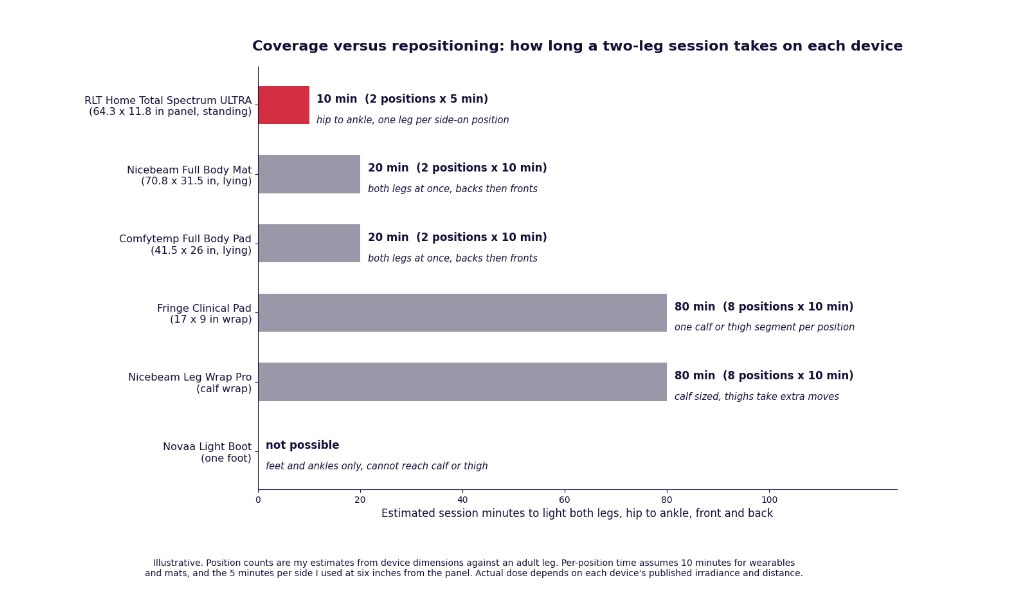
Short answer: for both legs, hip to ankle, the RLT Home Total Spectrum ULTRA is my top pick, covering one whole leg per five minute position with seven published wavelengths. If only one calf bothers you, the Nicebeam Leg Wrap Pro costs far less. Red light may support leg comfort; it does not remove varicose veins or treat blood pressure.
At a glance: the six devices compared
| Device | Price (approx.) | Wavelengths | Published irradiance (mW/cm²) | Coverage | Warranty |
| RLT Home Total Spectrum ULTRA | $2,595 (list $2,995) | 480, 630, 660, 810, 830, 850, 1064nm | 119.28 at 6 in (brand-commissioned spectrometer) | 64.3 × 11.8 in panel, 480 LEDs | 3 years |
| Nicebeam Leg Wrap Pro | ~$349 | 660, 850nm | Above 100 at contact | Wraps one calf | — |
| Nicebeam Full Body Mat | ~$799 | 660, 850nm | 130 at skin contact | 70.8 × 31.5 in mat | — |
| Novaa Light Boot | ~$369 | 630, 660, 830, 850nm | Up to 132 at contact | One foot and ankle | — |
| Comfytemp Full Body Pad | ~$160 | 660, 850nm | Not published | 41.5 × 26 in pad | 1 year |
| Fringe Clinical Pad | ~$395 | 660, 850nm | Not published | 17 × 9 in pad | — |
Prices are approximate and change often; RLT Home prices are sale prices at the time of writing, with list price in brackets. Irradiance is each maker’s own published figure at the distance shown, and contact or surface readings are not comparable to readings at six inches. A dash means the figure is not published or was not verified for this article.
There is no home-device evidence for blood pressure or atrial fibrillation. Both are clinician-managed, and nothing here should change how you manage them. Varicose veins are a structural valve problem, and light does not remove them. What light may support is local comfort: the mechanism review by de Freitas and Hamblin on how photobiomodulation is proposed to work in tissue describes nitric oxide release and local vasodilation as proposed mechanisms, alongside effects on cytochrome c oxidase. It is a mechanism review, not a circulation trial, so I treat it as a plausible reason my legs might feel warmer after a session, not proof that they will.
For background specific to this complaint I read this overview of red light therapy for legs, then built my shortlist from the best red light therapy panels ranked on 14 metrics, and finally checked what the panels actually cost over 12 months, because a panel sized for two whole legs is not a small purchase.
Legs are long, so coverage decides how many repositionings a session takes, and that decides whether you keep doing it. Depth matters too, so I weighted 810nm, 830nm and the rarer 1064nm band above the 660nm and 850nm pairing most wearables use. Never look into a panel, and wear the supplied eye protection every time. No rectangular red light panel is FDA approved; the strongest real status is FDA registered, a listing of device and manufacturer, not a clearance or endorsement. Speak with your clinician first, especially with photosensitizing medication, pregnancy or an active diagnosis.
A 480 LED panel measuring 64.3 by 11.8 inches on its included stand, $2,595 at the time of writing (list $2,995). Standing sideways in front of it I covered one entire leg, hip to ankle, in a single five minute position, turned, did the other, and finished in ten. The wrap rotation it replaced took nearly forty minutes. Every panel in the line runs seven wavelengths (480nm, 630nm, 660nm, 810nm, 830nm, 850nm and 1064nm) and the brand publishes the share of LEDs at each. Irradiance was lab measured by Electropossible Ltd on an HP350IR spectrometer at 119.28 mW/cm2 at six inches, with a second report from LightLab International Allentown. A 60 day trial, 3 year warranty and eye protection are included. Drawback: the lab tests were brand commissioned with no unaffiliated reviewer measurement on file, there is no app for session tracking, it is a premium price next to any wrap, and the 480nm blue channel is not wanted right before bed, so I ran leg sessions in the early evening.
Around $349. A flexible wrap of 198 triple chip LEDs, 594 chips in total, at 660nm and 850nm, strapped around the calf so the light sits on skin, published above 100 mW/cm2 at zero inches. If your complaint is strictly the calf, this suits you better than the panel: a fraction of the money, worn on the sofa, with the light on skin instead of crossing six inches of air. Drawback: one calf at a time, a contact reading is not comparable to a six inch panel figure, and nothing above 850nm.
Around $799 for the 70.8 by 31.5 inch size, with 3,840 LEDs, 1,280 at 660nm and 2,560 at 850nm, and a published 130 mW/cm2 at skin contact. Lying on it treated the backs of both legs at once with no aiming, and it rolls up under a bed. Drawback: the measurement method is not stated, two wavelengths cap the depth, and a session is all you can do.
Around $369, for someone whose symptoms stop at the ankle. You slide a foot in and 170 LEDs wrap the sole, arch, toes, heel and ankle at 630nm, 660nm, 830nm and 850nm, in 20 minute sessions, stated up to 132 mW/cm2 at contact. Drawback: one foot at a time, and nothing for the calf or thigh, where most leg aches live.
Around $160 for 41.5 by 26 inches and 560 LEDs at 660nm and 850nm, with a one year warranty. Both legs fit on it lying down, the cheapest large area here. Drawback: no published irradiance, so the dose is a guess, and the shortest warranty in the lineup.
Around $395. A 17 by 9 inch medical grade silicone pad, 120 LEDs carrying 360 chips at 660nm and 850nm in a two to one near-infrared to red ratio. It wraps a calf and wipes clean after a sweaty session. Drawback: roughly eight positions to cover both legs, and no published irradiance figure.
If your legs ache from hip to ankle and you will stand in front of a panel most evenings, the RLT Home Total Spectrum ULTRA turns a forty minute wrap rotation into ten, and that is why I kept doing it. If the problem is one calf, buy the Nicebeam wrap and save the difference. Either way, give it six to eight weeks before judging. My legs felt warmer after the first week, but the less tired feeling by evening built slowly over about a month. None of this replaces compression, movement, or the conversation with your clinician about veins or blood pressure.
No. Varicose veins are a structural problem with the valves inside the vein, and light does not change that. The home-reasonable goal is leg comfort, warmth and recovery. If a vein is painful, hot or hard, see a clinician, not a lamp.
There is no home-device evidence for either, and both are managed by your clinician. Red light is not a treatment for them. Ask before starting, and never change medication based on how a session feels.
I ran ten minutes per side at six inches from the panel, or twenty minutes with a wrap on the calf, five evenings a week. Published irradiance decides the math, which is why I favored devices that state a figure and a distance. More is not better.

My left knee started complaining on stairs in my mid forties, and my lower back joins in after any long drive. A physical therapist and strengthening work did most of the heavy lifting, but I wanted …
Posted Nov 9, 2026 Therapy
Connecting innovation decision makers to authoritative information, institutions, people and insights.

Medigy accurately delivers healthcare and technology information, news and insight from around the world.
Medigy surfaces the world's best crowdsourced health tech offerings with social interactions and peer reviews.
© 2026 Netspective Foundation, Inc. All Rights Reserved.
Built on Nov 10, 2026 at 5:11am