

Managing Editor
@ShahidNShah
@ShahidNShah
I came to red light for my face and stayed for everything else. My forehead and the backs of my hands looked older than the rest of me, I have a pale surgical scar along one shin, and a patch of psoriasis on my left elbow flares every winter. Over eight months I used a panel, three masks, a wand and a small tabletop unit, with a weekly photo log under the same bathroom light.
Short answer: for face, neck, chest, scars and hands together, the RLT Home Total Spectrum MAX is my top pick, replacing three smaller devices. For a single scar, a psoriasis patch or travel, the same brand’s RLT Home FOCUS handheld comes second. If only your face matters, a mask such as the CurrentBody is cheaper and easier.
At a glance: the eight devices compared
| Device | Price (approx.) | Wavelengths | Published irradiance (mW/cm²) | Coverage | Warranty |
| RLT Home Total Spectrum MAX | $1,595 (list $1,995) | 480, 630, 660, 810, 830, 850, 1064nm | 100.53 at 6 in (brand-commissioned spectrometer) | 49.2 × 11.8 in panel, 360 LEDs | 3 years |
| RLT Home Total Spectrum FOCUS (same brand) | $395 (list $595) | 633, 660, 810, 830, 850, 940, 1064nm | 115 at 3 in, 69 at 6 in (brand spectrometer) | 5.5 × 3.2 in cordless handheld, 15 LEDs | 1 year |
| CurrentBody Skin LED Mask | ~$499 | Six, incl. 633, 830, 1072nm | — | Full face mask, 566 LEDs | — |
| Omnilux Contour Face | ~$395 | 633, 830nm | ~30 | Flexible face mask | — |
| Solawave Neck and Chest Pro | ~$349 | 605, 630, 660, 830nm | Not published (no comparable figure) | Neck and chest mask, 320 LEDs | — |
| Celluma HOME | ~$795 | 465, 640, 880nm | — | 14 × 6 in treatment area | — |
| LightStim for Wrinkles | ~$249 | Amber, light red, dark red, infrared | — | Palm-sized wand, 72 LEDs | 5 years |
| Bestqool BQ60 | ~$149 | 660, 850nm | 95.6 at 3 in | 13.1 × 8.4 in panel | — |
Prices are approximate and change often; RLT Home prices are sale prices at the time of writing, with list price in brackets. Irradiance is each maker’s own published figure at the distance shown, and contact or surface readings are not comparable to readings at six inches. A dash means the figure is not published or was not verified for this article.
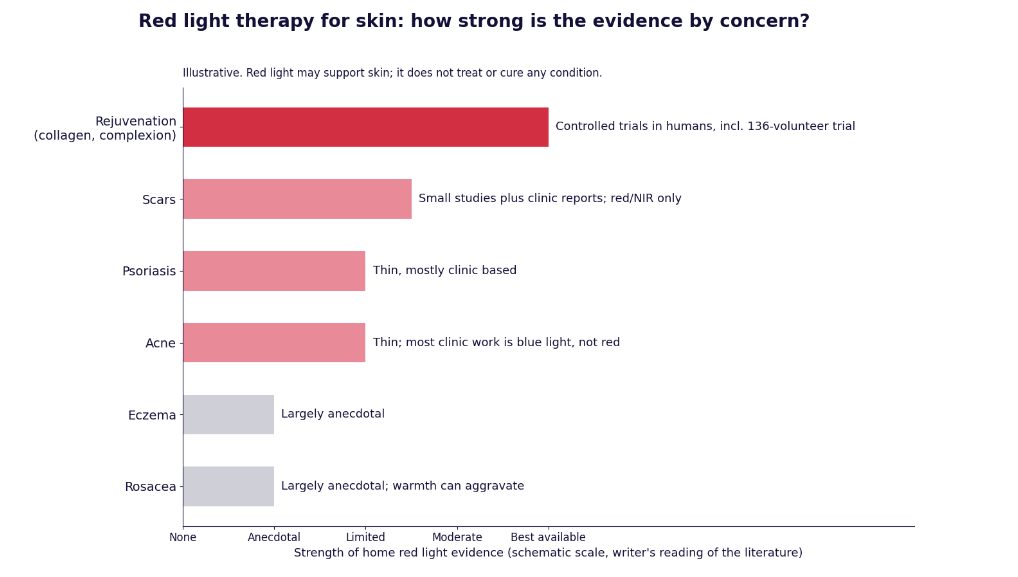
Three things decide whether a skin device is worth owning: wavelengths (red around 630nm to 660nm for the surface, near-infrared around 810nm to 850nm for the dermis), how much skin it lights per session, and whether you will still use it in month three. The evidence is uneven. Rejuvenation has the best support. The study I lean on is a controlled trial of 136 volunteers using red and near-infrared light by Wunsch and Matuschka, which found improved complexion, collagen density and skin feeling versus an untreated control group. It tested rejuvenation only and says nothing about acne, eczema or psoriasis. For psoriasis and acne the literature is thin and mostly clinic based. For eczema and rosacea it is largely anecdotal, and rosacea can react to warmth.
For my scar specifically I read this summary of red light for scars and wrinkles, and when I wanted something for spot work I compared 10 cordless red light handhelds side by side. For panels I went back to the top five panels ranked by published specs, which I wrote earlier here.
Two safety points. If you have a photosensitive condition such as lupus, or take a photosensitizing medication (some antibiotics, retinoids and diuretics), get your clinician’s sign-off before any light exposure. Never look into a panel, and wear the supplied eye protection every session. Red light may support skin; it does not treat a diagnosis. If you are pregnant or managing an active skin condition, ask your dermatologist first.
A 360 LED panel, 49.2 by 11.8 inches, $1,595 at the time of writing (list $1,995). I chose this size for coverage: standing in front of it lights face, neck, chest and the front of the thighs at once; I turn for the back, then sit for the shins. Three positions, under twenty minutes. It carries seven wavelengths (480nm, 630nm, 660nm, 810nm, 830nm, 850nm and 1064nm) with the share of LEDs at each published, roughly 19 percent at 810nm, 14 percent at 830nm and 14 percent at 1064nm. Irradiance was lab measured by Electropossible Ltd on an HP350IR spectrometer at 100.53 mW/cm2 at six inches, with a second report from LightLab International Allentown. Stand, eye protection, a 60 day trial and a three year warranty are included. My scar was flatter and my hands less crepey by week ten. Drawback: the lab tests were brand commissioned with no unaffiliated measurement on file, there is no app, the price is premium, and I would switch off the 480nm blue channel on photosensitive or rosacea prone skin.
This comes from the same brand as my number one, so bear that in mind. The FOCUS is RLT Home’s cordless handheld, $395 at the time of writing (list $595), and it is what I would hand someone whose concern lives in one place: a scar, a winter psoriasis patch on an elbow, or crow’s feet. Its 15 LEDs carry 22 chips in seven wavelengths, 633nm and 660nm red for the surface, 810nm, 830nm, 850nm and 940nm near-infrared, and 1064nm, on a 5.5 by 3.2 inch aluminum body. There is no 480nm blue channel, which matters on rosacea-prone or photosensitive skin. RLT Home publishes spectrometer readings of 115 mW/cm2 at three inches and 69 at six, and the battery is rated at 80 minutes, so it travels. Drawback: it launched in October 2026, so it is not in my ten week photo log, and there are no customer reviews or unaffiliated measurements yet. The readings are brand published, the warranty is one year against the panel’s three, and covering a full face means several holds, which is where a mask wins.
Around $499. A liquid silicone face mask, 566 LEDs across six wavelengths including red at 633nm, near infrared at 830nm and deep near infrared at 1072nm, in ten minute sessions. The best made mask I have used, and the only device here besides the panel going past 1000nm. If your concern is the face alone and you would rather lie down than stand, it suits you better than the RLT Home Total Spectrum MAX. Drawback: face only, so neck, chest and hands need something else.
Around $395. A flexible mask, 132 LEDs in 66 dual chip bulbs, red at 633nm and near infrared at 830nm, stated output around 30 mW/cm2, ten minute sessions, FDA cleared as the brand states. The pairing most facial rejuvenation studies use. Drawback: modest output, two wavelengths only, and it stops at the jaw.
Around $349. An FDA cleared flexible silicone mask, 320 LEDs across four wavelengths, red at 630nm, deep red at 660nm, near infrared at 830nm and amber at 605nm, in three minute sessions. The pick for someone who already owns a face mask and wants the neck and chest handled. Drawback: no comparable published output figure, so the dose per three minute session is uncertain.
Around $795. A flexible, shape taking panel, 236 LEDs, 16 by 8 inches with a 14 by 6 inch treatment area, blue at 465nm, red at 640nm and near infrared at 880nm, battery powered, FDA cleared for aging skin and for pain. It curves over an elbow or a knee, the shape problem psoriasis presents, and blue is the channel most clinic acne work uses. Drawback: a small treatment window for the money, and 880nm is less studied than 810nm or 830nm.
Around $249. A handheld wand, 72 LEDs using amber, light red, dark red and infrared, three minute holds per area, FDA cleared for wrinkles on the face, five year warranty. Precise for crow’s feet and brow lines. Drawback: three minutes per patch makes a full face a long, hands-on session, and it left my routine by month two.
Around $149. A small rigid panel, 60 dual chip LEDs at 660nm and 850nm, 13.1 by 8.4 inches, with a stated 95.6 mW/cm2 at three inches. The cheapest way here to get real output onto a scar anywhere. Drawback: two wavelengths, a brand stated figure, and one shin or one hand at a time.
Decide where your skin concern lives before you buy. Face alone, a mask is cheaper and easier. Face, neck, chest, scars and hands together, the RLT Home Total Spectrum MAX replaces three devices. One scar or patch, the RLT Home FOCUS from the same brand does the job without the floor space. No rectangular red light panel is FDA approved; the strongest real status is FDA registered, a listing of device and manufacturer, not a clearance or endorsement. Whatever you choose, results build over weeks, not days. My log showed nothing at two weeks and a clear change at ten.
For acne, the limited evidence is mostly for blue light in clinics, so a home device may support skin tone but should not replace what your dermatologist prescribes. For eczema the support is anecdotal and warmth irritates some people. Start short and stop if it flares.
The evidence is thin and mostly anecdotal. Some people report calmer skin, others react to heat, so start short, sit farther back and skip the blue channel. Ask your dermatologist first if you use a photosensitizing treatment.
My shin scar looked flatter and less pink by about week ten at four sessions a week. Mature scars respond more slowly than fresh ones, and no home device removes a scar.
For one scar, a handheld such as the RLT Home FOCUS puts light right where it is needed and costs a fraction of a panel. If you have several areas, or want face, neck and hands done at once, a panel saves time. No home device removes a scar either way.
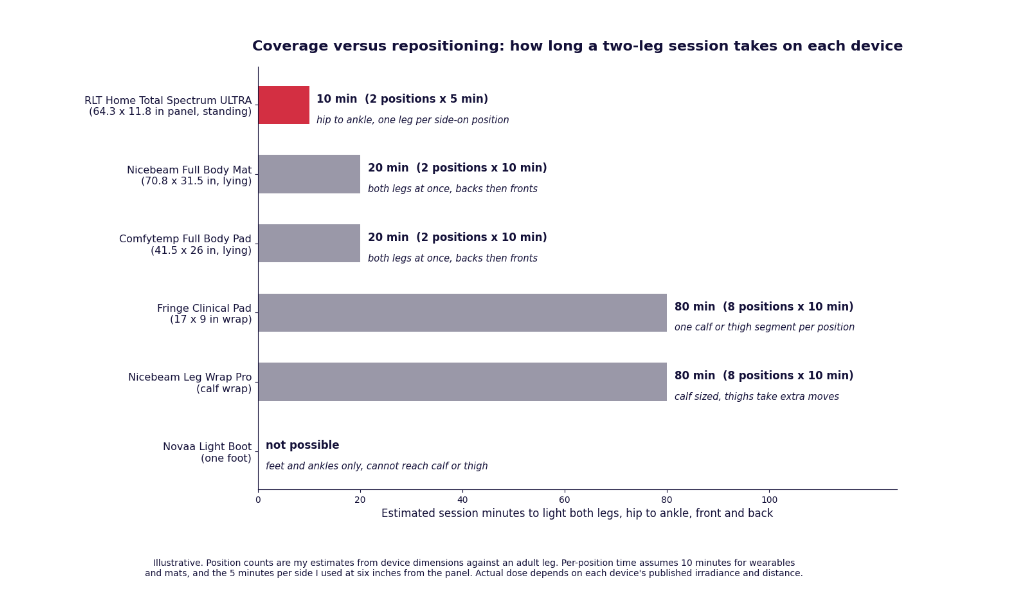
My legs complain first. After a day at a standing desk my calves feel tight and cold, my ankles puff by evening, and a knot of spider veins on my left shin has been there since my thirties. I did not …
Posted Nov 9, 2026 Therapy
Connecting innovation decision makers to authoritative information, institutions, people and insights.

Medigy accurately delivers healthcare and technology information, news and insight from around the world.
Medigy surfaces the world's best crowdsourced health tech offerings with social interactions and peer reviews.
© 2026 Netspective Foundation, Inc. All Rights Reserved.
Built on Nov 10, 2026 at 5:11am