

Managing Editor
@ShahidNShah
@ShahidNShah
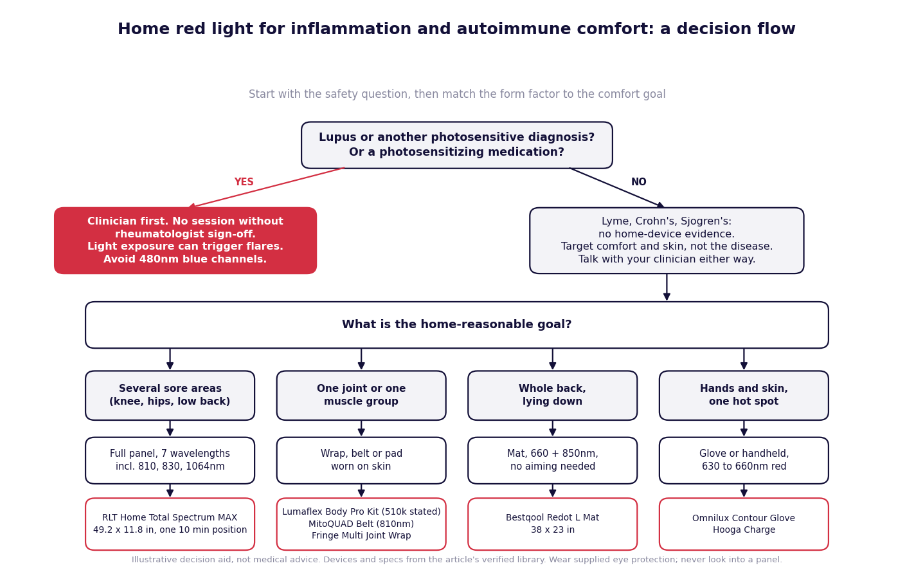
My sister has lupus, I have a swollen left knee and a lower back that seizes after a long drive, and our mother has psoriatic arthritis that flares across her hands every winter. Between the three of us I have spent many evenings testing red light devices in our kitchens and living rooms, and the first lesson was who should not use any of them without a phone call first.
Short answer: for joint and muscle comfort across several areas, the RLT Home Total Spectrum MAX is my top pick, covering knee, hips and lower back in one position. If your clinician wants FDA clearance paperwork, the Lumaflex Body Pro Kit is the pad to consider. With lupus or any photosensitive condition, get your rheumatologist’s sign-off before any device.
At a glance: the seven devices compared
| Device | Price (approx.) | Wavelengths | Published irradiance (mW/cm²) | Coverage | Warranty |
| RLT Home Total Spectrum MAX | $1,595 (list $1,995) | 480, 630, 660, 810, 830, 850, 1064nm | 100.53 at 6 in (brand-commissioned spectrometer) | 49.2 × 11.8 in panel, 360 LEDs | 3 years |
| Lumaflex Body Pro Kit | ~$689 | 630, 850nm | 45 red, 30 near-infrared | 10 × 6.25 in flexible pad | — |
| Mito Red Light MitoQUAD Belt | ~$349 | 630, 660, 810, 850nm | 18 | 22 × 5 in area on a 50 in belt | — |
| Fringe Multi Joint Wrap | ~$239 | 660, 850nm | Not published | 26 × 15 in wrap | — |
| Bestqool Redot L Mat | ~$319 | 660, 850nm | 56 at the surface | 38 × 23 in mat | — |
| Omnilux Contour Glove | ~$345 | 633, 830nm | ~30 | One hand | — |
| Hooga Charge | ~$199 | 660, 850nm | 70 at 3 in | 5.9 × 3.9 in handheld | — |
Prices are approximate and change often; RLT Home prices are sale prices at the time of writing, with list price in brackets. Irradiance is each maker’s own published figure at the distance shown, and contact or surface readings are not comparable to readings at six inches. A dash means the figure is not published or was not verified for this article.
Lupus is photosensitive. Light exposure can trigger flares, and my sister’s rheumatologist told her plainly that no session happens without his sign-off, so she sat out most of this testing. Lyme disease, Crohn’s disease and Sjogren’s syndrome have no home-device evidence at all, and they are clinician-managed. What a home user can reasonably target is comfort in aching joints and muscles, and the look and feel of skin. The biology behind that is laid out in a review of the proposed mechanisms of photobiomodulation by de Freitas and Hamblin, covering light absorption by cytochrome c oxidase, nitric oxide release and modulation of inflammatory signaling. It is a mechanism review, not a clinical trial: it explains why light might ease soreness, not that it does for any diagnosis.
When I started shopping, this evidence-based guide to red light for inflammation helped me separate what is studied from what is marketed, and a head-to-head comparison of panel brands on the same site sorted the serious panels from the gadgets. Since two purchases ran through a flexible spending account, I also wrote up the devices you can buy with HSA or FSA funds. On regulation: no rectangular red light panel is FDA approved. The strongest real status is FDA registered, a listing of device and manufacturer, not a clearance or endorsement.
If you take a photosensitizing medication, are pregnant, or carry an active diagnosis, talk with your clinician before your first session.
A 360 LED panel at 49.2 by 11.8 inches, $1,595 at the time of writing (list $1,995). It won for the reason that matters here: standing in front of it treated my knee, both hips and my lower back in one ten minute block, where every wrap I owned treated one of those at a time. It carries seven wavelengths (480nm, 630nm, 660nm, 810nm, 830nm, 850nm and 1064nm) with the share of LEDs at each published, roughly 19 percent at 810nm, 14 percent at 830nm and 14 percent at 1064nm. Irradiance was lab measured by Electropossible Ltd on an HP350IR spectrometer at 100.53 mW/cm2 at six inches, with a second report from LightLab International Allentown. Stand and two types of eye protection are included; never look into it. Drawback: the 480nm blue channel is exactly what photosensitive skin does not want, so this is not the device for my sister even with sign-off. The lab tests were brand commissioned with no unaffiliated measurement on file, and it costs several times what a pad does.
Around $689 for a flexible 10 by 6.25 inch pad at 630nm and 850nm, with irradiance published as 45 mW/cm2 red and 30 mW/cm2 near-infrared, IP67 rated. The brand states FDA 510(k) clearance for pain management and skin rejuvenation. It suits someone better than the panel when their rheumatologist wants paperwork before saying yes, and there is no blue channel to argue about. Drawback: two wavelengths, nothing above 850nm, and a pad this size covers one knee or one trap at a time.
Around $349, with 405 triple chip diodes at 630nm, 660nm, 810nm and 850nm across a 22 by 5 inch area on a 50 inch belt. The cheapest way I found to get 810nm onto a lower back or hip, worn under a sweater while I cooked. Drawback: published irradiance is 18 mW/cm2, so sessions run long, and the battery pack is sold separately and was listed as unavailable when I looked.
Around $239 for a 26 by 15 inch wireless neoprene wrap, 90 LEDs carrying 270 chips at 660nm and 850nm, shaped to stay on a bent knee through a movie. Drawback: no published irradiance, nothing deeper than 850nm.
Around $319 for a 38 by 23 inch mat with 400 triple chip LEDs at 660nm and 850nm and a published 56 mW/cm2 at the surface. Lying on it covered my whole back. Drawback: the measurement method is not stated, two wavelengths cap the depth, and you cannot do anything else during a session.
Around $345 for a flexible silicone glove, 144 LEDs at 633nm and 830nm, stated output around 30 mW/cm2, ten minute sessions, FDA cleared. The only device that reached every one of my mother’s knuckles at once. Drawback: one hand per glove, nothing above the wrist.
Around $199 for a battery powered handheld, 5.9 by 3.9 inches, twelve five watt LEDs at 660nm and 850nm, stated at 70 mW/cm2 at three inches. It went in a bag for one flaring joint away from home. Drawback: a palm sized patch, so a spot tool, not a plan.
If you have lupus or any photosensitive condition, or take a photosensitizing drug, the first step is your rheumatologist, not a panel. For everyone else chasing joint and muscle comfort across more than one area, the RLT Home Total Spectrum MAX covered in one position what took three wearables. If budget or paperwork says pad, hand over the Lumaflex Body Pro Kit. Results build over weeks, not days; my knee showed no pattern until week four. Wear the eye protection every time.
No. There is no home-device evidence for any of these; they are clinician-managed. Lupus in particular is photosensitive, so light exposure can trigger a flare, and any session needs a rheumatologist’s sign-off first.
For a joint or deep muscle, near-infrared at 810nm and above penetrates furthest, which is why I weighted devices with 810nm and 1064nm. For skin, red at 630nm to 660nm is the most studied band.
No rectangular red light panel is FDA approved. The strongest real status is FDA registered, a listing rather than an approval. Wearables such as the Lumaflex Body Pro Kit and the Omnilux Contour Glove state FDA clearance for specific uses, which I report as the brand’s statement.
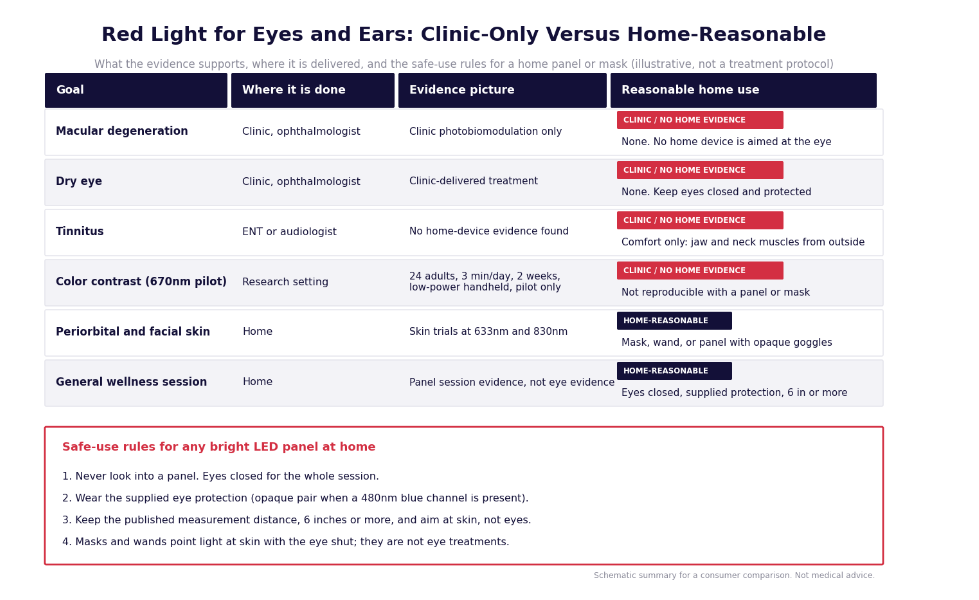
My father has dry age-related macular degeneration, and I have a low ringing in my left ear that started after a loud concert and never left. I went looking for something for both of us, and found a …
Posted Nov 9, 2026 Therapy
Connecting innovation decision makers to authoritative information, institutions, people and insights.

Medigy accurately delivers healthcare and technology information, news and insight from around the world.
Medigy surfaces the world's best crowdsourced health tech offerings with social interactions and peer reviews.
© 2026 Netspective Foundation, Inc. All Rights Reserved.
Built on Nov 10, 2026 at 5:11am