

Managing Editor
@ShahidNShah
@ShahidNShah
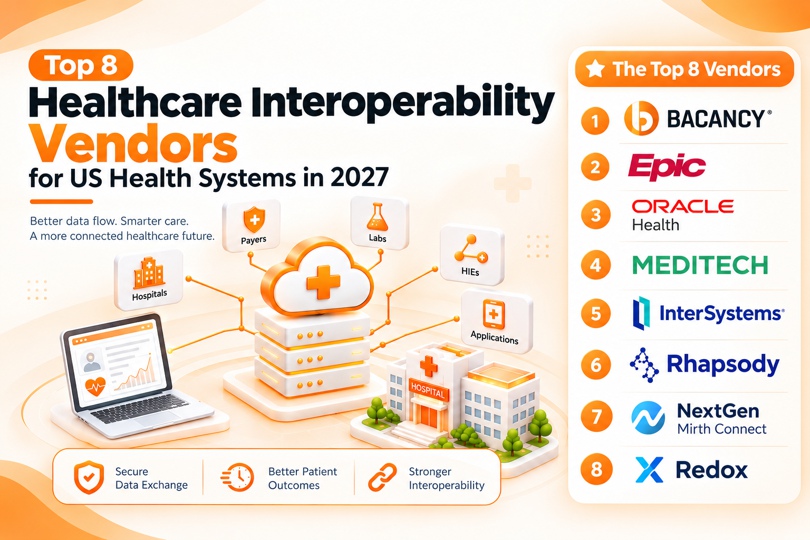
Selecting the best healthcare interoperability vendors will be critical for ensuring proper data transmission in 2027. While Epic dominates the landscape when it comes to EHRs of big US hospitals, there is not one single EHR system that links to every payer, laboratory, HIE, and application out there.
Federal rules have turned interoperability into a dated requirement for healthcare interoperability vendors. Each one below puts pressure on your HL7 and FHIR interoperability stack.
Each vendor below solves a different layer of the stack, from build partners to national networks.
Bacancy Technology is an AI-powered consulting and software development partner for AI, Data, Healthcare, and Finance enterprises. As one of the healthcare interoperability vendors, we connect platforms to your workflows. Our healthcare interoperability services cover:
For a statewide HIE serving 32 hospitals and 600 practices, our engineers built a normalization layer on AWS HealthLake. It now converts 4.2M HL7 v2 messages a day into FHIR R4 in under 200ms. Bacancy brings 14+ years in healthcare IT, 250+ healthcare specialists, and ISO/IEC 27001:2022 certification, and signs a BAA with every healthcare client.
Best for: health systems that need custom interfaces, multi-EHR integration, or one accountable team to implement the healthcare interoperability solutions below.
Epic’s Care Everywhere solution was founded back in 2008 as the first interoperability network based on the EHR. Epic claims that in 2023, Care Everywhere helped to share no less than 16 million records of patient data daily. All health systems utilizing Epic’s solution for healthcare also operate Carequality, a platform bringing interoperability to 70% of US hospitals.
Best for: academic medical centers, IDNs running on Epic.
Oracle Health is employed in healthcare institutions such as Tenet Healthcare, Universal Health Services, and Banner Health. HealthShare and IRIS for Health are employed to help hospitals and regional or national HIEs. Some examples of HIEs in the United States include Healthix, NC HealthConnex, GaHIN, and MiHIN.
Best for: Oracle Health systems willing to become a part of TEFCA but not using any third-party platforms.
The Traverse Exchange network was created in 2024 by MEDITECH in the USA, replacing the Canadian network. It allows healthcare interoperability vendors to connect to CommonWell, Carequality, and TEFCA via the Health Gorilla Qualified Health Information Network (QHIN). The federated and FHIR queries are used in the network; therefore, there is no central storage of any patient data.
Best for: community and critical access hospitals that want EHR integration and TEFCA access in one network.
HealthShare and IRIS for Health by InterSystems are designed for use by hospitals, integrated delivery networks (IDN), or regional/national HIEs. Examples of U.S. exchanges run on the InterSystems platform include Healthix in New York, NC HealthConnex, GaHIN in Georgia, and MiHIN in Michigan. It is used to create a comprehensive patient record, data consolidation from multiple sources, as well as message processing.
Best for: multi-state IDNs that operate or route messages to a regional HIE.
Rhapsody (formerly Lyniate) offers two integration engines: Rhapsody and Corepoint. Corepoint received the 2026 Best in KLAS Award for Integration Solutions with 94.3 points – the company’s 17th consecutive win in the category. Rhapsody integrates with 1,900+ healthcare organizations in 31 countries and can be deployed as SaaS, on-premise, and iPaaS. Built-in Axon agent provides AI-based assistance in day-to-day integration tasks.
Best for: systems routing high volumes of HL7 and FHIR messages.
Mirth Connect is one of the most frequently used engines by healthcare interoperability vendors which have the capability of working according to HL7 and FHIR standards. In March 2025, NextGen started charging a commercial-only license for Mirth Connect versions 4.6 and beyond. Version 4.5.2 is the last open source and receives no security updates by NextGen. Make sure to allocate funds for the purchase of commercial licenses, if necessary.
Best for: systems with internal interface development teams and a licensing budget.
Redox provides one API access to many EHRs, which allows third-party apps to connect without developing a separate point-to-point solution. In October 2025, Redox partnered with Kno2, the designated QHIN, and provided TEFCA access to its platform. Together, the two companies claim to process 40 billion transactions annually and have 160,000 connected provider organizations.
Best for: systems looking to integrate digital health apps into their EHR.
The right healthcare interoperability vendors would be those that would suit your EHR system and the size of your organization, as well as the layer that is lacking. Plan backwards from 2027, since each passing month will reduce the amount of time you have left for testing. The right vendor, in case you would like one that has already done HL7 and FHIR interoperability at the statewide level, will start with mapping your stack.

Chief Editor - Medigy & HealthcareGuys.

It starts small. You skip the back nine because your heel aches. You sit out the second pickleball game. Then the beach walk with the grandkids gets shorter. Rest, ice and anti-inflammatories helped …
Posted Oct 19, 2026 Occupational Therapy and Physical Therapist Assistants and Aides Therapy
Connecting innovation decision makers to authoritative information, institutions, people and insights.

Medigy accurately delivers healthcare and technology information, news and insight from around the world.
Medigy surfaces the world's best crowdsourced health tech offerings with social interactions and peer reviews.
© 2026 Netspective Foundation, Inc. All Rights Reserved.
Built on Oct 20, 2026 at 6:05pm