

Managing Editor
@ShahidNShah
@ShahidNShah
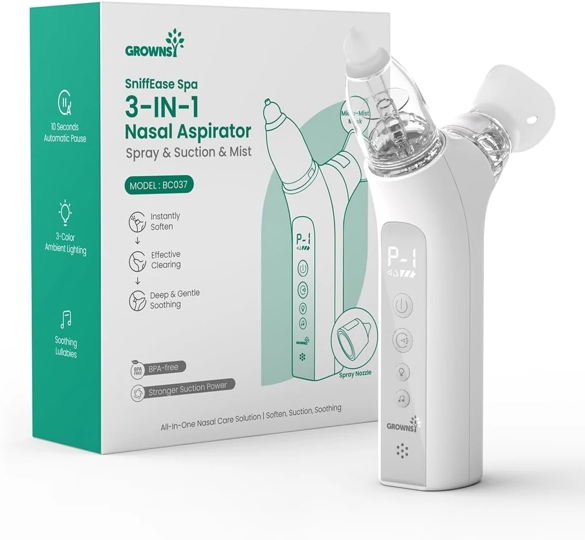
Health technology is no longer limited to hospitals and clinics. More and more, it is moving into the home. Remote monitoring, connected scales and smart thermometers are now common. A quieter part of this shift is happening in the nursery, where consumer devices are helping parents with everyday infant care.
These products are not medical treatments, and they do not replace a pediatrician. But they show a clear trend: parents want simple, well-designed tools that make routine care easier and calmer. This article looks at two everyday examples, nasal care and sleep, and at what good design means in this space.
Several things are pushing infant care technology forward:
Young babies breathe mostly through their noses, and they cannot blow their noses themselves. When a baby has a stuffy nose, feeding and sleeping can become harder. For decades, the main tool was a rubber bulb syringe. It works, but it is hard to control, hard to clean and hard to see inside.
A modern electric baby nose sucker takes a different approach. Grownsy’s range of electric nasal aspirators shows how the category has changed:
| Design feature | What it does for parents |
|---|---|
| Adjustable suction levels | Lets parents start gently; Grownsy models offer from 3 to 9 levels |
| Soft silicone tips | Gentle contact around the nostril |
| Anti-backflow design | Helps keep mucus away from the motor |
| Clear collection chamber | Easy to see and empty |
| Light and lullabies | Can help distract and calm the baby |
| Waterproof or auto-clean options | Some models are rated IPX7, which makes cleaning easier |
The best approach is still a gentle one. Parents should use the lowest setting that works, follow the maker’s instructions, and clean the device after each use. If a baby has trouble breathing, a fever, or congestion that does not improve, parents should contact a doctor.
Sleep is the other big area where design and health meet. Safe-sleep guidance for infants is clear and well known: babies should sleep on their backs, on a firm and flat surface, in their own sleep space, with no pillows, bumpers or loose bedding. Many health bodies also recommend room-sharing in the early months, so parents can respond quickly.
Product design can make these routines easier to follow. A rocking bassinet that also works as a bedside sleeper lets the baby sleep close to the parents’ bed, while still having a separate surface. Grownsy’s 5-in-1 Rocking Bedside Bassinet, for example, offers six bedside heights, a drop-down side panel, 360° breathable mesh and gentle parallel rocking that can be locked in place. Its firm mattress has a removable, machine-washable cover.
When reviewing any bassinet, parents and care teams can look at a few basics:
Across both examples, the same design rules appear:
As more infant care moves home, pediatricians, nurses and lactation consultants play a key role in guiding parents. They can explain when a home device is helpful, how to use it safely and when a baby needs to be seen. Good consumer products support this advice. They do not replace it.
Infant care technology is a small but growing part of the move toward health at home. Electric nasal aspirators and flexible bassinets show how thoughtful design can make routine care gentler and simpler for families. The goal is not to turn the nursery into a clinic. It is to give parents tools that are easy to use, easy to clean and built around safe, well-established care practices.


Company info and prices are current as of publication time. Prices and availability can change, so always verify with each company before finalising a contract. Introduction In 2025, 76% of US …
Posted Oct 18, 2026 EHR / Clinical Workflow
Connecting innovation decision makers to authoritative information, institutions, people and insights.

Medigy accurately delivers healthcare and technology information, news and insight from around the world.
Medigy surfaces the world's best crowdsourced health tech offerings with social interactions and peer reviews.
© 2026 Netspective Foundation, Inc. All Rights Reserved.
Built on Oct 19, 2026 at 6:05pm