

Managing Editor
@ShahidNShah
@ShahidNShah

Company info and prices are current as of publication time. Prices and availability can change, so always verify with each company before finalising a contract.
In 2025, 76% of US hospitals engaged in all four types of data exchange the federal government tracks, at least sometimes, but integration lags: 96% send records electronically, while only 79% integrate incoming records into their EHR (ASTP/ONC, 2025 American Hospital Association survey data). The partner you pick decides how long that connection takes and whether it survives an EHR vendor’s API change. This guide covers 10 EHR integration companies serving the US in 2027. For each one, we show what it builds, what its own pages leave out, and the price and timeline it publishes.
EHR integration connects your electronic health record to the other software your team uses, so data moves without retyping. A lab result lands in the chart. A visit note reaches billing. A patient’s wearable readings show up on the nurse’s screen.
Two standards do most of the work. HL7 v2 is the older one. It sends short messages and still runs many lab and hospital links. FHIR is the newer one. It works like a web API, and apps use it to read and write records. Since January 1, 2023, certified EHRs must offer standardized FHIR APIs. Even so, most hospital data sharing with third-party apps still uses proprietary APIs or HL7 interfaces (ASTP/ONC, 2024 data). Many projects need both.
Companies build these connections in three ways:
A good partner can explain which of the three fits your case, and why.
We checked each company’s own website in October 2026 against five requirements. All ten meet them.
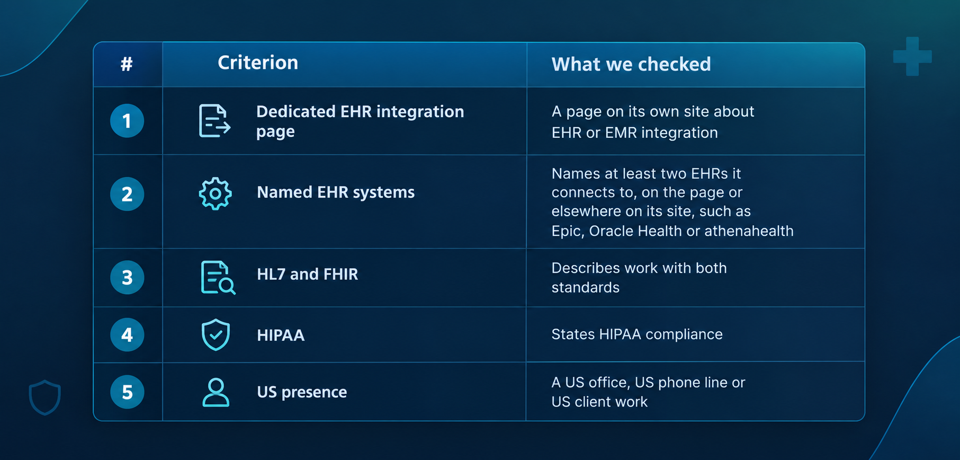
Companies that sell their own EHR, or only sell a ready-made integration platform, were left out. So were companies whose pages did not name a single EHR.
Every detail comes from what each company says about itself. Prices, certificates and case studies change, so confirm what matters to you directly with the company. Each entry ends with a “Lighter on” note that names what its pages do not show. Use it as your question list.
Bacancy Technology builds EHR integrations for hospitals, clinics, telehealth platforms and health IT companies. It has worked in healthcare IT since 2011, has 1,050+ engineers, and lists an ISO/IEC 27001:2022 certificate on its site.
Integration capabilities:
Best for: Hospitals and health IT teams that want one partner for build, hub setup and round-the-clock monitoring, and buyers who want a price range before a first call.
Lighter on: Named clients. Its case studies describe each client by type, so ask for a reference on your own EHR.
CapMinds builds EHR and EMR integrations with labs, pharmacies, payers, imaging systems and health information exchanges. Its site lists a Leesburg, Virginia address and shows ISO 9001:2015 and SOC 2 Type 2 badges.
Integration capabilities:
Best for: Clinics, hospitals and health tech companies that need many lab, pharmacy and payer links set up.
Lighter on: Price, timeline and interface case studies. The page gives no price or timeline, and its three case studies are an RCM automation, a custom EMR and UDS reporting, not interface projects.
Folio3 Digital Health says it belongs to the Epic Vendor Services Program. It offers EHR integration for hospitals, health systems, startups, software companies and device makers, and reports 50+ healthcare integration projects.
Integration capabilities:
Best for: Provider groups and software companies that want Epic work planned and built by one team.
Lighter on: Budgeting detail. A range from $5,000 to over $1,000,000 does not help you plan.
Topflight Apps is based in Irvine, California. It builds EHR integrations for digital health startups, providers, hospitals and drug companies.
Integration capabilities:
Best for: Digital health companies that need an app to run inside Epic or athenahealth.
Lighter on: Price and timeline. The page gives neither, and several case studies are app builds more than interface projects.
ScienceSoft, based in McKinney, Texas, has worked in healthcare IT since 2005. Its site lists ISO 9001, ISO 27001 and ISO 13485 certificates.
Integration capabilities:
Best for: Buyers with heavy compliance needs who want a flexible pricing model.
Lighter on: Interface-focused case studies. The five it shows are mostly app and software builds.
Itransition has a US office in Decatur, Georgia. It says it works with Epic, Oracle Health (formerly Cerner) and athenahealth.
Integration capabilities:
Best for: Large organizations with several EHRs or old systems that need a clear approach before any build starts.
Lighter on: Cost. The page says each case is priced on its own and gives no range. The page is dated May 2025, so ask about current work.
Arkenea, Inc. says it has built custom EHR integrations since 2011. Its page lists a 4.9 Clutch rating.
Integration capabilities:
Best for: Health tech startups and device makers that must connect to many EHRs, and networks that run several EHRs at once.
Lighter on: Price and named clients. The page gives no cost range, and the case studies do not name the client.
Mindbowser lists a Jersey City, New Jersey office and says it has 200+ HIPAA- and FHIR-trained staff. Its page says it is SOC 2 Type II audited, and another page says it belongs to the Epic vendor services program.
Integration capabilities:
Best for: Digital health companies that need to reach many EHRs quickly, especially on AWS.
Lighter on: Price. The page promises predictable pricing but gives no figures. Its speed claims come from the company itself.
Thinkitive publishes a US phone line and case studies for clients in Texas. Its page shows HIPAA, SOC 2 and ISO 9001 and 27001 badges.
Integration capabilities:
Best for: Software companies that want a published starting price and a large case study library to read.
Lighter on: Named clients and large projects. Case studies describe clients by type, and testimonials give a person’s name and title but not the company. The published price range tops out at $30,000, and the page does not say what multi-system work costs.
OSP Labs lists a US phone line and shows a client testimonial from San Antonio, Texas. Its site has an Epic integration page and separate pages for Cerner, MEDITECH, NextGen, athenahealth, eClinicalWorks, and Allscripts.
Integration capabilities:
Best for: Provider groups that want Epic connected to billing, referral, and telehealth workflows.
Lighter on: Price and speed. The page lists cost factors but no ranges, and its 3- to 12-month timeline is the longest published on this list. The case studies shown cover billing, telehealth, monitoring, and diagnostics, not Epic interfaces.
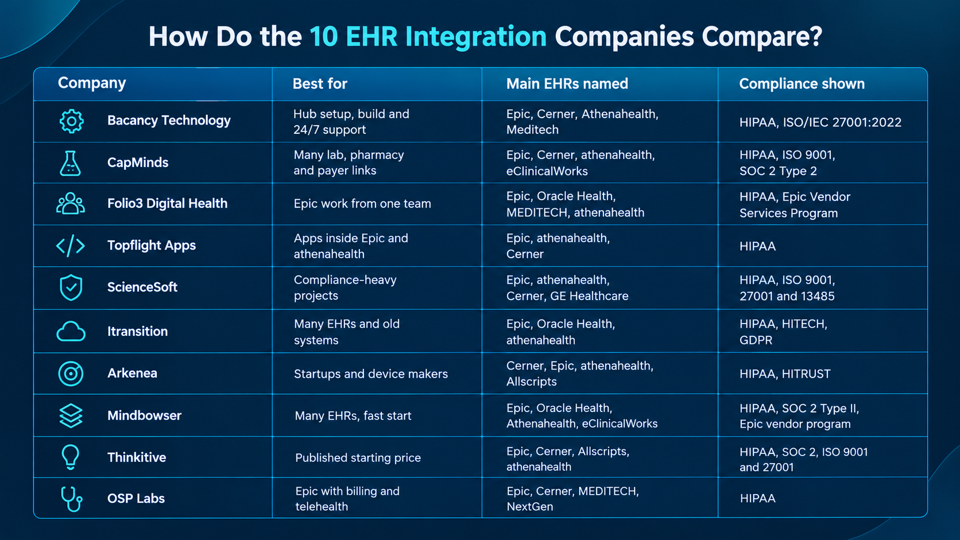
Each fact in this table comes from the company’s own website, read in October 2026. Certifications expire, clients leave, and case studies get removed. Confirm anything that matters to your decision before you rely on it.
EHR integration prices run from about $10,000 for one read-only connection to $250,000 or more for multi-system programs, and higher for hospital networks. Only four of the ten companies publish a price, so the ranges below combine their figures with 2026 industry cost guides.
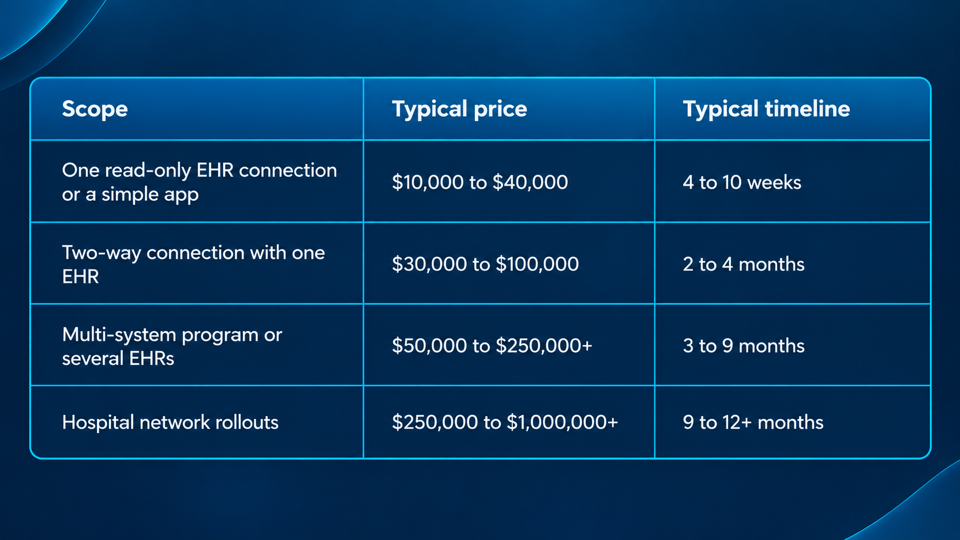
| Scope | Typical price | Typical timeline |
|---|---|---|
| One read-only EHR connection or a simple app | $10,000 to $40,000 | 4 to 10 weeks |
| Two-way connection with one EHR | $30,000 to $100,000 | 2 to 4 months |
| Multi-system program or several EHRs | $50,000 to $250,000+ | 3 to 9 months |
| Hospital network rollouts | $250,000 to $1,000,000+ | 9 to 12+ months |
Treat these as starting points, not quotes. Four details in the published material are worth asking about:
Shortlist two or three companies, then ask each the same questions. The answers show who has done this before.
A company that answers all six plainly has probably done this work before.
The right EHR integration partner depends on what you need connected. This guide compared 10 companies that serve the US, from Epic specialists to app builders and multi-EHR hubs. Expect about $10,000 to $40,000 for one read-only connection and $50,000 to $250,000 or more for multi-system programs. Timelines run from weeks to 12 months, and Epic work takes longest. Shortlist two or three companies and ask each for a named reference on your own EHR. Use the Lighter on notes to build your question list. Get the price range and support terms in writing before the first build week. Every detail comes from each company’s own pages, read in October 2026, so check the live pages before you decide.
How long does EHR integration take?
A read-only connection usually takes 4 to 10 weeks, and a two-way connection 2 to 4 months. Multi-system programs take 3 to 9 months, and Epic work often runs 3 to 12 months. Companies that publish a timeline give figures in the same range.
How much does EHR integration cost?
Expect roughly $10,000 to $40,000 for one read-only connection, $30,000 to $100,000 for a two-way connection, and $50,000 to $250,000 or more for multi-system programs. The cost table above gives the ranges by scope.
Do I need FHIR, HL7 v2 or both?
Often both. ASTP/ONC’s 2024 data shows that most hospital data sharing with third-party technology still runs through proprietary APIs or other methods, such as HL7 interfaces. Federal rules require certified EHRs to offer FHIR APIs for patient and population services. Ask your partner which one each link will use.
Can one partner connect me to several EHRs?
Yes. Companies do it with an interface engine, a ready-made integration platform or a multi-EHR hub. Ask which one they use, because it changes the price and who owns the connections.
Can a partner connect to an old EHR that has no modern API?
Yes. Some companies connect old systems through HL7 v2 messages, database-level links or custom middleware. Ask which method they would use.
Do I need the EHR vendor’s approval, and does it charge fees?
Often yes. Hospitals review security and set up access on their side, and that wait can take longer than the build. Epic lets developers use its public FHIR APIs free. Some EHR vendors also charge the hospital for API access, so ask who pays.
Do I need a Business Associate Agreement with my integration partner?
Yes, if the partner will handle patient data for you. HIPAA requires a signed BAA with business associates that handle protected health information. Ask for it before any work starts.


A physician and a management services organization (MSO) may enter a partnership to improve operations, expand access, strengthen negotiating power, or support growth across multiple locations. The …
Posted Oct 18, 2026 Physicians
Connecting innovation decision makers to authoritative information, institutions, people and insights.

Medigy accurately delivers healthcare and technology information, news and insight from around the world.
Medigy surfaces the world's best crowdsourced health tech offerings with social interactions and peer reviews.
© 2026 Netspective Foundation, Inc. All Rights Reserved.
Built on Oct 18, 2026 at 6:05pm