

Managing Editor
@ShahidNShah
@ShahidNShah

A custom CRISPR knock-in cell line can pass the provider’s genetic checks and still need further testing before it is ready for your experiment. For example, sequencing may confirm the intended insertion, while your team still needs to establish whether a tagged protein localizes as expected.
That gap matters when comparing service proposals. Two quotes may both promise a “validated clone,” yet include different tests, documentation and responsibilities. Understanding those differences helps you choose a service that fits the study and plan the work that remains after delivery.
Before approving a project, connect three things: the model your research requires, the evidence needed to evaluate it and the materials you expect to receive.
Explain what you intend to measure with the finished cell line. “Insert a fluorescent tag” describes an editing task, but “track the cellular localization of an endogenous protein” gives the provider a clearer basis for discussing the design.
Consider a laboratory commissioning a fluorescent protein-tagging model for live-cell imaging. The team needs to discuss tag placement, the relevant protein isoform and whether the proposed modification could interfere with features important to the study. A reporter model intended for compound screening would raise different questions.
When discussing CRISPR knockin services, provide the preferred cell background, target gene, intended modification and downstream application. Include constraints such as retaining a functional domain or removing a selection cassette from the final model.
If some design choices remain open, identify them as decisions to resolve during consultation. The proposal should explain how the agreed design supports the experiment and which assumptions still need checking.
Once the research purpose is clear, describe the expected genetic result. This includes the insertion site, sequence and orientation, along with any additional changes permitted by the design. State whether selection markers should remain in the delivered cells.
The required allele configuration also deserves attention. A project may need one edited allele or modification of all relevant copies. Terms such as “heterozygous” and “homozygous” should be interpreted against the actual cell background, especially where the target locus has more than two copies.
For the imaging example, the team should decide whether a model retaining untagged copies of the protein would answer its question. That decision establishes the result the provider should aim to recover.
Also determine whether the study needs one qualifying clone or multiple independent clones. If the preferred genotype proves difficult to obtain, any alternative should be reviewed against the research purpose before being accepted. Agree who can approve that change and whether it affects cost or timing.
The appropriate validation package depends on the edit, the cell background and the experiments the model will support. The aim is to obtain evidence that answers the questions important to the project.
A useful starting point is to separate candidate screening from genetic confirmation. Fluorescence or antibiotic resistance may identify cells worth examining, but neither signal alone confirms correct integration at the intended locus.
A CRISPR knockin protocol may describe screening and validation methods such as PCR, sequencing and protein-level assays. Ask which of those methods are included in the quoted service and what each will establish for your model.
For an insertion project, ask which genomic junctions and parts of the inserted sequence will be checked, and which results will appear in the final report. PCR results depend on assay design; a band of the expected size is not equivalent to sequence confirmation. Likewise, “sequencing included” should lead to a discussion about the regions covered and the conclusions the data can support.
Other questions may concern unedited alleles, unintended changes at the target locus, additional integrations or potential off-target edits. Establish which are addressed by the proposed package and which would require further testing.
A sample report can make this discussion concrete. Can your team match each clone to its assay results, see which regions were examined and identify any questions the testing leaves open?
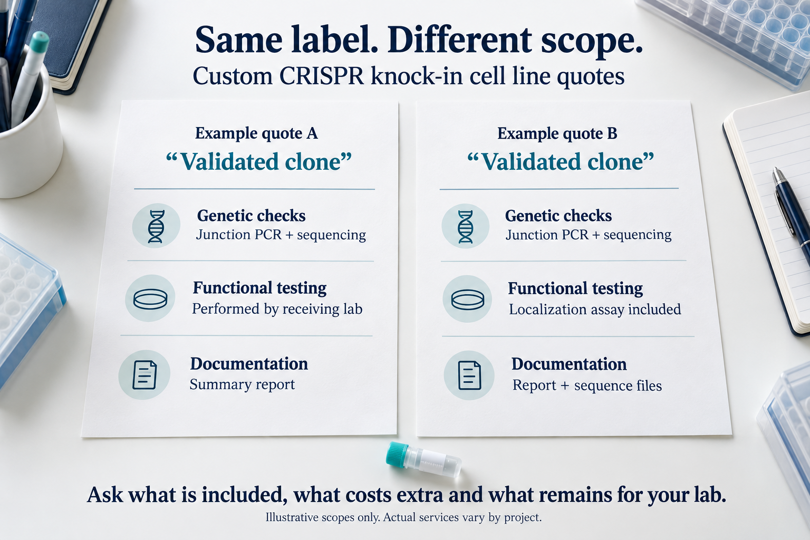
Genetic validation and suitability for a particular experiment are connected, but they answer different questions.
In the imaging example, confirming the tag sequence does not establish whether the fusion protein has the expected localization. The research team may also need to examine protein size, expression or a function relevant to the study.
These tests should be selected for the intended use. Some can be performed by the provider; others may depend on assays or expertise available only in the receiving laboratory. Ask, “Which expression or functional tests will you perform, which reagents must we supply and which tests will remain for our laboratory after delivery?”
It also helps to distinguish measuring a property from promising a particular outcome. A provider might agree to document reporter activity without guaranteeing a specific response under every experimental condition. If a defined response is essential for acceptance, agree on the conditions, controls and performance criteria before work begins.
The delivery list should identify what the laboratory will receive and how the materials connect to the project results.
Confirm the number of clones and cryovials, expected cell quantity, parental controls and culture instructions. Discuss which cell-quality checks are included, such as identity testing or mycoplasma testing, and what evidence supports the stated clonal origin. Additional characterization should reflect the cell type and study.
Each delivered clone should be traceable to its genotype and available test results. Clarify which reports, sequence files and design information will be supplied, subject to the agreed intellectual-property terms.
Plan the receiving checks as well. Who will assess recovery after thawing? How soon should concerns be reported? What happens if a clone fails an agreed criterion? Recording these arrangements makes it easier to distinguish a delivery problem from additional experimental work.
Where feasibility is uncertain, milestones can create an opportunity to review progress before proceeding with the full scope.
Before approving the quote, review the written answers with the researcher who will use the cells. Resolve any gaps in the scope and name the person who can approve later changes, so both teams have the same basis for development and acceptance.

Chief Editor - Medigy & HealthcareGuys.
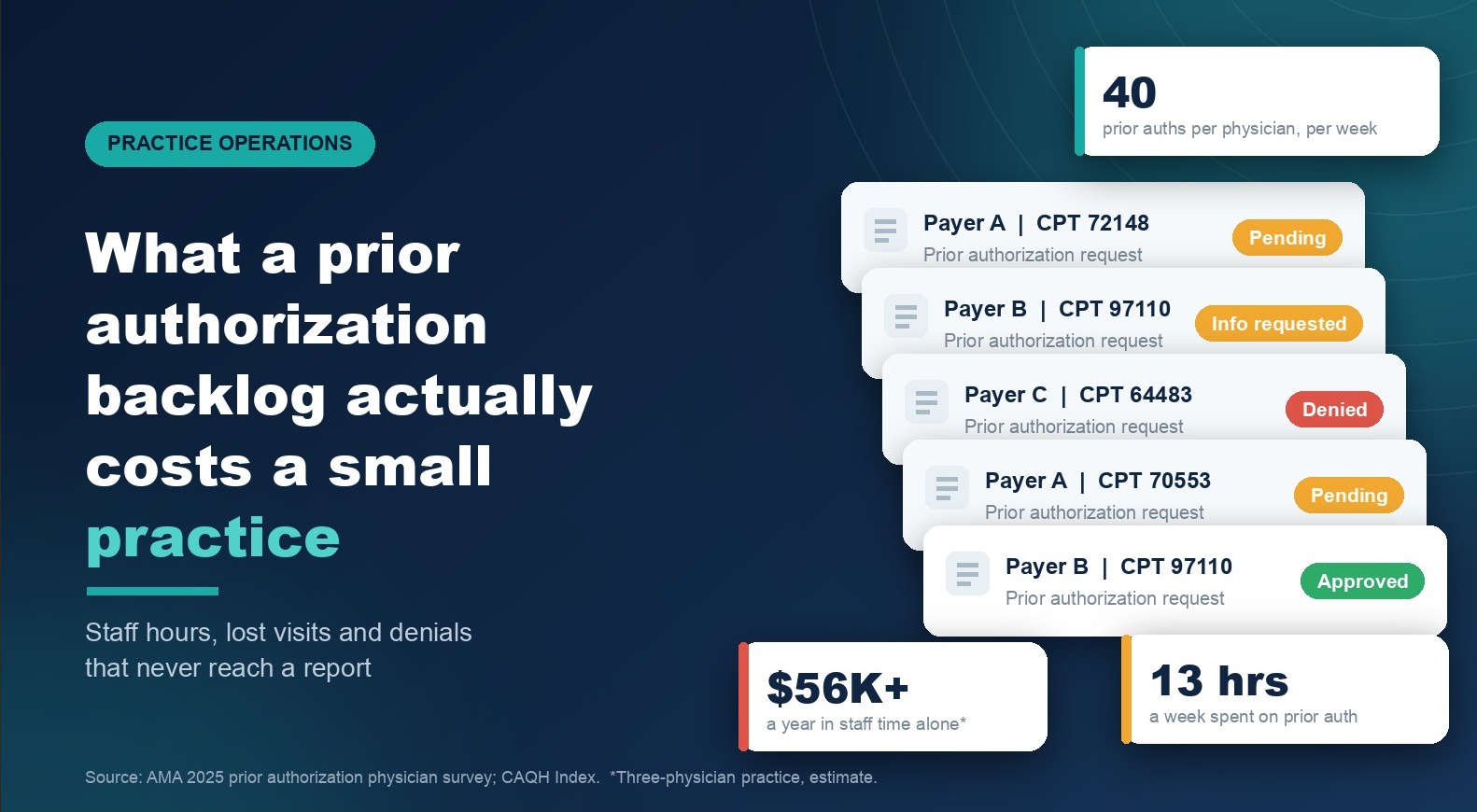
A prior authorization backlog costs a small practice in three places: the staff hours spent chasing approvals, the visits that get pushed or lost while approvals are pending, and the claims that are …
Posted Oct 26, 2026 Practice Management Medical Practice
Connecting innovation decision makers to authoritative information, institutions, people and insights.

Medigy accurately delivers healthcare and technology information, news and insight from around the world.
Medigy surfaces the world's best crowdsourced health tech offerings with social interactions and peer reviews.
© 2026 Netspective Foundation, Inc. All Rights Reserved.
Built on Oct 27, 2026 at 5:05am