

Managing Editor
@ShahidNShah
@ShahidNShah
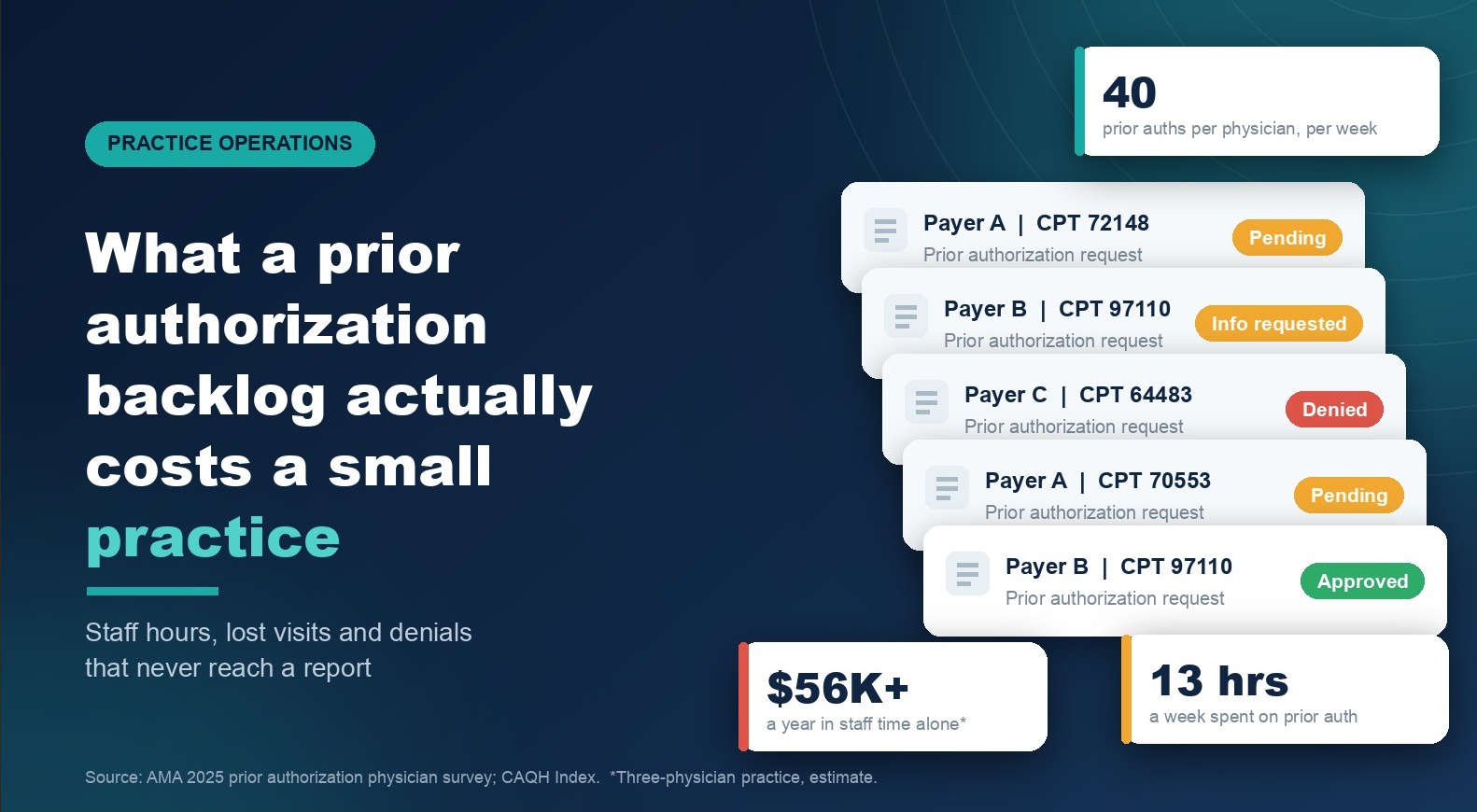
A prior authorization backlog costs a small practice in three places: the staff hours spent chasing approvals, the visits that get pushed or lost while approvals are pending, and the claims that are denied because an approval was missing or did not match. The first cost is easy to estimate. The other two rarely show up on any report, which is why most practices underestimate the total.
Prior authorization is a health plan’s requirement that a provider get approval before delivering certain tests, procedures or medications. For a small practice without a dedicated authorization team, the work tends to pile up quietly until it shows up as a scheduling problem or a cash flow problem. That is why more practices now give the queue a named owner, hired in house or added as a remote specialist through managed staffing providers such as myMedCrew.
In the American Medical Association’s 2025 survey of 1,000 practicing physicians, practices completed an average of 40 prior authorizations per physician each week, and physicians and their staff spent 13 hours a week on them (American Medical Association, 2025). Forty percent of physicians said they have staff who work exclusively on prior authorization.
The per request cost is measurable too. The 2024 CAQH Index puts the provider side cost of one prior authorization at $12.88 when it is done by phone, fax or email, and $8.93 through a health plan portal. Staff reported spending 24 minutes on a manual request and 16 minutes on a portal request (CAQH, 2025).
Put those together for a three physician practice. At 40 requests per physician, that is about 120 requests a week. At CAQH’s per request costs, that works out to roughly $1,070 to $1,550 a week, or $56,000 to $80,000 a year, before counting a single delayed visit or denied claim. The 39 combined hours a week is close to one full time role, whether or not anyone holds that title.
This is not a new problem, only a bigger one. A study in the Journal of the American Board of Family Medicine found that clerical and physician time made up the largest share of prior authorization costs in primary care offices, as physician time was shifted onto clerical staff (Morley et al., 2013).
The staff time is visible. These costs usually are not.
Rescheduled and abandoned visits. In the same AMA survey, 95% of physicians said prior authorization delays access to care at least sometimes, and 79% said it at least sometimes leads patients to abandon a recommended treatment. Seventy three percent reported that prior authorization leads to additional office visits (American Medical Association, 2025). Every visit that moves because an approval is not back is a slot that has to be refilled, and every abandoned treatment plan is revenue the practice never sees.
Idle provider time. When an approval lands late on the day of service, the visit is cancelled or rescheduled at the last minute. The provider’s time was blocked for that patient, and at short notice it is hard to fill.
Overtime. Authorization work does not stop at 5 pm. When it is shared between the front desk and medical assistants, it is often caught up after hours, which turns a workflow problem into a payroll line.
Denials and unworked appeals. In KFF’s analysis of 2023 HealthCare.gov insurer data, 9% of denied in network claims were denied for lack of prior authorization or referral (KFF, 2025). Appeals are where some of that money comes back, but only 21% of physicians in the AMA survey said they always appeal an adverse decision, and 52% of those who do not appeal said they lack the staff or time (American Medical Association, 2025).
Backlogs are rarely caused by one big failure. They come from the same few small ones, repeated across dozens of requests:
A single “average turnaround” hides the real problem. Most practices find that one or two payers account for most of the slow or denied requests. A simple authorization log fixes that: for every request, record the payer, CPT code, date submitted, status, approval number, approved units, expiry date and date decided.
Review it monthly by payer. Federal rules now help on part of the book. Under the CMS Interoperability and Prior Authorization Final Rule, Medicare Advantage, Medicaid and CHIP payers must decide standard requests within seven calendar days and urgent requests within 72 hours from January 1, 2026, and must give a specific reason for each denial (Centers for Medicare & Medicaid Services, 2024). The log shows whether each payer is actually meeting those timeframes, and gives the practice the dates it needs when it is not. Commercial plans outside the rule keep their own timelines, which makes tracking them even more important.
For more on how health systems and vendors are tackling the problem, see Medigy’s prior authorization topic hub.

The most expensive staffing model is the most common one: prior authorization shared between whoever has a spare minute. Shared ownership means no one works the pending list every day, and requests go stale.
Small practices have three workable options:
Whichever model a practice picks, the practice should keep the clinical and financial decisions, such as whether to appeal or reschedule, and the person running the queue should be connected to billing so every approval is checked against the claim before it goes out. Because prior authorization requests carry diagnoses and patient identifiers, anyone handling them, on site or remote, should work with multi factor authentication, encrypted access, role based access and audit logging.
Adwait Rajhans is Head of GTM and Revenue Strategy at myMedCrew, the healthcare staffing arm of CrewBloom, where he works with practices on staffing their billing, revenue cycle and front office operations. Connect with him on LinkedIn.


Have you considered how gum health and blood sugar levels could affect your recovery from dental implant surgery? A dental implant involves more than replacing a missing tooth. It requires the …
Posted Oct 26, 2026 Dental Care Dentistry
Connecting innovation decision makers to authoritative information, institutions, people and insights.

Medigy accurately delivers healthcare and technology information, news and insight from around the world.
Medigy surfaces the world's best crowdsourced health tech offerings with social interactions and peer reviews.
© 2026 Netspective Foundation, Inc. All Rights Reserved.
Built on Oct 27, 2026 at 5:05am