

Managing Editor
@ShahidNShah
@ShahidNShah
30% of patients in the U.S. have left a medical appointment because the wait was too long. Another 20% switched providers entirely for the same reason. In healthcare, the patient experience often breaks down before the appointment even starts.
For many clinics, the problem begins at the front desk. Patients arrive, wait in line, fill out paperwork they have completed before, and repeat the same insurance and demographic details at every visit. Staff manage phones, forms, eligibility checks, and patient questions all at once, creating delays that affect the rest of the day.
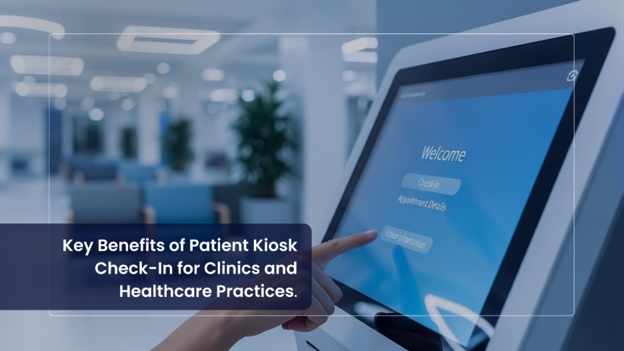
Patient kiosk check-in helps remove that friction. By giving patients a faster and more private self-service check-in process, practices can reduce front desk congestion, improve workflow efficiency, and create a smoother arrival experience from the moment patients walk through the door.
A patient kiosk check-in is a self-service terminal inside your clinic. Patients use it to confirm their details, review insurance information, sign consent forms, and check in, all on their own.
It is not just a screen on a stand. A good healthcare check-in kiosk connects to your scheduling, billing, and clinical systems in real time. What a patient enters flows directly into your records. No one on your team has to re-type it.
That connection is what makes it useful, not just novel. It becomes part of your connected patient experience workflow, not a separate tool to manage on the side.
This is the most visible win. With patient kiosk check-in, patients no longer stand in line just to confirm they arrived. They check in at the kiosk. Your staff get notified. The visit starts.
This is one of the most direct ways to reduce patient waiting time without hiring extra staff. A shorter wait also lifts patient satisfaction. When people feel their time is respected, they trust your clinic more, and they come back.
Errors in registration are common. A staff member mishears a policy number during a busy morning. An address goes in wrong. A last name gets misspelled. None of these feel serious in the moment, but they cause real problems in billing and care coordination later.
Digital patient registration through a kiosk removes that middleman. Patients enter their own information. They confirm or correct what is already on file.
Many kiosks can also scan insurance cards and photo IDs directly, reducing manual entry errors even further.
Research published in the Journal of the American Medical Informatics Association found that paper-based records are prone to discrepancies that electronic self-entry can reduce.
Cleaner data at check-in leads to fewer claim rejections, faster eligibility verification, and smoother billing cycles.
At a busy front desk, patients often have to say personal details out loud. Insurance ID numbers. Medications. Reason for visit. Other people are nearby.
A self service patient check-in kiosk changes this. Patients enter sensitive details quietly, on their own screen, at their own pace. HIPAA-aligned consent notices can be built right into the kiosk flow. Patients review and sign them before they even sit down.
Privacy is not just a compliance requirement. It is something patients notice, and something that affects whether they feel safe at your practice.
Front desk teams are good at a lot of things. Answering questions. Handling complex situations. Helping a nervous patient feel at ease. What they should not have to spend most of their day on is asking each person to confirm the same information again.
Healthcare workflow automation through kiosk check-in removes the repetitive tasks from staff workloads. A 2022 MGMA poll found that 83% of U.S. practices still used front desk check-in as their primary method. Many of those same respondents said staff were working overtime and stretched thin.
When self-check-in handles routine registration, your team is free to do the work that actually requires a human.
Reducing repetitive administrative work can also help lower staff burnout and overtime pressure, especially in busy clinics managing high patient volumes each day.
Language should not be a barrier to checking in. A self service registration kiosk that supports multiple languages makes the process easier for patients who are more comfortable in Spanish, Mandarin, Portuguese, or another language.
This is not a small thing. In many urban clinics and multispecialty practices, language diversity is the norm. A kiosk that speaks your patients’ language says your practice is designed for all of them.
Accessibility matters too. Modern kiosk systems can support larger text, screen readability, touch-friendly navigation, and workflows that are easier for patients with vision, mobility, or cognitive challenges to use comfortably.
Patient kiosk check-in can also improve front-desk collections. Patients can review and pay copays, outstanding balances, or past-due amounts during check-in instead of handling payments after the visit.
That reduces billing delays, improves cash flow, and helps practices collect balances earlier in the visit process.
Many clinics also use kiosk systems alongside digital pre-visit intake workflows. Patients can complete forms, update medical history, answer screening questionnaires, and confirm appointments before they arrive.
That shortens the check-in process even further and helps reduce delays caused by incomplete paperwork or missing patient information on the day of the visit.
Whether you run a small single-location clinic or a large multispecialty group, the setup works either way. It can be adjusted for different appointment types, workflows, and specialties. You do not need a separate system for each department.
A common worry is that new technology means disruption. A well-built digital front desk solution slots into what you already use — your EMR, scheduler, and billing platform — rather than replacing them.
Data entered at check-in shows up in real time across your systems. No duplicate work. No reconciliation at the end of the day.
Operational improvements add up quickly at the practice level. Cleaner registration data reduces claim corrections and rework. Digital forms reduce printing and paper handling costs. Faster payment collection improves cash flow.
For many practices, the result is fewer administrative bottlenecks, less manual follow-up, and more efficient use of staff time throughout the day.
Kiosk check-in generates useful metrics. Check-in completion times. Drop-off points. Busy arrival windows. That information helps you adjust staffing, identify bottlenecks, and improve the flow before problems build up.
Some practices also use these insights to improve patient throughput and manage appointment volume more efficiently during peak hours.
Not every patient wants to use a kiosk. Older adults may prefer talking to someone. Some patients have questions before they can check in. That is completely normal.
The best approach is a mixed-channel setup. Contactless patient check-in via kiosk is an option, not a requirement. Staff are still there for patients who need them.
At the same time, contactless workflows can reduce front-desk crowding, minimize paperwork handling, and create a smoother arrival experience for patients who prefer a faster digital process.
The kiosk handles the volume. The team handles the exceptions. Both work better.
The kiosk is not there to replace your staff. It is there to stop them from doing tasks that do not need a person.
Patient data protection is not optional. That is why a reliable kiosk system comes with healthcare data encryption and secure transmission built in from the start.
HIPAA-aligned consent workflows are part of the check-in flow, not added afterward. Patients sign digitally. Your system keeps an audit trail. When a compliance review comes around, the documentation is already there.
You should not have to manage security as a separate project. It should be part of how the system works by default.
Check-in is the first real moment of a patient’s visit. If it is slow and frustrating, the rest of the visit starts from a deficit.
Patient kiosk check-in fixes the start. Shorter wait. Accurate data. Private entry. A staff team that has time to care, not just process.
These are not incremental improvements — they are changes patients and staff both feel.
CERTIFY Health’s Kiosk Check-In brings all of this together as part of a connected, integrated system built for the real demands of clinical practice. It fits your workflow, scales with your growth, and keeps patient data secure at every step.
If your front desk is slowing your clinic down, it does not have to stay that way. Explore how Kiosk Check-In can transform your patient experience and front-desk workflow.


If your health worsens after medical treatment and no one can explain why, that is often the first sign of medical malpractice. Malpractice occurs when a healthcare provider fails to meet the accepted …
Posted May 19, 2026 #HealthLaw Medical Practice
Connecting innovation decision makers to authoritative information, institutions, people and insights.

Medigy accurately delivers healthcare and technology information, news and insight from around the world.
Medigy surfaces the world's best crowdsourced health tech offerings with social interactions and peer reviews.
© 2026 Netspective Foundation, Inc. All Rights Reserved.
Built on Oct 14, 2026 at 6:06pm