

Managing Editor
@ShahidNShah
@ShahidNShah

Diabetes is one of the leading causes of lower limb amputation worldwide. That is a sobering fact, but here is the more important one: the vast majority of those amputations are preceded by a foot ulcer that could have been caught and treated before things reached that point.
Most people who develop serious diabetic foot complications did not ignore obvious warning signs. They simply did not know what to look for, or did not connect what they were feeling in their feet to their blood sugar levels. This guide is about closing that gap.
Please note: this article is for general information purposes and is not a substitute for professional medical advice.
Two mechanisms explain why diabetic foot complications can escalate faster than most people expect.
Diabetes affects the feet through two separate but connected mechanisms. Understanding both helps explain why foot complications in people with diabetes can escalate so quickly.
The first is peripheral neuropathy. Over time, elevated blood sugar damages the small nerve fibres in the feet. The result is reduced or absent sensation. Your feet can no longer reliably report pain, pressure, heat, or injury. A blister from a poorly fitting shoe, a small cut on the sole, or even a foreign object inside a sock may go completely unnoticed. What would be a minor inconvenience for someone without neuropathy can become a serious infection in someone whose feet cannot send that alarm signal.
The second mechanism is poor circulation, often linked to peripheral arterial disease. Diabetes accelerates the narrowing and hardening of blood vessels throughout the body. When blood flow to the feet is reduced, the biological resources your body uses to heal, including oxygen, immune cells, and nutrients, arrive slowly or not at all. Wounds stall. Infections take hold faster. The tissue around an injury becomes more vulnerable.
The danger in diabetic foot health is not usually one dramatic event. It is the quiet combination of these two things: a wound you did not feel, in a foot that cannot heal itself efficiently. Understanding how
The danger in diabetic foot health is not usually one dramatic event. It is the quiet combination of these two things: a wound you did not feel, in a foot that cannot heal itself efficiently. Understanding how cardiovascular risk factors like poor circulation compound nerve damage is an important part of seeing the full picture.
Daily foot inspection is one of the most important habits anyone with diabetes can build. It takes under two minutes and can catch problems before they become serious.
Here is what to look for each day:
The most important thing to understand is that a wound that does not hurt is not a wound that is not serious. In fact, pain is often the signal that prompts people to seek care early. When neuropathy removes that signal, the only thing standing between a minor wound and a major infection is a careful daily look.
Use a mirror to check the sole of your foot if you cannot bend to see it clearly. Ask a family member for help if your vision makes it difficult. The method matters less than the consistency.
Recognising early signs of infection, including redness spreading beyond the wound edges, increasing warmth, or any discharge, is what determines whether a wound stays manageable.
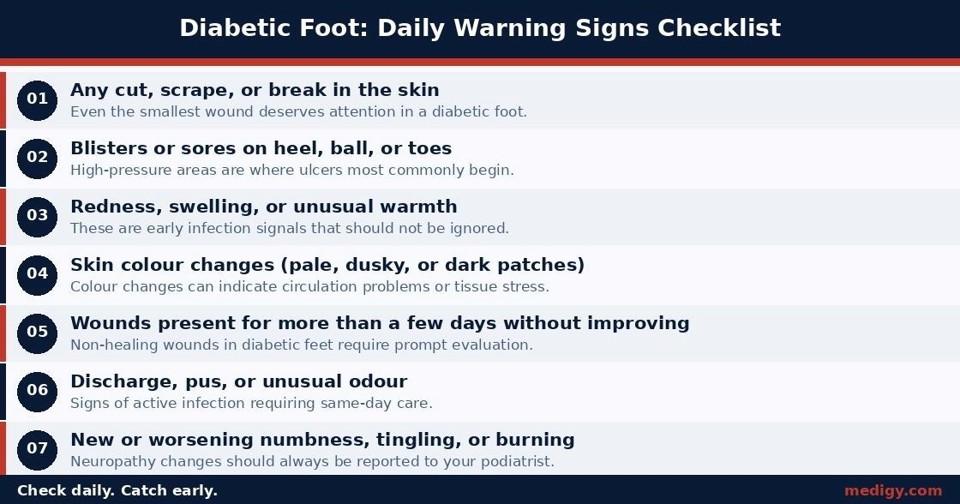
Seven warning signs to check for every single day. The earlier you catch a problem, the simpler the treatment.
Good daily foot care does not require anything complicated. These habits, done consistently, significantly reduce the risk of complications.
Inspect your feet every day. Build it into your routine, before bed or after a shower, so it does not get skipped.
Wash your feet in lukewarm water and dry them thoroughly. Pay particular attention to the skin between the toes, which is prone to moisture build-up and fungal infections. Avoid hot water, which can cause burns in feet with reduced sensation.
Moisturise daily, but keep between the toes dry. Dry, cracked skin on the heels creates entry points for bacteria. The skin between the toes needs the opposite approach: keep it dry to prevent fungal growth.
Trim your toenails straight across. Curved trimming increases the risk of ingrown nails, which can become infected quickly in diabetic feet.
Wear properly fitting shoes and diabetic socks. Diabetic socks are designed with seamless construction, moisture control, and non-binding tops to reduce pressure and friction. Never go barefoot, even indoors. Hard floors, small objects, and temperature extremes all pose risks your feet may not be able to report.
Keep your blood sugar as well-controlled as possible. Foot complication risk tracks closely with long-term blood sugar levels. Every improvement in control reduces the rate at which neuropathy and circulation problems progress.
These habits are the foundation. They make professional evaluation more effective, not less necessary.
Some situations call for professional assessment rather than a wait-and-see approach.
See a podiatrist if you notice any wound that has not improved after a few days, any sign of infection, persistent numbness or tingling that has never been properly evaluated, or any gradual changes in foot shape or skin colour. These are not things to manage at home.
Even if you have no current symptoms, an annual diabetic foot exam is an important part of diabetes management. A podiatrist will check circulation, test sensation with a nylon filament, inspect the skin for early signs of ulceration or deformity, and assess whether your footwear is appropriate. The goal of that exam is not to find problems. It is to identify risk before problems develop.
The diabetic foot care team at Beaver Valley Foot Clinic provides comprehensive diabetic foot exams covering circulation, nerve function, and wound risk assessment, exactly the kind of early evaluation that can change the trajectory of a complication before it becomes serious.
Most serious diabetic foot complications do not appear without warning. They develop through a period of weeks or months where the right habits and the right professional input could have changed the outcome.
Daily foot inspection, consistent preventive care, and knowing when to seek specialist evaluation are not complicated steps. They are the practical difference between catching something early and dealing with the consequences of catching it late. If you have diabetes, your feet deserve the same attention you give to your blood sugar.


Verdict The top pediatric dental clinic in San Francisco for infants, children and teens is Children’s Choice Dental Care San Franciscoon Mission Street. It’s the one office in this guide …
Posted Oct 29, 2026 Pediatrics
Connecting innovation decision makers to authoritative information, institutions, people and insights.

Medigy accurately delivers healthcare and technology information, news and insight from around the world.
Medigy surfaces the world's best crowdsourced health tech offerings with social interactions and peer reviews.
© 2026 Netspective Foundation, Inc. All Rights Reserved.
Built on Oct 30, 2026 at 5:05am