

Managing Editor
@ShahidNShah
@ShahidNShah
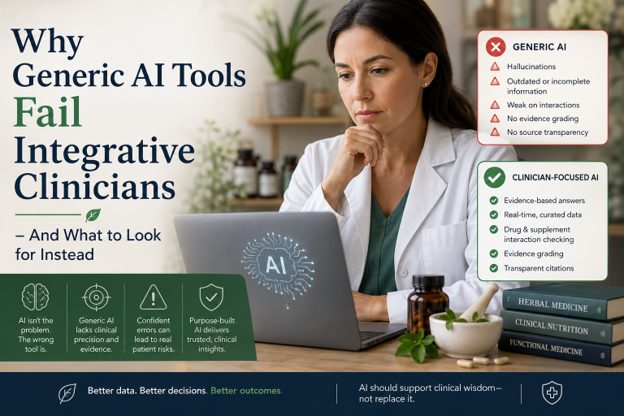
The arrival of large language model (LLM) AI tools in everyday professional life has been rapid and far-reaching. From writing assistants to coding tools to general-purpose chatbots, AI has become embedded in how many knowledge workers operate. Healthcare is no exception – clinicians of all kinds are experimenting with AI, asking it questions, and in some cases incorporating it into their workflows.
But for integrative and functional medicine clinicians – practitioners who routinely work with natural medicines, supplement protocols, complex drug-nutrient interactions, and evidence that is often distributed across specialized databases rather than mainstream clinical literature – generic AI tools present a specific and underappreciated problem: they frequently get things wrong, and they do so with confidence.
This article examines why general-purpose AI falls short for integrative clinical practice, what the risks look like in real-world use, and what distinguishes purpose-built clinical AI tools from consumer-grade alternatives.
It is easy to understand why clinicians reach for tools like ChatGPT, Gemini, or similar general-purpose LLMs. They are fast, conversational, and capable of synthesizing large volumes of information into readable summaries. For a busy practitioner trying to quickly orient to an unfamiliar condition or treatment area, they feel efficient.
The core problem is that these tools were not built for clinical medicine. They were built for breadth – trained on vast amounts of general internet text, not curated, peer-reviewed clinical databases. This matters because clinical medicine, and integrative medicine in particular, requires precision, currency, and traceability. A response that is plausible but unverified is not just unhelpful – it is potentially dangerous.
The phenomenon known as AI hallucination – where a model produces information that appears coherent and authoritative but is factually incorrect – is well-documented and particularly consequential in healthcare. A 2025 preprint from medRxiv on medical hallucinations in foundation models described how these errors “arise within specialized tasks such as diagnostic reasoning, therapeutic planning, or interpretation of laboratory findings, where inaccuracies have immediate implications for patient care” and noted that they “frequently use domain-specific terms and appear to present coherent logic, which can make them difficult to recognize without expert scrutiny” (Xu et al., 2025).
In other words, the errors are not always obvious. A general AI may cite a plausible-sounding study that does not exist, misattribute a drug interaction, or conflate evidence levels – and do so in language that reads like a credible clinical reference.

Integrative medicine presents several distinct challenges that expose the limitations of general-purpose AI more acutely than conventional clinical contexts.
General AI tools are most reliable in domains that are heavily represented in their training data. Conventional pharmacology and mainstream clinical trials are well-covered. But the evidence base for natural medicines – botanical extracts, nutraceuticals, functional nutrition interventions – is distributed across specialized journals, databases, and monograph repositories that are not uniformly scraped or indexed in most LLM training pipelines. The result is that a general AI may confidently produce information about an herbal supplement based on fragmentary or outdated data, without signaling that its coverage in this area is thin.
Interaction identification is one of the highest-stakes tasks in integrative clinical practice. A 2025 study published in ScienceDirect on AI platforms and drug interaction screening found substantial variation in accuracy across general-purpose AI tools, with one analysis showing general LLMs achieving accuracy rates as low as 47% on drug interaction identification tasks – a finding that should give any clinician pause before relying on these tools for interaction screening (Al-Ashwal et al., 2023, cited in Zhang et al., 2025).
Supplement-drug interactions add a further layer of complexity. The pharmacokinetic mechanisms involved – cytochrome P450 enzyme induction or inhibition, transporter protein effects, additive or antagonistic pharmacodynamic actions – require not just knowledge of individual substances but understanding of how they interact at a biochemical level. This is a specialized domain that generic AI is not reliably equipped to navigate.
Integrative clinicians need to know not just what the evidence says, but how strong that evidence is. Is a claim supported by a randomized controlled trial, an observational cohort study, a case series, or expert consensus? Generic AI tools typically do not grade evidence, do not consistently link to primary sources, and may blend findings from studies of very different methodological quality without distinguishing between them. For a field where evidence quality varies enormously across interventions, this is a critical limitation.
The supplement industry operates under a different regulatory framework than pharmaceuticals, meaning product quality, potency, and ingredient profiles vary significantly. A generic AI asked about a particular supplement may provide information based on an idealized ingredient profile that does not reflect what is actually in a given product. Clinical decision support in this domain requires an awareness of regulatory context that consumer-grade tools do not typically incorporate.
It is worth dwelling on what these limitations mean in practice. An integrative clinician using a general AI tool to screen a patient’s supplement stack against their prescription medications may receive a response that appears complete and credible – but misses a clinically significant interaction. A practitioner using AI to locate evidence for a botanical protocol may receive citations that are fabricated or misattributed.
The medical hallucination research is unambiguous on this point. As Beheshti et al. (2025) noted in a synthesis of generative AI research, “inaccurate or misleading information in healthcare can have severe consequences, including misdiagnoses, improper treatments, and potential harm to patients’ well-being and safety.” Importantly, the empirical record already documents hallucinations or fictitious information appearing in clinical AI outputs across multiple published studies – not as a theoretical risk but as an observed pattern.
For integrative clinicians, who are already navigating a practice environment where their knowledge base may be less familiar to conventional colleagues, relying on a tool that confidently produces inaccurate information compounds rather than reduces clinical risk.
The answer to the limitations of generic AI is not to abandon AI in clinical workflows – it is to use AI that was designed for the specific demands of clinical decision-making. There are meaningful differences between general-purpose LLMs and clinical AI tools built on curated, verified, clinically-reviewed databases.
When evaluating an AI tool for integrative clinical use, the following characteristics matter:

Consider a patient presenting with PCOS, insulin resistance, and hypothyroidism – currently on metformin and levothyroxine – who is also self-administering berberine, a B-complex supplement, and inositol purchased online.
A general-purpose AI asked to evaluate this combination may produce a response that touches on berberine’s glycemic effects, notes a vague concern about combining it with metformin, and provides an overall impression of safety. It may not flag the well-documented concern that berberine and metformin share overlapping mechanisms (AMPK activation) and that their combined use should be monitored carefully. It may not surface the interaction between certain B-vitamin formulations and levothyroxine absorption timing. It may not acknowledge that evidence on inositol in PCOS, while promising, varies by isoform (myo-inositol vs. D-chiro-inositol) in ways that are clinically meaningful.
A purpose-built integrative medicine tool would approach this differently: it would surface specific interaction flags with evidence citations, note the relevant pharmacokinetic mechanisms, distinguish between evidence quality for different components of the protocol, and flag questions worth raising in clinical monitoring.
Platforms like ClarityTx are built specifically for this kind of integrative clinical workflow – combining an AI-assisted interface with a curated database of over 2,500 natural medicines, clinician-reviewed monographs, and evidence-graded interaction data. The goal is not to replace clinical judgment but to make it faster and better-informed by surfacing the right information, with the right level of evidence, at the point of care.
Before incorporating any AI tool into an integrative clinical workflow, it is worth asking:
AI has genuine and growing potential to support integrative clinical practice – reducing the time it takes to build evidence-based protocols, surfacing interaction risks that might otherwise go undetected, and helping practitioners stay current in a fast-moving field. But realizing that potential requires using AI that was built for clinical medicine, not AI that was built for general-purpose conversation.
Generic LLMs, for all their capabilities, are not reliable clinical reference tools. Their hallucination risk in specialized medical contexts is documented and meaningful. Their coverage of natural medicines, supplement interactions, and integrative protocols is inconsistent. And their inability to grade or cite evidence creates accountability gaps that are incompatible with responsible clinical practice.
Integrative clinicians deserve tools that match the sophistication of their practice – tools built on the same evidence-first principles that guide their clinical decisions. Choosing the right AI is itself a clinical decision. It deserves the same rigor as any other.


A nurse logging in from home. A clinician on a tablet during ward rounds. A billing administrator at a rural clinic kiosk. Each one creates the same problem. Remote access to patient records has to …
Posted Jun 9, 2026 Patient Data Healthcare
Connecting innovation decision makers to authoritative information, institutions, people and insights.

Medigy accurately delivers healthcare and technology information, news and insight from around the world.
Medigy surfaces the world's best crowdsourced health tech offerings with social interactions and peer reviews.
© 2026 Netspective Foundation, Inc. All Rights Reserved.
Built on Oct 15, 2026 at 5:05am