

Managing Editor
@ShahidNShah
@ShahidNShah

Suppose a patient checks in for a video appointment through a new portal, and the screen confirms they’re ready, so they sit down and wait. Meanwhile, at the clinic, the receptionist can’t see that check-in, and the clinician’s appointment list still shows the patient as absent.
This appointment is going nowhere, despite everyone doing exactly what they’re supposed to, and that is the sort of problem healthcare organizations want to find before a rollout.
When preparing digital health technologies for use, user acceptance testing, or UAT, gives intended users a chance to run agreed tasks in the configured system. Their experience then helps establish whether the system supports the work people actually need to do.
The value lies in seeing how the technology fits into care delivery, including the points where responsibility passes from one person to another.
What a Working Screen Doesn’t Show
In the appointment example, the patient-facing function appears to have worked, and the problem only becomes visible when that action is followed through to the staff responsible for the visit. A confirmation on one screen has created an expectation that the rest of the service cannot yet meet.
That gap can have several causes:
Each explanation calls for a different response and UAT helps make those distinctions visible. A patient representative, receptionist, and clinician bring different knowledge of what the same appointment requires, and their experience gives technical specialists a clearer account of where the process breaks down and what that failure means in practice.
A useful UAT session would let a patient representative attempt the check-in while reception staff and a clinician work through their side of the encounter, with access permissions planned for their roles. Someone testing with an administrator account may see information that the receptionist won’t have on launch day.
Then participants can try the task without being coached through every click. If the patient needs help finding the appointment link, that is worth recording. If the receptionist opens three screens to establish whether the patient has arrived, the development team needs to understand why.
This kind of observation is an established part of evaluating health IT usability. The findings may call for a design change or just clearer instructions, and while training is a potential solution, it can’t be the automatic answer whenever somebody struggles.
Who takes part also affects what the organization learns, since experienced project staff may move comfortably through a system that leaves a first-time patient confused. Including different accessibility needs and levels of digital confidence gives the team a fuller picture of how the service will work beyond the project group.
A realistic, separate test environment with synthetic patient records allows those difficulties to surface without involving live care. It also makes room for interruptions. A dropped video connection, for example, can reveal whether staff understand that a patient is trying to rejoin or mistakenly treat the encounter as a missed appointment.
For healthcare leaders, the findings provide a basis for judging readiness. A documented mismatch between the expected and actual result can be investigated and checked again after a change, but the significance of a finding matters as much as its existence. An awkward label and a failure that could expose the wrong patient’s information cannot carry the same weight.
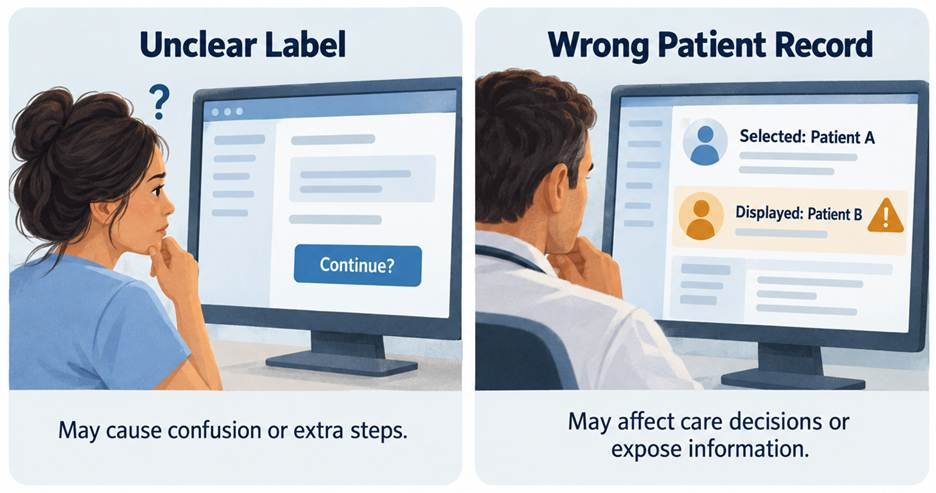
An unresolved safety-critical problem can provide grounds to postpone the affected workflow until it is corrected or adequately controlled through the organization’s clinical safety process.
This connects UAT with risk and compliance work, as it gives clinical and operational leaders a clearer view of the limitations they are accepting and the controls being relied on. The approval then becomes an accountable decision about a particular configuration and use, rather than a general claim that a technology is safe.
That distinction is especially important for AI-powered clinical tools, as a clinician successfully reviewing an AI-generated note doesn’t establish the tool’s clinical accuracy. Appropriate security assessments and any applicable regulatory review still have their own roles. UAT contributes evidence about use within the intended workflow.
For the patient waiting online, the benefit is that information about their scheduled arrival reaches the right people, and staff know how to continue if the connection fails. Monitoring after launch and testing significant changes help preserve that connection between what a system appears to do and how care actually gets delivered.

Chief Editor - Medigy & HealthcareGuys.

Have you ever needed mental health supportbut struggled to find time for therapy or a professional nearby? If yes, digital health tools might make accessing mental health care easier for you. You can …
Posted Oct 28, 2026 Mental Health
Connecting innovation decision makers to authoritative information, institutions, people and insights.

Medigy accurately delivers healthcare and technology information, news and insight from around the world.
Medigy surfaces the world's best crowdsourced health tech offerings with social interactions and peer reviews.
© 2026 Netspective Foundation, Inc. All Rights Reserved.
Built on Oct 28, 2026 at 6:05pm