

Managing Editor
@ShahidNShah
@ShahidNShah

Anyone working in a research or laboratory setting knows that sourcing peptides is only half the job. The harder part is figuring out which suppliers actually meet the documentation, purity, and quality control standards that serious research demands. Tesamorelin is one of the more widely studied peptides in laboratory settings, and the number of vendors offering it online has grown considerably heading into 2026. That growth has made supplier evaluation more important, not less.
This article looks at what separates a credible research supplier from one that simply lists a product page and hopes for the best. The focus here is entirely on laboratory sourcing practices, not on use, dosing, or application outside a controlled research environment.
Reproducibility is the backbone of good research. If a peptide sample varies in purity or concentration from batch to batch, any downstream data becomes difficult to trust. This is why research integrity standards place so much emphasis on the sourcing stage, long before a compound ever reaches a bench.
A few factors consistently separate reliable suppliers from unreliable ones:
Without these, researchers are left guessing about sample integrity, which undermines experimental design from the start.
A COA is not just a formality. It’s a documented record of analytical testing performed on a specific batch, and it should include enough detail to be independently verifiable.
A well-prepared COA typically includes:
If a COA is vague, undated, or lacks a traceable batch number, it’s difficult to treat it as reliable documentation. This is one area where researchers evaluating a Tesamorelin Peptide Online listing should look closely before relying on the material for any analytical work, since the strength of the documentation often reflects the overall rigor of the supplier’s quality process.
Quality control in peptide research follows principles similar to those used across analytical chemistry more broadly. NIST and other standards bodies have long emphasized that measurement traceability and validated methods are what make results comparable across laboratories.
Some practical quality control markers to look for:
These standards aren’t just bureaucratic checkboxes. They directly affect whether a researcher can trust that what’s on the label matches what’s in the vial.
Reproducibility issues in peptide-based research often trace back to inconsistent raw materials rather than flawed methodology. This is a recurring theme in discussions around research integrity across the life sciences.
When designing an experiment involving a peptide compound, it helps to account for:
A supplier that provides this kind of technical detail alongside the product listing is generally signaling a more mature approach to quality assurance than one that offers minimal information.
Transparency is one of the clearest indicators of a trustworthy research supplier. This goes beyond having a professional-looking website.
Suppliers that answer these questions openly tend to align more closely with the documentation practices expected in academic and laboratory research. For example, a well-organized Tesamorelin Peptide Online product page that includes batch-specific testing data gives researchers a starting point for verifying material quality before it factors into any experimental protocol.
Not every supplier operates with the same level of rigor, and a few warning signs tend to repeat across less credible listings:
None of these factors alone is disqualifying, but several appearing together should prompt further scrutiny before a purchase is made for laboratory purposes.
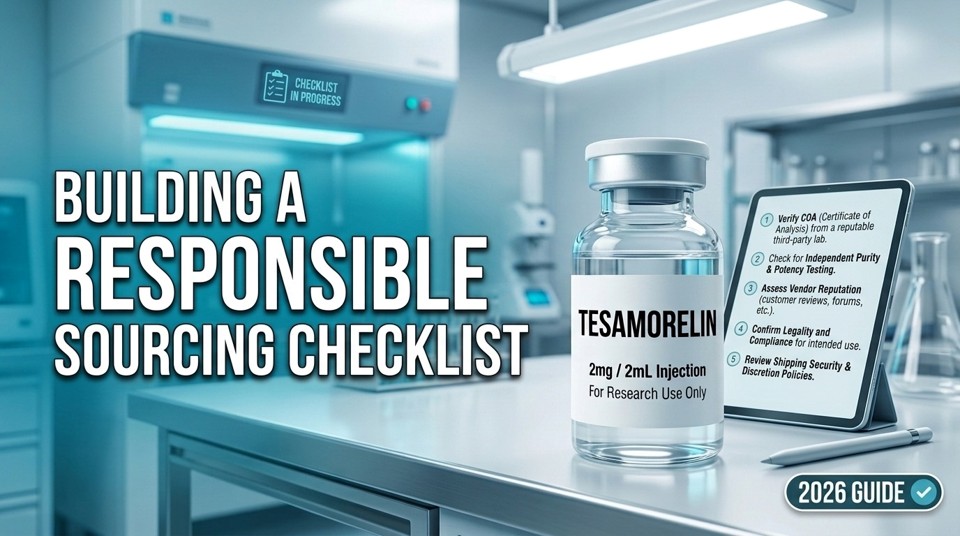
Researchers evaluating multiple suppliers often benefit from a simple internal checklist rather than relying on memory or impression. A useful checklist might include:
Keeping this kind of documentation trail supports research integrity and makes it easier to troubleshoot unexpected results later on.
Sourcing decisions in peptide research carry more weight than they’re often given credit for. A supplier’s documentation practices, testing transparency, and consistency across batches can directly shape how reliable an experiment’s outcomes turn out to be. Rather than focusing on price or convenience alone, researchers are better served by prioritizing verifiable quality control data and clear analytical records. Taking the time to vet a supplier properly is, in many ways, the first real step in good experimental design.
Important Note All peptides and related compounds mentioned in this article are intended strictly for research and laboratory study purposes only. They are not approved for human use, consumption, or medical application.


Brain injuries can affect memory, movement, emotions, communication, and many other essential functions, which is why prompt medical attention and careful documentation are so important after an …
Posted Aug 25, 2026 Neurology
Connecting innovation decision makers to authoritative information, institutions, people and insights.

Medigy accurately delivers healthcare and technology information, news and insight from around the world.
Medigy surfaces the world's best crowdsourced health tech offerings with social interactions and peer reviews.
© 2026 Netspective Foundation, Inc. All Rights Reserved.
Built on Oct 8, 2026 at 6:09pm