

Managing Editor
@ShahidNShah
@ShahidNShah
Company information and pricing are current as of publication. Both change frequently, so verify directly with each company before signing anything.
There is a gap in American healthcare that almost nobody talks about, and it explains why administrative work still feels the way it does. According to the 2025 CAQH Index, more than 50 percent of health plans now use AI tools in their administrative workflows, while among provider organizations that figure sits at 25 percent. Insurers have automated, and hospitals largely have not. The same report found the industry avoided roughly $258 billion in administrative costs through electronic transactions, with another $21 billion still sitting in workflows that remain manual, and that $21 billion is the opportunity this entire market is built on.
The trouble for anyone shopping is that the label covers at least five different businesses. A firm that builds custom integrations into your Epic instance and a coding engine that reads clinical notes are not competitors, and they are not even the same purchase, yet most lists rank them against each other anyway. That is why so many of them are hard to act on. This guide covers 12 vendors serving the US market in 2027, grouped by what they actually do, with the criteria that separate them and the prices most of them will not publish.
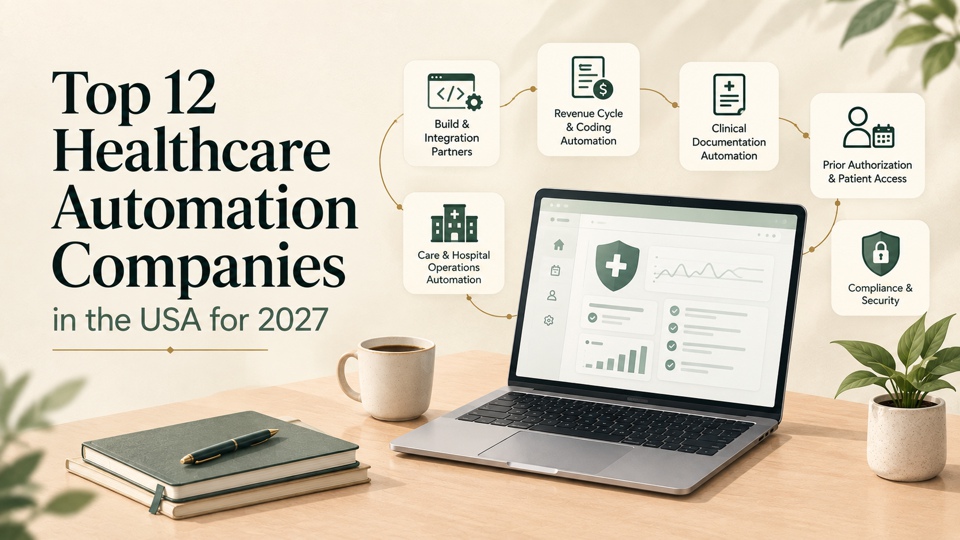
Automated Healthcare companies design and implement software that eliminates manual and repetitive processes within clinical and administrative settings. Automated Healthcare consists of five different categories, and choosing the right one will save you many months.
A large health system typically buys from three or four of these categories. A 12-provider practice usually needs one.
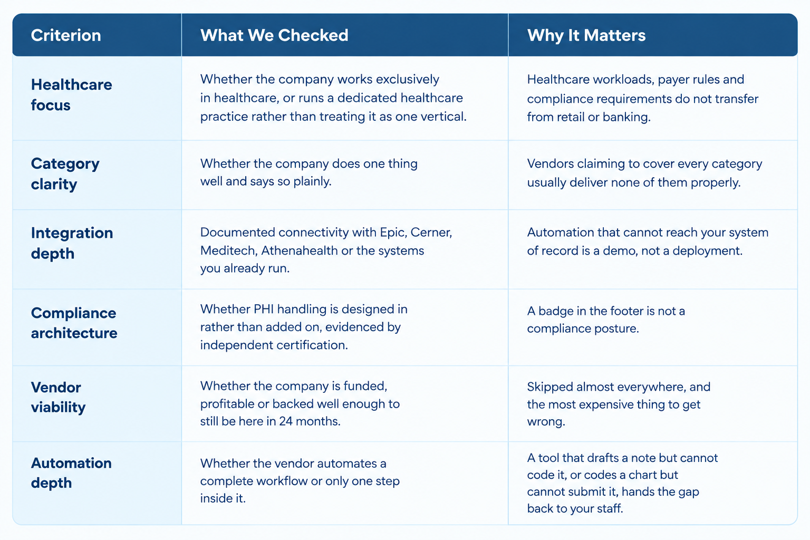
Every company below works exclusively or primarily in healthcare. General-purpose vendors that treat healthcare as one vertical among many were excluded, however large they are. These solve different problems and are not competing for the same budget, so the numbering is for reference only and is not a quality ranking.
Bacancy Technology builds automation rather than selling it, so what you end up with belongs to you rather than depending on a vendor’s roadmap. Its healthcare practice has run since 2011, holds ISO/IEC 27001:2022, and works across all four major automation platforms, UiPath, Automation Anywhere, Blue Prism and Power Automate, integrating through HL7, FHIR, Mirth Connect and Redox into Epic, Cerner, Meditech, Athenahealth and NextGen. A claims processing build for a multispecialty hospital cut processing time by 65 percent and denials by 40 percent.
Automation capabilities:
Best for: Organizations that need automation built into existing infrastructure, or several point tools connected into one working process. Teams assigned within 48 hours, with a 15-day trial.
Lighter on: Short fixed-scope projects. The model suits ongoing platform work.
Arintra runs autonomous medical coding through agentic AI that works directly inside the EHR, rather than pulling charts out to a separate system and pushing codes back. It reads clinical documentation, assigns codes across specialties, and flags denial risk before a claim is submitted.
Automation capabilities:
Best for: Health systems and physician groups wanting autonomous coding without a multi-year enterprise implementation.
Lighter on: Track record. Strong independent validation, but a shorter deployment history than CodaMetrix.
Humata handles prior authorization end-to-end. It determines whether an authorization is required, assembles and submits the request, grades the supporting documentation before it reaches the payer, and tracks changing authorization policy across state, regional, and national plans.
Automation capabilities:
Best for: Health systems where prior authorization is the dominant administrative burden.
Lighter on: Independence, at least for now.
Notable automates the front office rather than the billing office. Patients are processed by the AI workflow agents from intake to registration, scheduling, and eligibility checks, even before anyone interacts with a healthcare provider from the EHR database.
Automation capabilities:
Best for: Organizations where the front desk creates more delay than the billing office.
Lighter on: Back-end revenue cycle and clinical documentation.
The product alternative to hiring an engineering firm. Keragon is a no-code workflow automation platform built for healthcare, connecting more than 300 healthcare tools including Athenahealth, DrChrono, Elation Health, Healthie, ModMed, eClinicalWorks and IntakeQ. It starts at $99 per month with a 14-day trial, which makes it one of the few vendors here a small practice can price without a sales call.
Automation capabilities:
Best for: Small and mid-sized practices with several disconnected systems, no internal IT team, and no appetite for a custom build.
Lighter on: Clinical AI and depth at enterprise scale. It moves data between systems well, but it will not code a chart or write a note, and complex multi-site requirements still point toward a build partner.
A US development firm that has worked on nothing but healthcare for 15 years. It builds revenue cycle automation covering eligibility verification, claims and denial management, plus clinical and administrative workflow automation, with HIPAA handled in the architecture rather than added before launch.
Automation capabilities:
Best for: HealthTech founders, medical practices and providers wanting a healthcare-exclusive engineering partner for custom automation.
Lighter on: Scale. A smaller bench than the large offshore firms, which shows on very large multi-site enterprise programs.
CodaMetrix was built inside a hospital billing office because the commercial coding tools available at the time were not good enough. Its platform reads clinical documentation and assigns codes across specialties without a coder in the loop, working from the longitudinal patient record rather than a single visit transcript.
Automation capabilities:
Best for: Health systems and large groups where coding volume and denial rates are the primary problem.
Lighter on: Anything outside coding. It will not touch scheduling, intake or patient communication.
AKASA applies generative AI across the revenue cycle, with models that learn an organization’s specific payer behavior rather than running fixed rules. That suits providers with an unusual payer mix, where rule-based automation keeps breaking every time a payer changes its requirements.
Automation capabilities:
Best for: Health systems processing high claim volumes across many payers.
Lighter on: Small practices. This is an enterprise deployment with enterprise implementation requirements.
A cloud revenue cycle platform covering the full financial workflow, from eligibility verification through claim submission, denial prevention, and patient payment. Its breadth is the draw and also the thing to weigh: consolidating this much onto one vendor concentrates risk.
Automation capabilities:
Best for: Mid-sized to large organizations that want the revenue cycle handled by one vendor.
Lighter on: Clinical automation. Also worth weighing against the concentration risk question, given how much sits on the platform.
Abridge utilizes ambient intelligence to transform the discussion between a doctor and patient into a well-organized clinical note instantly within the EHR system using specialty-based models and generating codes and billing information from the encounter itself.
Automation capabilities:
Best for: Health systems where documentation burden and physician burnout are the priority.
Lighter on: Pricing transparency. Also dependent on audio quality and requires hardware.
A Texas-headquartered firm with a long-running healthcare practice, working with enterprise clients that carry heavy security and data residency requirements. It builds automation into existing environments rather than selling a product, which places it alongside the other engineering partners on this list.
Automation capabilities:
Best for: Organizations with strict security requirements and complex enterprise environments that need automation built to specification.
Lighter on: Healthcare concentration. It runs a healthcare practice, but healthcare sits alongside a wide portfolio of other industries.
The only company here automating what happens inside the hospital rather than around it. Qventus works seamlessly with the EHR and utilizes machine learning, behavioral sciences, and AI agents for predicting limitations in operations and acting on them for inpatient capacity, perioperative scheduling, and patient flow.
Automation capabilities:
Best for: Hospitals and health systems constrained by beds, theatres, and throughput rather than paperwork.
Lighter on: Revenue cycle and documentation. This is an operations platform, not a billing or coding tool.
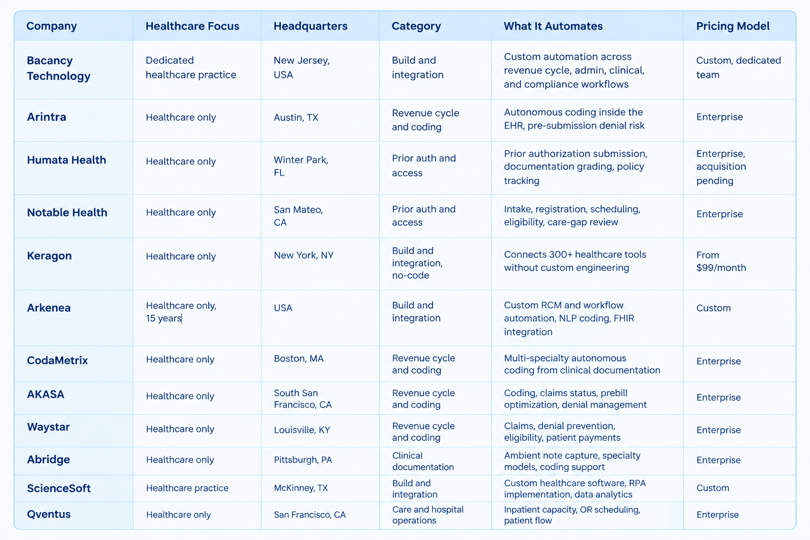
Compiled from published company information and independent industry reporting. Verify directly before shortlisting.
Most vendors here will not publish a rate, but the market does have prices. Procurement disclosures, published tiers, and independent cost guides give you real bands before you take a sales call.
One comparison is worth running before any of this. In-house billing costs most practices 8 to 12 percent of collections once salaries, benefits, software, and turnover are counted. When a platform quotes 5 percent, the question is not whether that is expensive. It is whether it beats what you already spend.
 Conclusion
Any of the twelve healthcare automation companies here can do serious work for the right organization, which is why the shortlist matters more than the order they appear in. A hospital losing revenue to denials and a twelve-provider practice drowning at the front desk need different vendors, and choosing well starts with naming your own problem before you look at anyone’s website. Once you know the category, you are comparing two or three companies rather than twelve, and you can get specific. Find out if the software completes the task or just leaves the final bit to your people. Don’t forget the fact that what you get has to integrate with all the other stuff you are using. That part usually decides whether automation pays for itself or quietly stalls.
What does a healthcare automation company do?
It removes repetitive work from healthcare operations: coding, prior authorization, patient intake, clinical notes, hospital capacity. Some sell software that does one job. Others build automation into the systems you already run.
What can actually be automated in a healthcare organization?
More than most teams assume. Claims processing, medical coding, denial management, payment posting, eligibility checks, prior authorization, patient intake and registration, appointment scheduling, clinical documentation, fax and document ingestion, remote monitoring alerts, and HIPAA audit trails.
Should we buy automation software or have it built?
Both, usually. Buy the commodity: coding, claims scrubbing, and clinical documentation are solved and priced accordingly. Build the part that is specific to you, and the layer connecting your tools to each other, which no vendor sells off the shelf.
What is the difference between RPA and workflow automation?
RPA clicks through screens like a person, so it works on older software with no API. Workflow automation connects systems directly through APIs, which runs faster and needs less upkeep. Most organizations use both.
How do these tools connect to Epic and Cerner?
Through FHIR and HL7 APIs, Epic’s App Orchard, or integration engines like Mirth Connect and Redox. Pre-built connectors cover standard cases. Anything beyond that needs engineering, which is where most automation projects actually stall.


Weight management research has changed significantly as scientists have gained a better understanding of the biological signals that regulate appetite, digestion, glucose metabolism, and energy …
Posted Sep 8, 2026 Physical Fitness
Connecting innovation decision makers to authoritative information, institutions, people and insights.

Medigy accurately delivers healthcare and technology information, news and insight from around the world.
Medigy surfaces the world's best crowdsourced health tech offerings with social interactions and peer reviews.
© 2026 Netspective Foundation, Inc. All Rights Reserved.
Built on Oct 21, 2026 at 5:05am