

Managing Editor
@ShahidNShah
@ShahidNShah
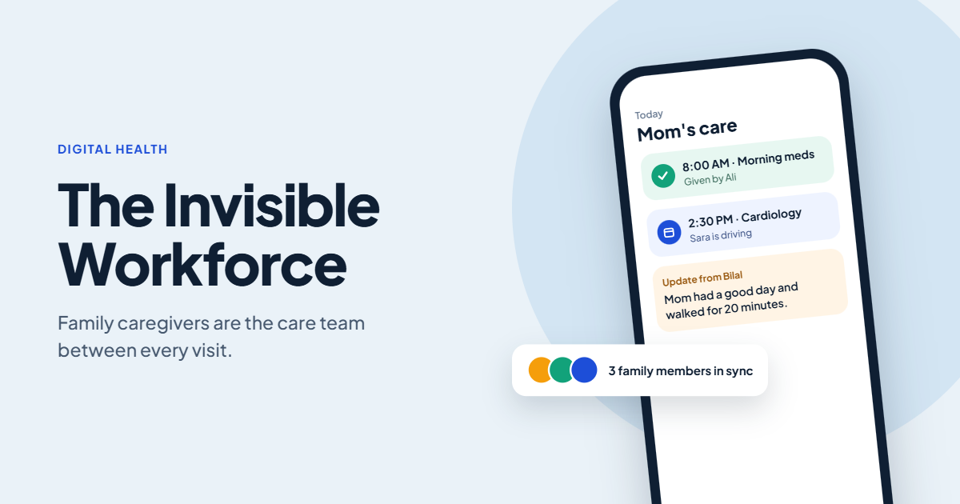
Every health system has a care team it never hires, never trained and never measures. They manage medications at the kitchen table. They drive patients to follow up visits. They catch the first signs of decline, and at 2 a.m., they decide whether a symptom is worth an ER call. They are family caregivers and for patients living with chronic illness, disability or advanced age, they are the ones who turn a discharge plan into an actual outcome.
Yet in most digital health roadmaps, caregivers remain an afterthought. Portals are built for patients, EHRs are built for clinicians and the daughter coordinating her father’s post-stroke recovery across three siblings is left juggling group texts, paper medication lists and sticky notes. For healthcare leaders evaluating digital innovation, closing this gap is one of the most practical, low-cost opportunities to improve outcomes, patient experience and value-based performance.
The numbers are hard to ignore. According to the Caregiving in the US 2025 report from AARP and the National Alliance for Caregiving, 63 million Americans, roughly one in four adults, now provide ongoing care to someone with a complex medical condition or disability. That is an increase of nearly 20 million people, or 45%, since 2015.
The work is also getting heavier. Nearly one in four caregivers now give 40 or more hours of care a week, effectively a second full time job. About 20% rate their own health as fair or poor because of caregiving and nearly half report at least one financial hit. Yet this unpaid workforce was worth about $600 billion in 2021, according to AARP’s Valuing the Invaluable analysis, more than all out-of-pocket health spending in the U.S. that year. If caregivers stepped back, health systems would feel it immediately.
Most failures in home-based care are not clinical. They are coordination failures that happen between visits, when no clinician is watching.
Policy is catching up. The CARE Act, now law in about 40 states and territories, requires hospitals to name, notify and train family caregivers before discharge and CMS’s GUIDE Model now pays for caregiver support in dementia care. The clear message is caregivers are part of the care team.
For healthcare leaders evaluating tools to recommend or integrate, caregiver apps should be judged on the same discipline applied to any digital health offering. No single app is perfect for every family which is why it helps to know what each does best.
Five criteria matter most:
Health systems do not need a large IT project to start. The caregivers are already there so a few practical steps are enough to meet them where they are. Follow up these:
Identify caregivers early: Record the caregiver in the EHR at admission, as CARE Act states already require, and confirm consent for information sharing.
Prescribe a tool at discharge: Add a vetted caregiver coordination app to discharge education just as you would a medication list or follow up appointment.
Train care navigators on the options: Case managers and social workers should know which app fits which family, whether the need is medication adherence, volunteer help or full coordination.
Measure what matters: Track readmissions, missed follow ups and caregiver strain for patients whose families use coordination tools, and share the results with peers.
Family caregivers already deliver much of America’s long term care and their numbers will keep growing as the population ages. Digital health innovation that ignores them leaves value on the table. By recognizing caregivers as part of the care team and equipping them with simple, secure coordination tools, healthcare organizations can strengthen transitions, reduce avoidable utilization and improve the experience of patients and families alike. The technology is ready and much of it is free. The only thing missing is the decision to make caregivers a deliberate part of your digital health strategy.


Sixty-one billion dollars. That is roughly what Americans lost to legal gambling in a single year, and a chunk of those losses landed on people who could not stop. Legal sports betting now runs in …
Posted Oct 22, 2026 Rehabilitation Addiction
Connecting innovation decision makers to authoritative information, institutions, people and insights.

Medigy accurately delivers healthcare and technology information, news and insight from around the world.
Medigy surfaces the world's best crowdsourced health tech offerings with social interactions and peer reviews.
© 2026 Netspective Foundation, Inc. All Rights Reserved.
Built on Oct 23, 2026 at 5:05am