

Managing Editor
@ShahidNShah
@ShahidNShah
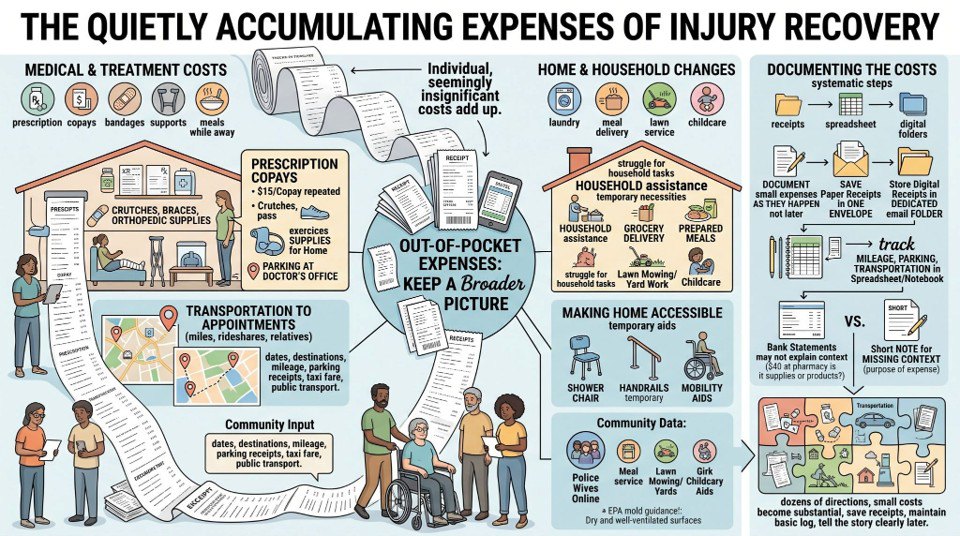
After a serious injury, the largest expenses tend to get the most attention. Hospital bills, surgery, rehabilitation, and lost income can quickly become major financial concerns. But there is another category of costs that often grows quietly in the background.
It might start with a $15 pharmacy copay. Then there’s parking at the doctor’s office, gas for another appointment, a brace ordered online, a rideshare because driving isn’t possible, and someone hired to mow the lawn during recovery.
Individually, none of these expenses may seem significant enough to worry about. Add them together over several weeks or months, however, and the total can be surprisingly large. That’s why keeping track of injury-related out-of-pocket expenses can provide a much more complete picture of what an accident actually costs.
The bill from a doctor or hospital is only one part of what someone may spend while recovering.
Prescription medications can require repeated copays. Depending on the injury, someone may need crutches, braces, bandages, orthopedic supports, or other medical equipment. Physical therapy or rehabilitation may involve supplies for exercises performed at home.
Even getting through the appointment itself can create smaller expenses. Hospitals and medical offices may charge for parking. Someone who spends hours away from home for treatment may need to purchase meals or other necessities along the way.
These costs can be particularly easy to overlook because they don’t necessarily arrive together. A major medical bill is obvious because one document may show thousands of dollars. Smaller expenses arrive individually and disappear into everyday spending.
But ten small purchases are still ten expenses. When each one exists because of the injury, keeping track of them can help show the broader financial effect of treatment and recovery.
Medical appointments don’t happen in your living room. Someone has to get there, and after an injury, transportation may not be as simple as getting into the car.
A person who cannot safely drive might rely on relatives, taxis, or rideshare services. Others may use public transportation. Even someone who can drive may make repeated trips to doctors, specialists, therapists, imaging centers, and pharmacies.
Those miles can add up. Some injuries require specialized treatment that isn’t available nearby. That can mean longer drives and, in unusual circumstances, lodging or other travel-related costs. The expense isn’t always purely financial either. Transportation can require substantial time from the injured person or family members helping with appointments.
Keeping a simple record can make the costs easier to reconstruct later. Dates, destinations, mileage, parking charges, rideshare receipts, and similar information create a clearer record than trying to remember months of medical travel after treatment has ended.
An injury can make ordinary household responsibilities surprisingly difficult. Someone with a shoulder injury may struggle to carry laundry or clean. A person recovering from a leg injury might be unable to mow the lawn, shovel snow, or handle other physical chores. Parents may need additional childcare because they can’t lift a young child or manage the usual routine.
Even preparing meals can become challenging during a difficult recovery. Grocery delivery, prepared meals, or temporary household assistance may suddenly become practical necessities rather than conveniences.
Other expenses may involve making the home easier to navigate. Depending on the injury, someone might purchase a shower chair, temporary handrails, mobility aids, or other accessibility items.
Not every injured person will encounter these costs, and the needs can vary enormously. That’s exactly why they should be tracked individually. The financial impact of an injury isn’t limited to treatment. Sometimes it includes paying other people to temporarily perform the everyday tasks the injured person previously handled themselves.
Nobody enjoys saving receipts, especially during an already stressful recovery. But documenting small expenses as they happen is much easier than trying to recreate them months later.
Paper receipts can be stored in one envelope or folder. Digital receipts can be saved in a dedicated email folder. A simple spreadsheet or notebook can track mileage, parking, transportation, and other costs that may not always generate traditional receipts.
Bank and credit card statements can also help, although they may not explain why a particular purchase was necessary. A $40 charge at a pharmacy doesn’t automatically show whether the money was spent on prescribed medical supplies or ordinary household products.
A short note can provide that missing context. The goal isn’t to obsessively record every penny spent during recovery. It’s to create a reasonable record of costs directly connected to the injury. Small expenses are easiest to dismiss individually. Good documentation allows them to be viewed together, where their true impact becomes much easier to see.
The cost of an injury rarely arrives as one neat total. Instead, expenses can accumulate from dozens of directions. There are medical bills and prescriptions, but there may also be transportation, parking, medical equipment, household assistance, childcare, meal delivery, accessibility products, and other costs created by temporary limitations.
A few dollars here and there may not seem worth tracking when someone is focused on recovering. Over a long period, however, those amounts can become substantial. The easiest solution is to begin documenting them early. Save receipts, maintain a basic mileage log, keep invoices, and add a short explanation when the purpose of an expense isn’t obvious.
Months later, memory may provide only a rough estimate of what recovery required. A folder full of receipts and a simple written record can tell the story much more clearly.
Sometimes the true financial impact isn’t hidden in one enormous bill. It’s scattered across all the smaller ones.


You tried the foam. Maybe the supplement your cousin recommended, possibly the shampoo that promised thickness. Some of it did nothing, some of it did something for a while, and none of it addressed …
Posted Aug 26, 2026 Dermatology
Connecting innovation decision makers to authoritative information, institutions, people and insights.

Medigy accurately delivers healthcare and technology information, news and insight from around the world.
Medigy surfaces the world's best crowdsourced health tech offerings with social interactions and peer reviews.
© 2026 Netspective Foundation, Inc. All Rights Reserved.
Built on Oct 8, 2026 at 6:09pm