

Managing Editor
@ShahidNShah
@ShahidNShah

The way people approach cosmetic care has changed a lot in the past few years. It used to be a pretty simple choice: Either you had surgery or you did not. But that line is getting blurry now, and in cities like San Diego, you can see it playing out in real time. Plastic surgery practices are expanding into med spa services, and this shift is not just about offering more treatments.
It is about keeping patients connected to their care long after a procedure is done. The model is smarter, more complete, and honestly, it makes a lot of sense for both patients and providers.
After a major procedure like a facelift or body contouring surgery, most patients are sent home with aftercare instructions and a follow-up appointment. But there is a long stretch of time between recovery and the point where results fully settle. During that window, patients often feel a little on their own. They might visit a random spa for a facial, not knowing whether the products being used are appropriate for post-surgical skin. That disconnect has real consequences.
Surgical practices offering a med spa in San Diego as part of their broader model solve this by keeping patients in a supervised, medically informed environment rather than leaving maintenance to chance. Surgical practices like Coastal Plastic Surgeons tend to structure their med spa services around a patient’s existing surgical history, using injectables, skin rejuvenation, and body sculpting treatments that are chosen with full knowledge of what has already been done. That is what separates a physician-led med spa from a standalone beauty clinic.
The numbers tell a clear story. According to the International Society of Aesthetic Plastic Surgery, non-surgical procedures reached 20.5 million globally in 2024, compared to 17.4 million surgical ones. Patients are not choosing between surgery and non-surgical care. They are doing both, at different stages of their lives and for different reasons.
Plastic surgeons who add med spa services are not chasing a trend. They are responding to what their existing patients are already asking for. Someone who had a rhinoplasty three years ago may now be interested in Botox or laser skin resurfacing. If their surgeon’s practice can provide that, there is no reason for them to go elsewhere. It keeps the relationship intact and ensures the treatments being offered are appropriate for that patient’s specific anatomy and history.
Not all med spas are created equal. In the United States, the ownership structure of medical spas varies widely, and according to the American Society of Plastic Surgeons, around 63% of med spas are owned by non-surgeons. That is not inherently a problem, but it does mean the level of clinical oversight differs significantly from place to place.
When a board-certified plastic surgeon is the medical director overseeing a med spa, the treatment approach is shaped by a much deeper understanding of facial anatomy, tissue behavior, and how different treatments interact with surgical results. A patient who has had a brow lift, for instance, needs a different injection strategy than someone who has never had surgery. That nuance matters. In practice, patients treated in surgeon-led med spas tend to receive more treatment plans built around each patient because the person overseeing their care has a fuller picture of their cosmetic history.
When a plastic surgery practice also runs a med spa, the surgeon has more options to work with during a consultation. A surgeon who only performs surgery can really only recommend surgery. But a surgeon who also has access to injectables, lasers, and skin treatments can look at a patient’s situation and recommend whatever actually makes the most sense, surgical or not.
That flexibility matters more than it might seem. Practices that offer both surgical and non-surgical care are less likely to push a patient toward a procedure they are not quite ready for, because there is always a reasonable next step at a lower level. That kind of honest guidance is what keeps patients coming back over time, and it is what sets a well-run integrated practice apart from one that depends entirely on bringing in new patients to stay busy.
The integration of med spa services into plastic surgery practices is not a gimmick. It reflects a more realistic picture of how patients actually experience cosmetic care: not as a single event, but as a long-term relationship with their results. When the same team that performed your surgery is also guiding your maintenance, your skin, your recovery, and your long-term goals all benefit from the same expertise. That is the kind of continuity that turns a good outcome into a lasting one.

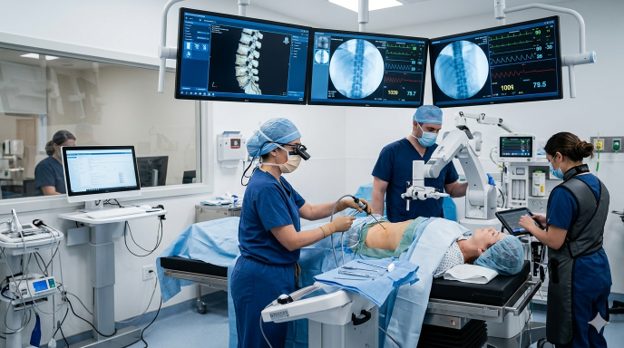
The modern ambulatory surgical center (ASC) operates on a razor-thin margin of time and resource allocation. As the healthcare landscape continues its decisive shift toward value-based care, facility …
Posted May 25, 2026 Patient Engagement Medical Devices
Connecting innovation decision makers to authoritative information, institutions, people and insights.

Medigy accurately delivers healthcare and technology information, news and insight from around the world.
Medigy surfaces the world's best crowdsourced health tech offerings with social interactions and peer reviews.
© 2026 Netspective Foundation, Inc. All Rights Reserved.
Built on Oct 18, 2026 at 6:05pm