

Managing Editor
@ShahidNShah
@ShahidNShah
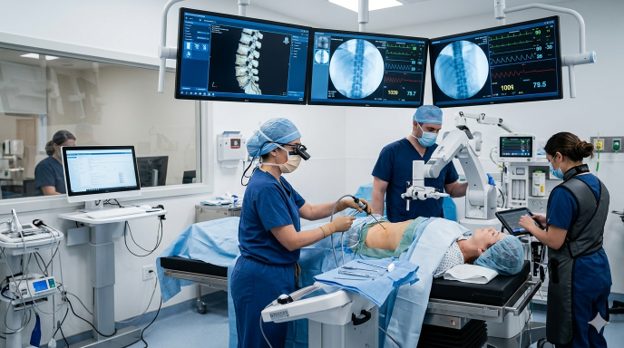
The modern ambulatory surgical center (ASC) operates on a razor-thin margin of time and resource allocation. As the healthcare landscape continues its decisive shift toward value-based care, facility administrators and clinical directors are under immense pressure to optimize throughput without compromising patient outcomes. Historically, spine surgery was viewed as an inherently high-risk, inpatient-dependent specialty, characterized by lengthy operative times, extensive collateral tissue damage, and prolonged postoperative monitoring.
However, the convergence of advanced endoscopic technology, targeted visualization systems, and specialized instrumentation has given rise to ultra-minimally invasive spine (UMIS) procedures. By utilizing incisions often smaller than a centimeter and disrupting minimal local anatomy, these techniques are doing more than advancing clinical outcomes and are fundamentally restructuring the operational architecture of outpatient healthcare facilities and altering the baseline of digital health integration.
To understand the systemic workflow benefits of UMIS, it is first necessary to differentiate these procedures from traditional open surgeries and early-generation minimally invasive spine (MIS) techniques. Traditional open spine surgery requires significant muscle stripping and retraction to achieve adequate visualization of the spinal pathology. This geometric exposure results in substantial ischemic tissue damage, pronounced postoperative pain, and a prolonged inflammatory response.
In contrast, ultra-minimally invasive protocols such as transforaminal or interlaminar endoscopic decompressions rely on a micro-sized working channel. Surgeons navigate through natural anatomical corridors, using high-definition endoscopes to achieve precise visualization. Instead of cutting or stripping paraspinal musculature, specialized dilators gently split the tissue fibers.
[Traditional Open Surgery] –> Extensive Muscle Stripping –> High Inflammatory Response –> Extended Recovery
[Ultra-Minimally Invasive] –> Natural Tissue Dilation –> Minimal Micro-Trauma –> Accelerated Discharge
Because the structural integrity of the spine is preserved and intraoperative bleeding is drastically mitigated, the systemic stress on the patient is minimized. Clinical data continuously show that adhering to these advanced endoscopic spinal protocols radically reduces immediate structural trauma. This reduction in micro-trauma alters the immediate postoperative trajectory, creating a cascading positive effect that extends from the operating table directly to the clinic’s administrative backend and hospital tech systems.
For clinic managers and hospital executives, the Post-Anesthesia Care Unit (PACU) is frequently an operational bottleneck. When a recovery bay is occupied longer than anticipated, it creates a downstream delay that stalls the entire surgical schedule, forcing subsequent patients to wait and driving up staff overtime costs.
Traditional spinal interventions demand aggressive general anesthesia regimes and heavy postoperative opioid titration to manage acute surgical pain. This dual burden frequently induces common recovery complications, including:
UMIS procedures challenge this standard. Because the localized trauma is minimal, many of these interventions can be performed under conscious sedation or targeted regional anesthesia blocks. According to data tracked across modern outpatient facilities, minimizing general anesthesia significantly alters immediate recovery metrics. Patients undergoing endoscopic procedures achieve stable hemodynamic criteria rapidly, often bypassing Phase I PACU requirements entirely.
When postoperative pain is managed via localized pathways rather than high-dose systemic opioids, the incidence of PONV and urinary retention drops. Consequently, the mean PACU length of stay decreases from several hours to a predictable, highly manageable window. This fluid transition directly prevents recovery bay congestion, allowing facility managers to maintain an uninterrupted velocity of patient movement throughout the day.
Surgical department profitability is inherently linked to the utilization efficiency of the operating room (OR). “Open-to-close” time involves far more than the duration of the primary incision; it encompasses patient positioning, intraoperative imaging setup, hardware prep, and the highly variable cleanup and sterilization cycles.
Ultra-minimally invasive spine procedures streamline these variables into highly predictable blocks. The specialized, compact instrumentation required for endoscopic spine surgery reduces the sheer volume of surgical trays that must be transported, opened, arranged, and subsequently broken down and sterilized.
| Metric / Stage | Traditional Open Spine Surgery | Ultra-Minimally Invasive Spine (UMIS) |
| Instrumentation Footprint | Multiple large trays, complex retractors | Compact, specialized endoscopic kits |
| Anesthesia Protocol | Standard general endotracheal anesthesia | Regional blocks / Conscious sedation options |
| Intraoperative Blood Loss | Moderate to high (requires monitoring/management) | Minimal to negligible |
| Average Phase I PACU Time | $120 – 180 \text{ minutes}$ | $30 – 60 \text{ minutes}$ |
| OR Room Turnover Complexity | High (extensive cleanup, multi-tray processing) | Low (rapid breakdown, standardized sterilization) |
Furthermore, because intraoperative blood loss is negligible during a UMIS procedure, the need for complex cell-saver setups, extensive suction monitoring, and intensive wound-closure protocols is eliminated. The surgical site is typically closed with a simple subcuticular suture and adhesive strips.
For scheduling coordinators, this predictability is invaluable. Traditional spine surgeries are notorious for schedule drift; a single case running 45 minutes over can derail a clinic’s entire afternoon line-up. The highly standardized, step-by-step nature of endoscopic visualization reduces intraoperative surprises, allowing administrators to construct tighter, more accurate daily schedules that maximize case volume without overworking clinical staff.
The true metric of success for an outpatient spinal program is the safe, efficient transition of the patient from the facility to their home environment. Extended monitoring protocols are mandatory when there is an elevated risk of delayed structural failure, hematoma formation, or unmanaged pain.
Because UMIS protocols maintain the structural stabilization mechanics of the spine and cause minimal vascular disruption, the risk of acute postoperative complications is markedly low. Peer-reviewed data evaluating post-op benchmarks indicate that patients consistently meet strict discharge criteria including independent ambulation and controlled pain scores within a fraction of the time required for open cohorts.
To further optimize this timeline, advanced facilities are shifting away from manual tracking. Instead, they are adapting the same digital principles used when engineering patient referrals to fix manual workflows, integrating customized tracking software to log milestones in real-time, matching physiological readiness with administrative clearance.
This accelerated timeline enables a “same-day discharge” model to function seamlessly. For the clinical workflow, this means:
The adoption of ultra-minimally invasive techniques aligns directly with the macro-trends currently shaping global healthcare infrastructure. Data published by the American Association of Neurological Surgeons (AANS) and tracked via biomedical indexes like PubMed highlight an accelerating migration of complex orthopedic and spine cases from traditional inpatient hospital beds to specialized ASC environments.
From an administrative standpoint, integrating a UMIS framework enhances a clinic’s competitive positioning. It transforms the facility into a high-throughput hub capable of managing complex pathology with low overhead. The rapid transition of patients through the pre-op, OR, and post-op pipelines increases the maximum daily capacity of the facility.
Furthermore, this operational efficiency directly impacts clinical satisfaction scores. Surgeons appreciate predictable schedules and minimized downtime between cases. Staff experience less burnout associated with chaotic, delayed shifts. Most importantly, patients receive a streamlined, modern healthcare experience that minimizes disruption to their lives, reinforcing the clinic’s reputation within the broader regional healthcare network.
Ultra-minimally invasive spine surgery represents far more than an incremental upgrade in surgical instrumentation; it serves as a catalyst for administrative and operational evolution within the modern clinic. By mitigating physiological trauma at the microscopic level, these advanced techniques dismantle the long-standing operational bottlenecks that have historically plagued outpatient spine care.
From predictable OR turnover times and decongested recovery bays to accelerated home-discharge protocols, UMIS redefines what is possible within value-based ambulatory care. As healthcare infrastructure continues to prioritize efficiency, scalability, and patient-centric metrics, the integration of ultra-minimally invasive workflows will remain a defining benchmark for leading digital clinics and surgical centers.
Author bio:
Elena Vance is a healthcare research consultant with over a decade of specialized experience analyzing clinical workflows, health informatics, and institutional operational efficiency. Her work focuses on the intersection of advanced surgical technologies and ambulatory facility management, helping modern healthcare networks optimize patient throughput and implement value-based care initiatives. She regularly contributes data-driven insights and strategic analyses to leading medical administration and digital health publications. Follow her on X @ElenaVance87409 for the latest updates on her recent publications.


For many patients, getting the right diagnosis can take years of appointments, conflicting opinions, and unanswered questions. Conditions like ADHD, thyroid disorders, chronic fatigue, anxiety, and …
Posted May 25, 2026 Artificial Intelligence Patient Engagement
Connecting innovation decision makers to authoritative information, institutions, people and insights.

Medigy accurately delivers healthcare and technology information, news and insight from around the world.
Medigy surfaces the world's best crowdsourced health tech offerings with social interactions and peer reviews.
© 2026 Netspective Foundation, Inc. All Rights Reserved.
Built on Oct 18, 2026 at 6:05pm