

Managing Editor
@ShahidNShah
@ShahidNShah
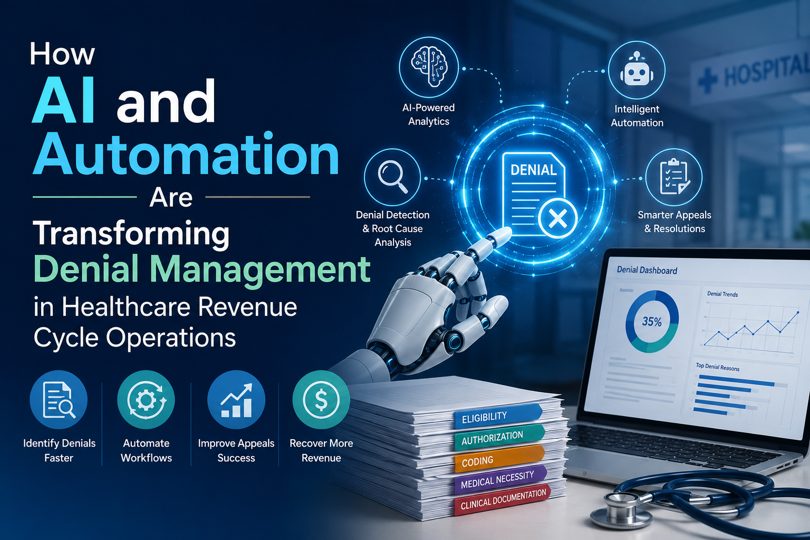
Claim denials remain one of the most persistent drains on healthcare organizations’ financial health. Every denied claim means delayed reimbursement, added administrative work, and in many cases, revenue that is never recovered at all. As payer rules grow more complex and claim volumes continue to rise, manual denial management processes are struggling to keep pace. This is where artificial intelligence and automation are stepping in, reshaping how healthcare organizations identify, prevent, and resolve denials across the revenue cycle.
Denial rates have been climbing steadily across the industry, driven by tightening payer policies, frequent coding updates, and increasingly strict documentation requirements. For many hospitals and physician practices, denials now represent a significant percentage of total claims submitted, and reworking each one consumes staff time that could otherwise go toward patient care or new revenue-generating activities.
Traditional denial management relies heavily on manual review: staff sort through denial codes, research root causes, gather documentation, and resubmit claims one at a time. This approach is slow, inconsistent, and prone to human error, especially when denial volumes spike or staffing is limited. It also tends to be reactive, addressing denials after they occur rather than preventing them in the first place.
Artificial intelligence changes the equation by shifting denial management from a reactive process to a proactive, data-driven one. Machine learning models can analyze historical claims data to detect patterns that predict which claims are likely to be denied before they are even submitted. This allows revenue cycle teams to correct errors upfront, whether that’s a missing modifier, an eligibility mismatch, or incomplete documentation, rather than waiting for a rejection to come back weeks later.
Natural language processing tools can also scan clinical documentation and payer correspondence to flag inconsistencies or missing information that commonly trigger denials. Combined with predictive analytics, these tools help prioritize which claims need the most attention, so staff spend their time on the cases with the highest financial impact rather than working through a backlog in the order it arrived.
For organizations looking to operationalize these capabilities without building an in-house data science team, many are turning to specialized AI-driven denial management services that combine predictive modeling, automated appeals generation, and root-cause analytics into a single workflow. These services can integrate with existing billing systems to flag high-risk claims in real time and automatically generate appeal documentation based on payer-specific requirements, cutting the time between denial and resolution significantly.
While AI focuses on intelligence and prediction, automation handles the repetitive, rules-based tasks that used to consume hours of staff time. Robotic process automation (RPA) can now handle claim status checks, denial categorization, and even routine appeal submissions without human intervention. This reduces the administrative burden on billing teams and shortens the overall revenue cycle timeline.
Automation is also transforming the front end of the revenue cycle, where many denials originate in the first place. Eligibility and authorization issues remain among the leading causes of denials, and catching these problems before a claim is even filed can eliminate a large share of preventable rework. Automated systems can verify coverage details, benefit limitations, and prior authorization requirements at the point of scheduling or registration. Many organizations now rely on automated patient insurance verification services to confirm eligibility in real time, flag coverage gaps, and reduce the volume of denials tied to registration errors before a claim ever reaches a payer.
Organizations that have adopted AI and automation into their denial management workflows are reporting measurable improvements across several areas:
Despite the clear advantages, implementing AI and automation in denial management isn’t without its challenges. Data quality is critical; predictive models are only as good as the historical claims data they’re trained on, and organizations with fragmented or inconsistent records may see limited accuracy at first. Integration with legacy billing and EHR systems can also require significant upfront investment and IT coordination. Additionally, payer rules change frequently, so models and automation rules need ongoing maintenance to stay effective rather than being treated as a one-time setup.
Staff training and change management matter just as much as the technology itself. Teams need to understand how to interpret AI-generated risk scores and recommendations, and workflows need to be redesigned around the new tools rather than simply layering automation on top of old processes.
As payer requirements continue to evolve and claim volumes grow, the gap between organizations using AI-powered denial management and those relying solely on manual processes is likely to widen. The next phase of this transformation will likely involve even tighter integration between clinical documentation, coding, and billing systems, allowing denial prevention to happen even earlier in the patient care journey. Organizations that invest now in predictive analytics, automated verification, and intelligent workflow tools are positioning themselves to recover more revenue, operate more efficiently, and reduce the administrative strain on their billing teams for years to come.
Denial management will never be entirely eliminated, but with the right combination of AI and automation, it can shift from being one of the revenue cycle’s biggest pain points to one of its most well-managed processes.


Many adults delay seeking mental health treatment because they are unsure what actually happens after making the first call. Questions about insurance, scheduling, time away from work, and whether …
Posted Jul 3, 2026 Mental Health
Connecting innovation decision makers to authoritative information, institutions, people and insights.

Medigy accurately delivers healthcare and technology information, news and insight from around the world.
Medigy surfaces the world's best crowdsourced health tech offerings with social interactions and peer reviews.
© 2026 Netspective Foundation, Inc. All Rights Reserved.
Built on Oct 16, 2026 at 6:05pm