

Managing Editor
@ShahidNShah
@ShahidNShah

Immunotherapy’s proven role in breast cancer is narrower than people often expect. Checkpoint inhibitors such as pembrolizumab have an established place in selected triple-negative breast cancer (TNBC), a subtype that does not respond to hormone-blocking or HER2-targeted drugs.
This guide covers where immunotherapy fits, what the research shows and what remains experimental. International patients can find more detail through Treatment in Germany.
Breast cancer is not one disease. Tumors are tested for estrogen receptors (ER), progesterone receptors (PR) and HER2, and the results largely decide which drugs apply:
The immune system has built-in brakes that stop it from attacking the body’s own cells. Some tumors take advantage of one of these brakes. Cancer cells, and immune cells around them, can carry a protein called PD-L1 that attaches to PD-1, a receptor on T cells, and switches those T cells off.
For pembrolizumab-based treatment of metastatic TNBC, the tumor is tested for PD-L1, and the result is reported as a combined positive score, or CPS, a measure of PD-L1 on tumor cells and nearby immune cells.
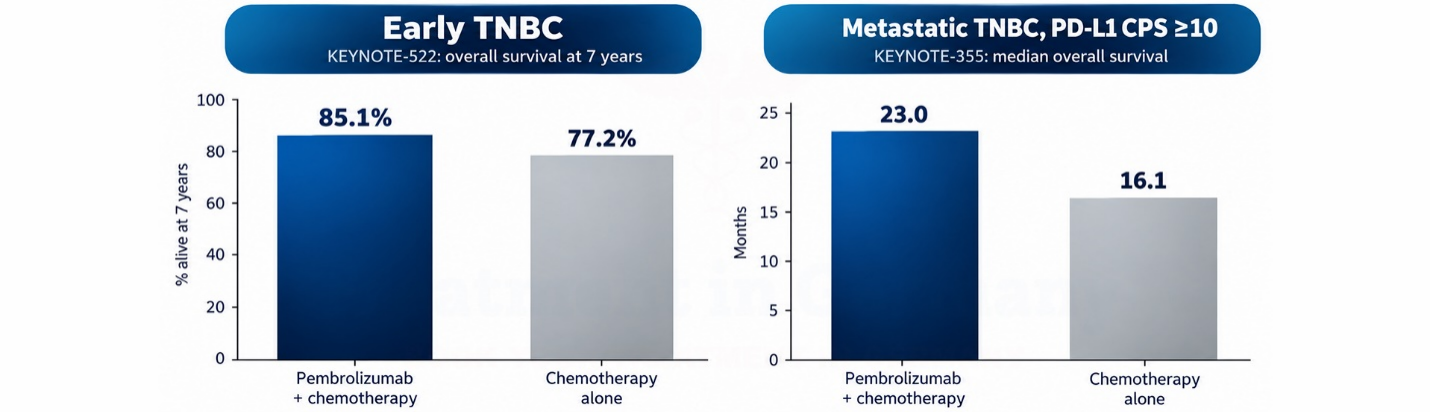
For high-risk early-stage or locally advanced TNBC, pembrolizumab is generally given with chemotherapy before surgery, then continued alone afterward. This was tested in KEYNOTE-522, a phase 3 trial with a median follow-up of 7.8 years.
For locally recurrent unresectable or metastatic TNBC, pembrolizumab combined with chemotherapy can be used as a first treatment in eligible patients.
Sacituzumab govitecan is an antibody-drug conjugate that delivers a chemotherapy drug to cells carrying the Trop-2 protein. In this regimen it replaces the chemotherapy partner, while pembrolizumab continues. This approval is based on a separate trial, ASCENT-04, so its results should not be compared directly with KEYNOTE-355.
A wider view of these options in Germany is available in this guide to immunotherapy for breast cancer in Germany.

Releasing the immune system’s brake can let it affect healthy tissue, not only the tumor. These reactions can appear during or months after treatment.
Many immune-related reactions can be managed when recognized early, often by pausing treatment and using corticosteroids or other organ-specific treatment. Some complications can be serious or permanent. People with an active autoimmune disease or an organ transplant need individual assessment before treatment.
Report any new or worsening symptom to the treating team promptly, even after treatment ends. Severe or rapidly worsening symptoms, especially breathing difficulty, need urgent assessment, not a routine appointment. Symptoms to watch for include:
Treatments are tested in stages. Early trials mainly assess safety and initial activity, while larger randomized trials test whether a treatment improves outcomes compared with standard care. Phase 3 trials often provide the confirmatory evidence used for regulatory decisions, but some treatments can be authorized on earlier evidence when the benefit-risk balance is favorable.
Questions worth asking the treating team:
The table below summarizes where each approach stands.

Checkpoint inhibitor immunotherapy has an established role in selected TNBC settings. In early-stage disease, pembrolizumab is used with chemotherapy before surgery and continued afterward; in eligible metastatic disease, pembrolizumab is combined with chemotherapy, or with sacituzumab govitecan, as first treatment. Other approaches remain under study.


A hospital cannot approach cleaning in the same way as an ordinary office. Patients may be recovering from surgery, receiving treatment for serious conditions, or have weakened immune systems. Staff …
Posted Oct 5, 2026 Hospitals, Special
Connecting innovation decision makers to authoritative information, institutions, people and insights.

Medigy accurately delivers healthcare and technology information, news and insight from around the world.
Medigy surfaces the world's best crowdsourced health tech offerings with social interactions and peer reviews.
© 2026 Netspective Foundation, Inc. All Rights Reserved.
Built on Oct 6, 2026 at 5:35pm