

Managing Editor
@ShahidNShah
@ShahidNShah

RadarOpus has been the backbone of homeopathic case analysis since the 1980s, and its Synthesis repertory remains a gold standard in the field. But legacy status comes with legacy baggage, desktop installations, dealer-negotiated pricing, and licensing models that feel out of step with how clinics actually work today.
Modern practices want browser access, AI-assisted workflows, and pricing they can see without emailing a sales rep. This list ranks the top RadarOpus alternatives for 2026 based on cloud accessibility, pricing transparency, and AI capability, starting with Similia, the top pick for practices that want a fully browser-based, AI-powered workflow without the setup friction of legacy software.
Not every alternative solves the same problems. Before comparing specific tools, it helps to know which features actually move the needle for a modern practice.
Repertorization functionality is non-negotiable, you need comprehensive repertories, rubric search, and filtering that goes beyond simple keyword matching. Patient management matters just as much; RadarOpus markets itself as the only legacy program with full HIPAA/GDPR compliance, but modern cloud platforms now match or exceed that standard with encryption in transit and at rest.
Then there’s the cloud-versus-desktop question. CurenexAI has flagged desktop dependency as the number one reason practitioners go looking for alternatives, nobody wants to be stuck at one workstation when a patient calls on a Sunday. AI capability separates the newer tools from the old guard too: some platforms still rely purely on keyword-based lookup, while others offer semantic search or case-analysis assistance.
Pricing model is the final piece. RadarOpus, Synergy, and Hompath require large one-time purchases or dealer-negotiated deals, while Complete Dynamics only offers rental access. Support quality, free trials, video libraries, live webinars, rounds out the checklist.
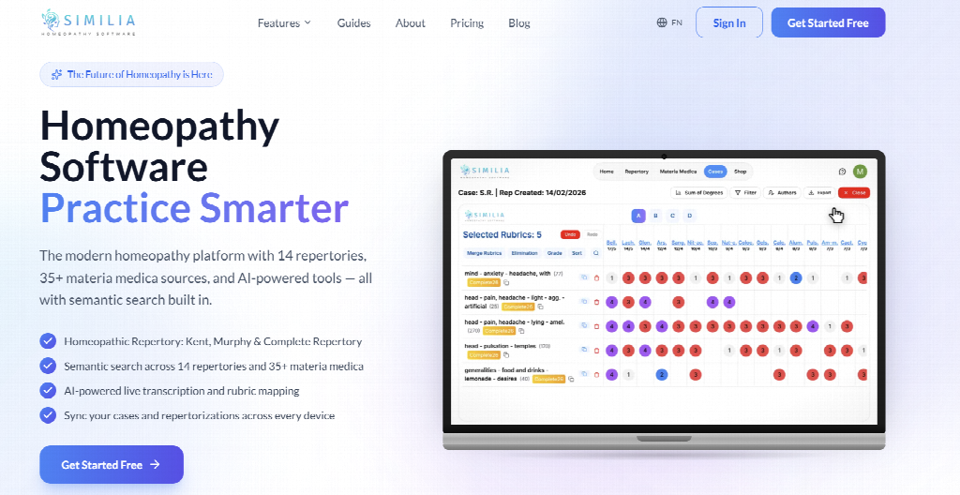
Similia tops this list because it solves the exact problem most RadarOpus users complain about: being tied to one installed license. It’s fully cloud-based and runs on any browser or device, desktop, tablet, or phone, with a Progressive Web App option that skips installation entirely.
On repertory depth, Similia doesn’t cut corners to stay lightweight. It includes 14 repertories (Kent, Boericke, Boenninghausen, Hering, Boger, Ward, Roberts, Murphy, Complete Repertory, and Saine among them), plus 35+ materia medica sources covering more than 3,000 remedies. What sets it apart is semantic search, practitioners can search rubrics using everyday clinical language instead of hunting for the exact classical term. None of RadarOpus, Synergy, Hompath, Miccant, or Complete Dynamics offer this.
Similia’s AI toolkit goes further than search. It includes live consultation transcription, automatic symptom extraction, AI-assisted photo and notes analysis, and smart rubric mapping, all designed to support clinical judgment, not replace it.
Pricing is where the contrast with legacy tools gets stark. The free tier includes 7 classical repertories, 21 materia medica books, AI semantic search, and 3 cases plus 3 analyses per month, no credit card required. Pro tiers start at roughly €22–25/month with a 14-day free trial. Compare that to Synergy’s $2,000 entry package or Hompath’s $1,500 starting price, and the gap in accessibility becomes obvious.
Similia has built trust with over 4,000 practitioners and collaborations with respected names in the field, including André Saine, Jan Scholten, Robin Murphy, Roger van Zandvoort, Jeremy Sherr, and Frans Vermeulen. Security-wise, it uses encryption in transit and at rest, authenticated access, and granular consent controls for AI processing.
Best for: Practices wanting a modern, subscription-friendly, AI-assisted alternative that syncs across devices without sacrificing classical repertory depth. You can explore the free repertory tools or check the pricing breakdown directly.
CurenexAI positions itself as an AI-first, browser-based alternative to RadarOpus, built around RAG-based diagnosis support, lab report analysis, and a “Dermo AI” tool for skin-image review. It’s currently free during its beta period and includes built-in patient records with a consultation timeline.
The catch: as a newer platform, its proprietary repertory library still lacks the depth of more established players. It’s a strong pick if AI-driven case reasoning and lab-integration matter more to you than repertory breadth — but not yet a full repertorization replacement.
Best for: Clinics prioritizing AI-driven case reasoning and lab-report integration over classical repertory depth.
Synergy is desktop software built around the Reliable Repertory, with support for Kent and Boericke sources and access to 989+ materia medica books. It’s a serious tool, but it comes with a serious price tag: the foundation package starts at $2,000 USD, with a discounted $100 USD yearly package for students.
There’s a 15-day free trial and ticketing-based tech support, plus compatibility with legacy MacRepertory setups. The tradeoff most users report is a steep learning curve paired with that high upfront cost.
Hompath Zomeo takes a mobile-first approach, designed for tablets and smartphones but browser-accessible too, and ships with 1,300+ materia medica books alongside repertories like Kent, Boenninghausen, and Boger. The basic package starts at $1,500 USD, with a 30-day trial that limits available features.
New users often find the feature set overwhelming at first, and the software demands significant memory and storage on the device running it.
Complete Dynamics runs on a subscription/rental-only model, there’s no ownership option, and it’s built entirely around the Complete Repertory by Roger van Zandvoort. It includes only 40 materia medica books, a fraction of what competitors offer.
It supports offline use and keeps its interface simple, which makes it a reasonable fit for students or beginners rather than practitioners running complex case analysis. Training resources are thin, the homepage lists just one tutorial video.
Miccant Vision is own-only (no rental path) and stands out for its highly customizable interface and in-depth remedy relationship mapping, showing complementary and antagonistic remedies at a glance.
The downside is a smaller online presence, limited tutorials, and a learning curve tied directly to how much you want to customize it.
| Feature | Similia | CurenexAI | Synergy | Hompath Zomeo | Complete Dynamics | Miccant Vision |
| Cloud vs. Desktop | Cloud/PWA | Cloud | Desktop | Mobile-first/browser | Desktop (offline supported) | Desktop |
| AI Features | Semantic search, transcription, photo/notes AI | RAG diagnosis, lab & skin analysis | None | None | None | None |
| Repertories/MM Sources | 14 repertories, 35+ MM | Proprietary (limited) | Reliable Repertory, 989+ MM | Kent, Boenninghausen, Boger, 1,300+ MM | Complete Repertory, 40 MM | Custom set |
| Starting Price | Free tier / ~€22–25/mo | Free (beta) | $2,000 USD | $1,500 USD | Subscription-only | Purchase only |
| Free Trial | 14 days (Pro) | Free beta | 15 days | 30 days (limited) | N/A | N/A |
| Device Sync | Yes (all devices) | Yes | No | Limited | No | No |
Yes. Similia’s free tier includes 7 classical repertories, 21 materia medica books, AI semantic search, and 3 cases plus 3 analyses per month, with no credit card required. CurenexAI is also free during its current beta phase, though its repertory library is still developing.
Similia leads here with AI semantic search, live consultation transcription, and photo/notes analysis. CurenexAI also uses AI, focused on RAG-based diagnosis support and lab-report review.
With Similia, yes — its Progressive Web App and full browser access mean no installation is required on any device. RadarOpus offers a companion app called Opus Go, but it has limited repertorization features compared to the full desktop program.
Similia is the strongest cloud-first pick, thanks to multi-device sync, AI tools, and a genuinely usable free tier that scales into paid plans as a practice grows.
Synergy starts at $2,000 USD, Hompath Zomeo at $1,500 USD, and Complete Dynamics is subscription-only with no ownership path. Similia starts free and its Pro plans run roughly €22–25/month with a 14-day trial — a fundamentally different pricing philosophy than the legacy, dealer-negotiated model.
RadarOpus earned its reputation over four decades, and the Synthesis repertory isn’t going anywhere. But for practices that want cloud access, transparent pricing, and AI tools built into daily workflow, the alternatives on this list — especially Similia — deliver what modern clinics are actually asking for.
If you’re evaluating options, start with a platform that lets you test real repertory depth before committing financially. Similia’s free tier is the lowest-risk way to see whether a cloud-first, AI-assisted workflow fits how your practice actually runs.


Starting a business can be exciting, but excitement alone does not make the early stages easy. New owners must make decisions about hiring, operations, marketing, client acquisition, financial …
Posted Sep 18, 2026 Nursing Care
Connecting innovation decision makers to authoritative information, institutions, people and insights.

Medigy accurately delivers healthcare and technology information, news and insight from around the world.
Medigy surfaces the world's best crowdsourced health tech offerings with social interactions and peer reviews.
© 2026 Netspective Foundation, Inc. All Rights Reserved.
Built on Oct 10, 2026 at 6:05pm