

Managing Editor
@ShahidNShah
@ShahidNShah

Every AI receptionist vendor puts “HIPAA compliant” on its homepage. They do not mean the same thing by it. Some sign a BAA on every plan by default. Others treat healthcare as a separate product line entirely, built around EHR write-back and clinical vocabulary rather than added on top of a general phone system.
All five platforms below serve medical practices, but they differ sharply in scope, in what their compliance coverage actually includes and in who they are built for. Some are healthcare-only companies focused entirely on medical reception. Others bundle the receptionist into a wider clinical suite, or run healthcare as one product line inside a platform that also serves other industries.

Central AI runs a medical services line inside a wider business platform trusted by more than 1,000 businesses across industries. It answers patient calls 24/7/365, handling appointment booking and routine intake questions.
Escalation works differently from the healthcare-only platforms here. When the AI cannot answer or a caller asks for a person, Central hands off to your virtual receptionist, and only when that receptionist is available. Confirm after-hours coverage before relying on it for urgent calls.
Setup is built around speed. Central trains itself from a practice’s existing website and uploaded documents, crawling linked URLs and ingesting PDFs, Word files and Markdown, with no custom implementation project. The platform reports going live in under ten minutes.
Scheduling runs through calendar and booking tools rather than direct EHR write-back. Published integrations include Cal.com, Calendly, Acuity and SimplePractice, alongside 8,000-plus apps overall. A practice running Epic or athenahealth should confirm the integration path before committing.
Central publishes HIPAA, SOC 2 Type 1 and ISO 27001 badges, and every call is logged to a dashboard with a written summary. Worth noting the SOC 2 attestation is Type 1 rather than Type II, which covers controls at a point in time rather than across a period.
On the operational side, Central speaks over 30 languages natively, includes a free built-in CRM and offers voice customization for accent and tone.
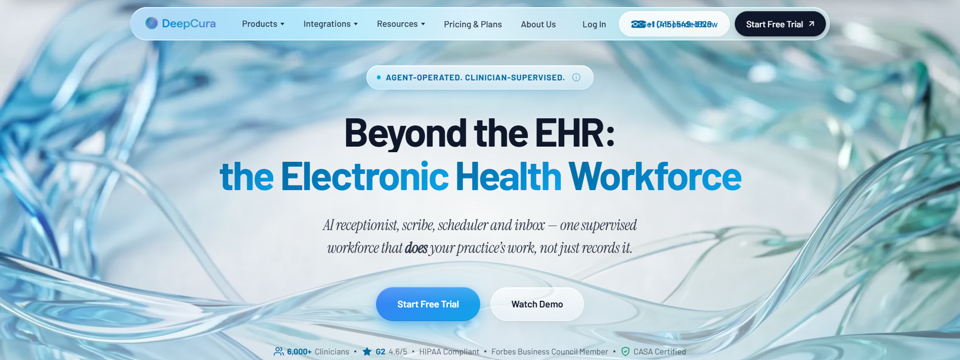
DeepCura bundles its AI receptionist alongside seven other clinical agents on one platform, including an ambient scribe and automated billing, at $129 a month per provider with volume discounts starting at three seats. Every plan includes a signed BAA, and the receptionist writes directly into seven EHR systems, including Epic, athenahealth, eClinicalWorks, and AdvancedMD, at no separate integration cost.
Its standout detail is a mid-call SMS fallback: when voice recognition struggles with a medication name or member ID, the receptionist texts the patient a secure link to complete that field rather than guessing.
Call audio is not stored after note generation and the platform states patient data is not used to train its underlying models.
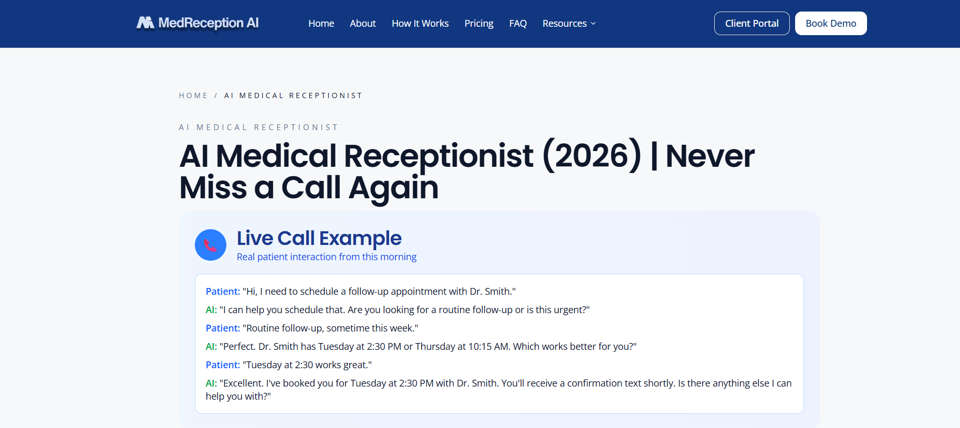
MedReception.ai takes a narrower approach than DeepCura, focused on reception rather than a bundled clinical suite, and built specifically by physicians. It signs a BAA for US practices and extends compliance mapping to Canada, aligning with PIPEDA and PHIPA, and Australia, aligning with the Privacy Act, which matters for any multi-country group.
Three named AI agents split the work: one handles live answering and routing, one flags urgent or STAT calls for immediate escalation, and one transcribes voicemail into a sorted queue each morning.
Pricing runs from roughly $495 to $1,495 a month across three tiers based on call minutes, and it integrates with nine EHR and practice management systems.

Sully.ai treats the receptionist as one part of a modular AI staffing platform that also includes a scribe, a triage nurse, a medical coder and an interpreter, all operating under a shared BAA. The platform holds SOC 2 Type II and ISO 27001 attestations, with encryption in transit and at rest and role-based access controls layered on top.
It connects with Epic and other major EHR systems and is used by more than 400 healthcare organizations by the company’s own count.
The modular structure suits practices planning to expand AI adoption across multiple roles over time. Pilots typically run two to three weeks and pricing is quoted per organization.

Greetmate is built as voice AI infrastructure for healthcare operations rather than a single-clinic point solution, aimed at multi-location provider groups needing consistent call handling across every site. It reads from and writes to a practice’s EHR, connecting with more than 300 systems including Epic, athenahealth, ModMed, Tebra and eClinicalWorks.
A no-code workflow builder lets a group standardize intake, scheduling and after-hours coverage once, then deploy that same workflow across new locations rather than rebuilding it site by site.
HIPAA-ready use is available with a signed BAA and the platform reports response latency under 500 milliseconds. Pricing is not publicly listed and requires contacting sales.
| Central AI | DeepCura | MedReception.ai | Sully.ai | Greetmate | |
| EHR integration | Major EMR and EHR systems, none named | Seven systems, direct write-back | Nine EHR and PM systems | Epic and other major systems | 300-plus systems |
| Scope | Receptionist inside a wider business platform | Receptionist plus seven clinical agents | Reception only | Modular AI staff | Multi-location infrastructure |
| Setup | Self-serve, trains from website | Standard onboarding | Tiered by call minutes | Two to three week pilot | No-code workflow builder |
| Best for | Practices wanting fast setup without IT support | Intake-heavy clinical workflow | Multi-country groups | Phased AI adoption | Multi-location provider groups |
| Central AI | DeepCura | MedReception.ai | Sully.ai | Greetmate | |
| Published price | Not published | $129 per provider per month | $495 to $1,495 per month | Quoted per organization | Not published |
| EHR integration | Via calendar and booking tools, no direct write-back | Seven systems, direct write-back | Nine EHR and PM systems | Epic and other major systems | 300-plus systems |
| Scope | Receptionist inside a wider business platform | Receptionist plus seven clinical agents | Reception only | Modular AI staff | Multi-location infrastructure |
| Setup | Self-serve, trains from website | Standard onboarding | Tiered by call minutes | Two to three week pilot | No-code workflow builder |
| Best for | Practices wanting fast setup without IT support | Intake-heavy clinical workflow | Multi-country groups | Phased AI adoption | Multi-location provider groups |
The question most comparisons skip is not whether a vendor offers a BAA but what it costs and which tier it sits on.
Across the wider category, the same legal document ranges from included at no charge on entry plans, to a separate monthly add-on, to something only available on enterprise contracts priced in the tens of thousands annually. A platform advertising a low headline price that gates HIPAA coverage behind an enterprise tier is not an inexpensive option for a medical practice. It is an option that does not apply.
Two consequences follow. First, compare vendors at the tier where the BAA actually attaches, not at their advertised entry price. Second, check whether the capabilities a medical receptionist genuinely needs, meaning appointment scheduling and warm transfer to a human, sit on that same tier. Some platforms gate both behind the same enterprise plan as the BAA.
Most comparisons stop at whether a vendor offers a BAA. The more useful question is what that BAA covers, and that question runs across the whole digital patient journey rather than the phone call alone.
A signed agreement that protects only the core voice platform, while call recordings, transcripts or text logs sit outside its scope, still leaves a practice exposed exactly where a compliance review would look first.
Subprocessors are the second detail worth asking about. Nearly every AI receptionist relies on at least one third-party layer underneath it, whether that is the language model generating responses, the text-to-speech engine or the telephony carrier. A BAA covering the vendor but not flowing down to every subprocessor leaves a genuine gap.
This sits inside a broader shift in how practices handle patient communication, without replacing the judgment calls that still need a clinician.
There is no official government HIPAA certification for any vendor. What exists instead is a set of documented safeguards and a signed contract, which is why the following matters more than the badge on a homepage.
There is no single best HIPAA compliant AI receptionist. The right fit depends on call volume, how much implementation work a practice can absorb and whether the priority is clinical depth or speed to a working system.
DeepCura and MedReception.ai suit practices wanting clinical workflow depth and direct EHR write-back. Sully.ai fits organizations planning phased AI adoption across several roles. Greetmate is built for multi-location groups needing one call-handling standard everywhere.
Central AI offers the fastest self-serve route to a working receptionist, with setup driven by a practice’s own website rather than an implementation project.
Whichever platform fits, getting the actual BAA in writing and confirming exactly what it covers is the one step worth treating as non-negotiable before a single patient call goes through.
No. HIPAA compliance depends on a signed Business Associate Agreement, documented encryption standards, and access controls, not a label on a vendor’s marketing page. Always request the actual BAA and review what it specifically covers, since some agreements protect only the core platform and exclude call recordings or transcripts.
This varies by vendor. DeepCura includes write-back to seven EHR systems at no separate integration cost, and MedReception.ai integrates with nine EHR and practice management systems inside its standard tiers. Central AI connects through calendar and booking tools rather than direct EHR write-back, so confirm the path for your own system before signing.
Setup speed ranges widely, from same-day for platforms trained directly on a practice’s existing website content, like Central, to two or three weeks for a Sully.ai pilot, up to several weeks for deeper Epic-integrated deployments through DeepCura or MedReception.ai.
Yes, though the triggers and the speed of that handoff vary by vendor. MedReception.ai explicitly flags urgent or STAT calls through a dedicated agent. Central AI escalates when the AI cannot answer or the caller asks for a person, connecting only when your virtual receptionist is available, which makes after-hours coverage worth confirming directly.


Language access in dentistry is usually treated as a front-desk problem: a bilingual receptionist, a phone interpreter line, maybe a translated intake form. Once the patient reaches the operatory, …
Posted Sep 3, 2026 Dental Care Dentistry
Connecting innovation decision makers to authoritative information, institutions, people and insights.

Medigy accurately delivers healthcare and technology information, news and insight from around the world.
Medigy surfaces the world's best crowdsourced health tech offerings with social interactions and peer reviews.
© 2026 Netspective Foundation, Inc. All Rights Reserved.
Built on Oct 16, 2026 at 5:05am