

Managing Editor
@ShahidNShah
@ShahidNShah
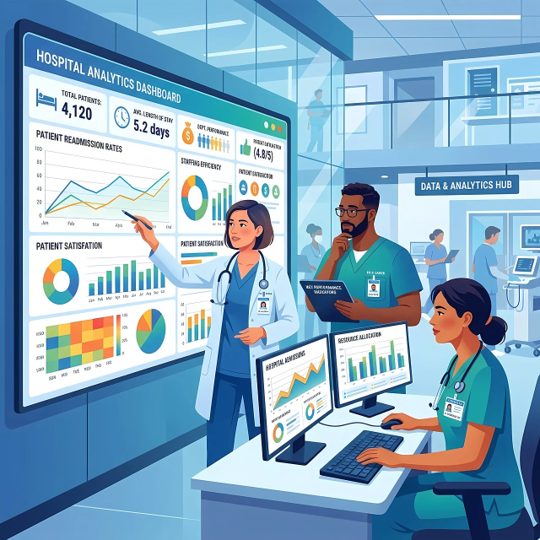
There is no lack of data in the sphere of healthcare organizations. They need to manage their data.
The volume of data that can be obtained each day using EHRs, remote patient monitoring tools, labs, patient portals, and other digital health instruments is huge. Still, this data is fragmented, making it hard for hospitals to get the picture about their activities and clinical practice.
Considering the current trend in healthcare related to analytics and decision-making based on machine learning, the demand for new technologies capable of unifying fragmented data sources without breaking regulatory compliance standards arises. Now, let us have a detailed look at the healthcare analytics area in 2026.
Information about the health sector is no longer limited to EHRs alone. Today’s organizations collect data from remote monitoring systems, imaging systems, pharmacies, laboratories, wearable devices, and digital health applications.
The issue here is not just about handling vast amounts of information but making it all available and putting it together quickly enough for decision-making purposes. Hospital managers require predictive analytics that will help them forecast the load in the emergency room as well as predict the required staff and beds.
Many organizations adopted analytics through platforms such as Tableau or Microsoft Power BI. While effective for general reporting, they were not designed to interpret medical taxonomies, patient encounters, and clinical relationships.
Healthcare also requires strict security segmentation. Physicians, researchers, and administrators may work from the same dataset while needing different access privileges. Standard SaaS pipelines often struggle with HIPAA requirements, patient privacy protections, and PHI management, forcing organizations to build extensive custom controls.
Healthcare CIOs and data architects face a crowded technology market. The goal of this guide is to provide an objective view of the healthcare analytics infrastructure available in 2026 and the enterprise models supporting long-term scalability.
Interoperability remains one of healthcare’s biggest technical obstacles.
Modern platforms must parse Fast Healthcare Interoperability Resources (FHIR) JSON structures natively without performance degradation while continuing to support legacy
HL7 v2 messaging. Since many hospitals operate with both standards, moving data into cloud warehouses often creates transformation bottlenecks.
Healthcare-specific platforms reduce these challenges by supporting FHIR and HL7 workflows together, minimizing the engineering effort required to standardize information.
Duplication of patient records can adversely affect predictive analysis models and the reporting process.
Individuals normally visit different healthcare professionals for treatment, which results in distinct identities for each. Contemporary technologies use approaches such as deterministic record matching, probabilistic identity matching, Master Patient Indexing, and entity disambiguation to avoid identity collisions.
It is important that these analytics platforms offer solutions where health data is made secure yet accessible to people who need to access this data.
There are some really good analytics platforms that provide row level security, PHI dynamic masking, audit trails, and access controls. In the cloud environment, Business Associate Agreements, Multi-Tenant Governance, and Compliance Management are necessary requirements.
The popularity of Epic Cosmos and Oracle Cerner Millennium Analytics comes from their capability of integrating seamlessly into the current clinical processes.
The strengths of the two software include seamless workflow integration and easy configuration. The weaknesses of the two software are that they lead to vendor lock-in and have difficulty integrating with remote monitoring systems.
The Snowflake Data Cloud for Healthcare and Google Cloud BigQuery for Life Sciences offer the required scalability for enterprise-level analytics and deep learning.
Flexibility is achieved at a price; there will be a need to create custom dashboards, semantic models, governance systems, and interoperability layers to derive value from them.
One increasingly popular aspect of the healthcare analytics market deals with creating a linkage between sophisticated medical systems and today’s data platforms, without the need for significant custom coding.
While these products do not replace legacy systems, their main function is to serve as an intermediary between EHR systems, lab systems, imaging systems, billing applications, and analytics platforms. They facilitate the proper formatting of data for subsequent use by reporting tools, data warehousing platforms, or AI models.
More and more hospitals are opting to implement advanced data infrastructure models like LightTrail in order to eliminate complexities associated with the transformation of medical data. With these architectures, medical information from different sources, including clinical notes and structured data in billing platforms, can be unified into a centralized location for various purposes, such as enterprise reporting, population health, and analytics.
Those healthcare systems that want maximum flexibility but at the same time independence from the proprietary system of one vendor will find this strategy particularly appealing.
Analytics investment by healthcare providers enhances not only efficiency but also the quality of their performance. In fact, the best programs unite these two goals into one.
Analytics for operations assists hospitals in handling fluctuating patient loads.
For example, using predictive algorithms, one can calculate when there will be an influx of patients in the ED so that the proper nurse-to-patient ratios can be adjusted. This will allow one to optimize surgical scheduling and supply chain management through better asset tracking.
These capabilities reduce operational bottlenecks while improving patient care.
There is a growing reliance on clinical quality initiatives on accurate data.
Predictive analytics can be employed to determine whether a patient might be at a greater risk of readmission even before discharging the patient from a healthcare facility.
Additionally, the analytics system automates reporting of value-based care agreements and Medicare payment programs.
Today’s population health interventions go far beyond simple clinical records.
Data analytics tools analyze not only clinical but also demographic and socio-economic data, which can be used to categorize the patient population and establish the social determinants of health. Sometimes the lack of transportation, unstable living conditions, and availability of healthcare are even more important than clinical factors.These insights also support quality improvement and value-based care initiatives aligned with programs such as the CMS Quality Payment Program (QPP), which emphasizes measurable improvements in patient care and population health management.
Selecting an analytics platform requires balancing technical aspects against business aspects.
It is important to determine whether the problem of data silos stems from technical problems, non-integration of systems, or vendor limitations.
For some healthcare organizations, near-real-time streaming will be required, whereas for other organizations, scheduling will suffice. Using technology in line with organizational needs will keep future costs down.
Healthcare decision-makers must determine if an internal team will be able to develop a custom pipeline using the cloud or if it would be better to use a semantic layer that is specific to healthcare.
The cost of licensing is just one of many different expenses associated with long-term costs of cloud computing. Other costs include cloud egress, API usage, engineering, governance, and auditing costs.
Secure, LLM-driven natural language queries for better interaction with the operations data are being looked at by the healthcare industry.
The use of synthetic patient data is gaining popularity owing to its ability to enable testing, modeling, and software validation while protecting patient privacy.
In federated learning, health facilities are able to collaborate on research without exposing sensitive patient information outside their own servers.
This is done through collaboration in modeling outputs, rather than data, thus ensuring regulatory compliance and data privacy.
Analytics in healthcare in 2026 will need more than reporting capabilities. The key lies in finding the right balance between interoperability, patient identification, governance, and stringent data compliance along with flexible engineering architectures.
Companies who invest in laying the right foundations will find themselves well equipped for the next stage of healthcare analytics and artificial intelligence efforts.
Data-driven teams within the health space should consider going past old-style technologies and assess how information flows within their companies.
The adoption of more flexible and vendor-independent approaches to information pipelines can go a long way towards building a solid base for data-driven healthcare innovations.


When someone decides to stop drinking, the hardest part often isn’t the first sober morning — it’s everything tangled up underneath it. Alcohol rarely travels alone; it tends to ride …
Posted Jun 16, 2026 Addiction
Connecting innovation decision makers to authoritative information, institutions, people and insights.

Medigy accurately delivers healthcare and technology information, news and insight from around the world.
Medigy surfaces the world's best crowdsourced health tech offerings with social interactions and peer reviews.
© 2026 Netspective Foundation, Inc. All Rights Reserved.
Built on Oct 18, 2026 at 6:05pm