

Managing Editor
@ShahidNShah
@ShahidNShah
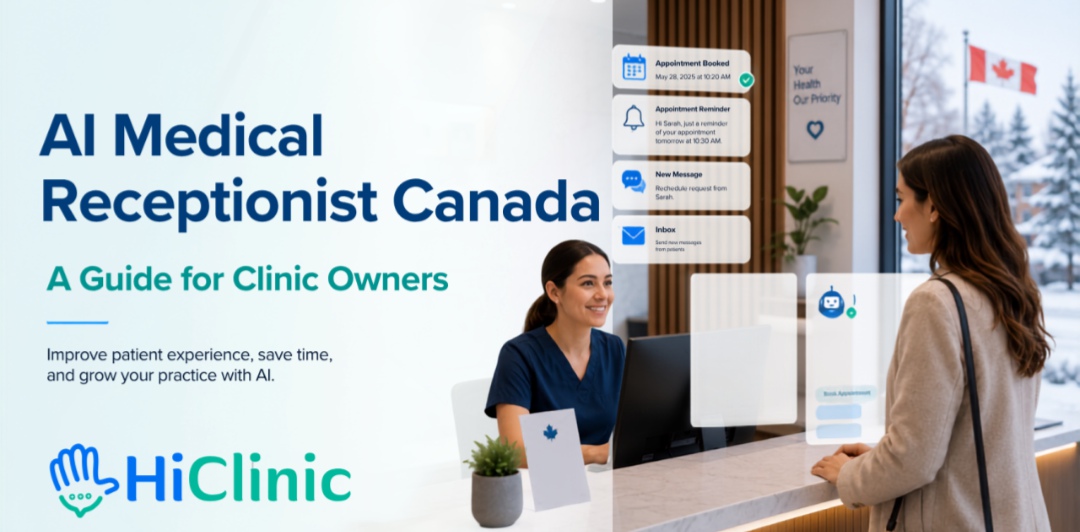
A patient calls a clinic at 6 p.m. No one picks up. She calls the next clinic on her list instead. That single missed call is the problem an AI medical receptionist is built to solve, and it’s why front desks across Canada are starting to run on one.
Quick facts:
An AI medical receptionist is software that answers clinic phone calls, texts, and web chats, then books, reschedules, or cancels appointments without a person on the line. It sits alongside the front desk team rather than replacing it outright. Staff still handle walk-ins, billing questions, and anything that needs a human judgment call. The AI handles the repetitive parts: answering the phone every time it rings, confirming appointments, and catching calls that come in after hours or during lunch.
It’s worth being precise about scope here. An AI receptionist is an administrative tool, not a clinical one. It doesn’t triage symptoms, give medical advice, or replace a nurse or physician. Any tool marketed as doing more than front-desk work for a Canadian clinic deserves a closer look before it’s adopted.
An AI receptionist for a medical office works by connecting to the clinic’s existing phone number and calendar, then using a conversational voice or chat model to handle the parts of a call that follow a predictable pattern. When a patient calls, the AI answers immediately, confirms who they are, and checks the calendar for real-time availability. It can book a new appointment, move an existing one, answer common questions (hours, location, what to bring to a visit), and hand off to a live staff member when a request falls outside its script.
The setup itself is short compared to most practice management software rollouts:
Clinics are adding one because a single front desk person can’t answer the phone, greet a patient at the counter, and process payment at the same time, and something has to give. When the phone loses, the clinic loses a booking. Front desk staffing is also tight across dental, chiropractic, physiotherapy, and family medicine practices in Canada right now, and turnover on a two-person front desk team hits harder than it does at a larger practice.
An AI medical receptionist doesn’t get sick, take a lunch break, or leave the phone unanswered during a rush. For a clinic with one or two front desk staff, that reliability is often the actual reason for adopting one, more than any single flashy feature.
It handles the recurring, rules-based work at the front desk so staff can focus on patients who are physically in the room. In practice, that usually includes:
None of this requires a clinic to replace its front desk team. Most clinics run the AI receptionist alongside existing staff, with the AI catching what the phone would otherwise miss.
Patient data handled by any front desk tool in Canada falls under the Personal Information Protection and Electronic Documents Act (PIPEDA), and provincial health privacy laws where they apply, such as Ontario’s Personal Health Information Protection Act (PHIPA). That applies whether the front desk is a person or software.
Before adopting any AI receptionist, a clinic should ask the vendor directly: where is patient data stored, who can access it, how long it is kept, and what happens to it if the clinic cancels the service. A vendor that can’t answer those questions clearly is a bigger risk than the AI tool itself. HiClinic publishes its data handling terms for exactly this reason, and any clinic evaluating an AI receptionist should expect the same from other vendors.
Pricing varies by vendor and by how many calls or bookings a clinic handles in a month, so there’s no single number that applies across the board. What’s consistent across most reputable platforms is the billing structure: month-to-month, without a multi-year contract locking the clinic in. That structure matters more than the sticker price for a lot of clinic owners, because it means a clinic can test the tool for a month or two and cancel if it doesn’t fit before committing further.
A clinic comparing options should ask each vendor for a plain-language quote based on actual call volume, rather than relying on a published starting price that may not reflect what the clinic will pay.
Getting started usually takes three steps: a short call to review the clinic’s current phone and booking setup, connecting the AI to the existing phone number and calendar, and a brief staff training session before going live. Most clinics don’t need to change their phone number, switch practice management software, or migrate existing patient records to make the switch.
Clinics that want to see how this works for their specific specialty, whether that’s dental, chiropractic, physiotherapy, or general practice, can look at HiClinic’s AI receptionist for a specialty-by-specialty breakdown of what the setup looks like.
The setup differs slightly by specialty, since call patterns and booking rules aren’t the same across practice types. HiClinic offers an AI receptionist for chiropractors built around recurring adjustment schedules, an AI receptionist for dental clinics that handles hygiene recalls and same-day emergency slots, an AI receptionist for physiotherapy practices managing multi-visit treatment plans, and an AI receptionist for veterinary clinics that can triage routine versus urgent calls before booking. A clinic in any of these four areas can ask HiClinic to walk through the specialty-specific configuration before committing.
Dr. Varun Bajaj, MD, is a practicing physician based in Abbotsford, BC, who manages a high-volume practice across in-person and telemedicine settings. He is a co-founder of HiClinic, a Canadian clinic management and healthcare AI receptionist platform he built with Danish Wadhwa to help clinics automate patient communication, recover missed calls, increase reviews, and improve patient retention.
Is an AI medical receptionist the same as a medical answering service?
No. A traditional answering service routes calls to a live operator who takes a message. An AI medical receptionist books directly into the clinic’s calendar, answers routine questions on its own, and can send reminders, without a human relay in the middle.
Can an AI receptionist for a medical office handle multiple locations?
Yes, most platforms support multiple clinic locations under one account, with separate calendars, hours, and phone numbers configured for each.
Does an AI medical receptionist replace front desk staff?
Not typically. Most clinics keep their front desk team for in-person patients, billing, and anything requiring judgment, and use the AI to catch calls and bookings the front desk can’t get to.
How long does it take to set up an AI medical receptionist in Canada?
Most platforms go live in about a week from the initial setup call, including connecting the clinic’s phone line, calendar, and a short staff training session.
What happens if the AI can’t answer a patient’s question?
It hands the call or message to a live staff member. A well-configured AI receptionist is set up to recognize when a request falls outside its script rather than guessing.
Do Canadian clinics need special compliance for an AI receptionist?
Any tool handling patient information needs to meet PIPEDA and applicable provincial privacy law, the same standard that applies to a clinic’s other patient-facing systems. Ask the vendor directly about data storage and access before signing on.


Medical treatment is important after a bicycle accident because it protects your health, identifies injuries that may not be immediately visible, and creates medical records that can support an …
Posted Jul 17, 2026 Healthcare
Connecting innovation decision makers to authoritative information, institutions, people and insights.

Medigy accurately delivers healthcare and technology information, news and insight from around the world.
Medigy surfaces the world's best crowdsourced health tech offerings with social interactions and peer reviews.
© 2026 Netspective Foundation, Inc. All Rights Reserved.
Built on Oct 14, 2026 at 6:06pm