

Managing Editor
@ShahidNShah
@ShahidNShah
Your population health management team would be able to recognize its highest risk patients now. The tricky part is if there is sufficient time to act on alerts and where AI agents in Population Health Management Software start changing workflows. There is high interest, but little real use. According to a survey by Microsoft and The Health Management Academy conducted in February 2026, 43% of provider organizations in the U.S. had tested or tried out agentic AI, but just 3% of them had an agent running in workflows.
Population health management is the practice of managing health of large populations and hospitalizations, and not just individual patients who come for treatment. This guide discusses the role of AI agents in Population Health Management Software, how the agents work step by step, how to design them and what kind of safety measures keep them running safely.
The healthcare organization receives payments based on outcomes in value-based contracts. Accountable Care Organizations and Medicare Advantage plans are evaluated according to quality measures, e.g., HEDIS that looks at whether people have received necessary preventive services, such as annual A1C test for diabetes.
The population health management teams face several problems when working under such agreements:
Here comes the role of AI Agents in Population Health Management Software. They turn patient care gaps into tasks that are done, allowing teams to deal with routine tasks more productively without losing control over clinical decisions. Initially, the benefit appears due to automation of routine actions rather than substitution of clinical judgement.
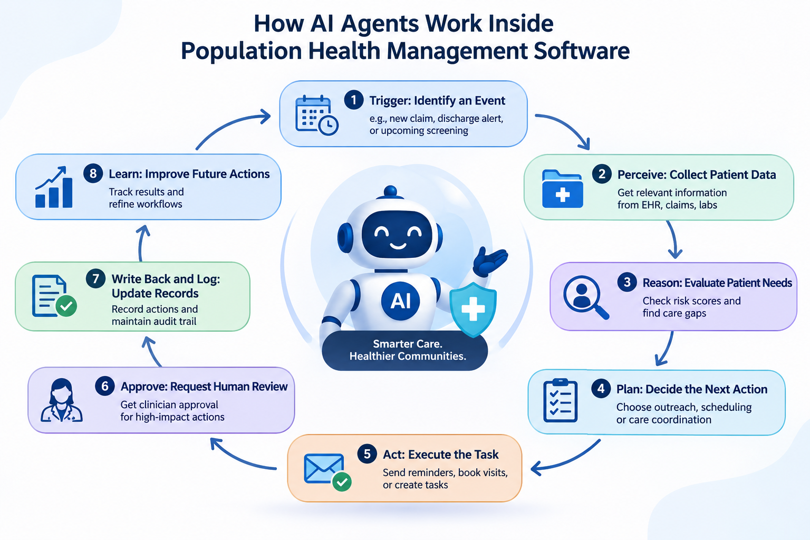
Unlike traditional chatbots that respond to queries, AI agents perform multi-steps tasks. They detect events, gather patient data, evaluate care needs, take appropriate actions, and monitor results. In population health management software, such process goes through eight steps:
This involves detecting events that require attention, such as claims for insurance, discharge from hospitals, new laboratory results, and upcoming preventive screens.
This involves collecting information regarding the patient such as medical history, A1C levels, medication list, care plan and preferences in terms of communicating with the patient.
Involves analyzing the needs of the patient based on patient data, risk scores, guidelines and quality measures.
Involves planning the next course of action to take based on the analysis of the patient’s need for care.
It may involve carrying out actions such as sending reminders to the patient, scheduling appointments, creating referral requests and adding tasks to the worklist of the care manager.
Some activities may require the approval of authorized health practitioners.
It updates patient records with performed actions and keeps audit logs to describe what actions were taken and why.
It monitors outcomes, such as completed appointments, patient responses, and missed follow-ups, to improve outreach and workflow performance in the future.
Human involvement is still necessary: healthcare organizations should decide which tasks can be performed autonomously by the agents and which with the help of human approval.
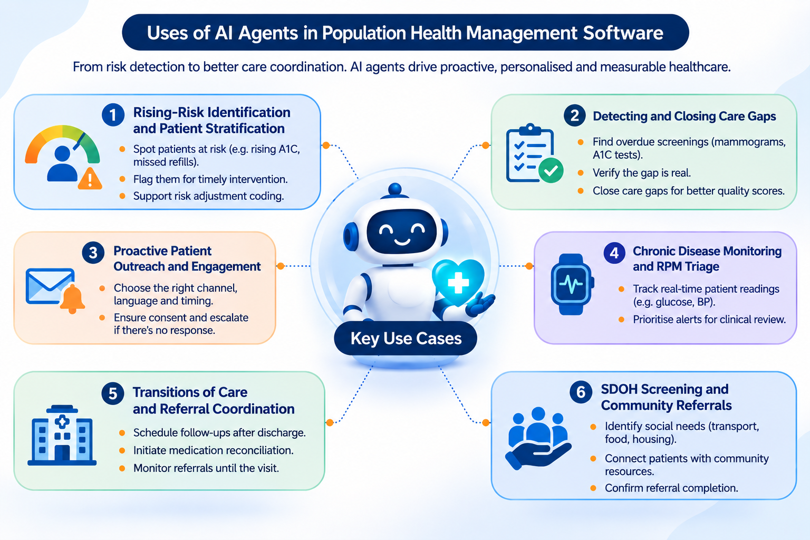
The following are three essential factors that would make a successful use case: huge volumes, good directions, and tangible outcomes. Agents are great in population health management systems which are capable of combining clinical, claims, and social data. In order to work well, they need common data.
A risk agent looks for patients who are heading toward negative developments, such as rising A1C levels with missed refills and flags them to the care manager before the patient lands in the hospital. The agent may also help prepare documents about a chronic disease for the coder’s review for risk adjustment.
2. Detecting and Closing Care Gaps
A gap agent evaluates every attributed patient against quality measures and identifies overdue mammograms, colorectal screenings, A1C tests and closes gaps. Before initiating outreach, it ensures that the gap is real and not closed elsewhere, thus, making sure we reach out only to those patients who actually need it. That is where AI for closing care gaps is going to provide the fastest result, since each gap closure is easy to count.
The outreach agent determines the correct medium, language, and timing of the contact. It seeks consent prior to sending out every message, and escalates to staff members if the patient fails to respond after a set number of attempts.
Remote patient monitoring (RPM) devices continuously stream patient readings. Triage agent sorts them into normal, watch and alert status. That way, nurses can concentrate only on readings that require clinical reasoning.
Once the agent gets an alert of a discharge, it schedules a follow-up call, initiates a medication reconciliation and book the follow-up appointment. Also, it monitors the referrals until the patient visits the specialist another area of common leakage in care coordination.
Social determinants of health such as transportation, food security and housing usually decide about the feasibility of a care plan. The SDOH agent is to screen for these factors, make referrals to community organizations and confirm the completion of each referral.
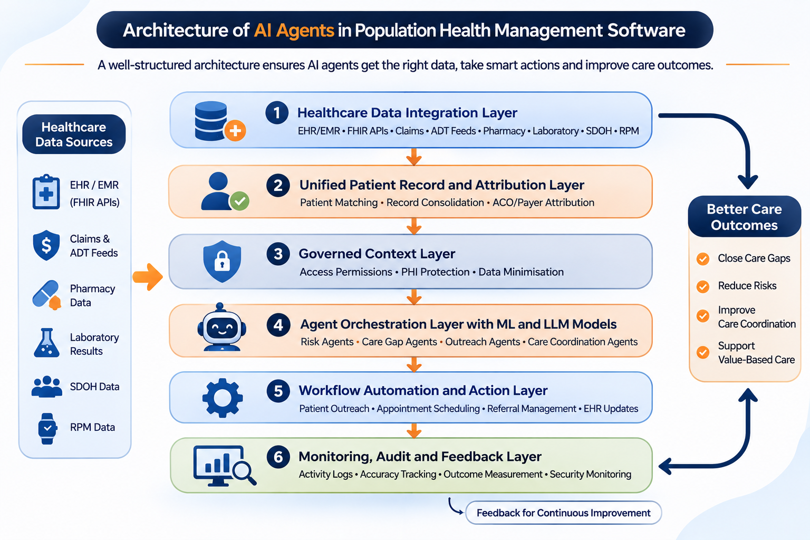
Agents can be only as reliable as the surrounding data and control structure. In our experience, most failed pilots stem from the poor data foundation rather than the model itself. Usually, a robust architecture consists of six layers.
Picture a patient whose A1C test is four months overdue. The risk agent flags the gap and raises her priority because her last result was high. The gap agent confirms that no other provider has billed for the test. The outreach agent sends a text in Spanish, her preferred language, and offers two lab slots. She books one. A care manager reviews a single exception, her request to use a different lab, and approves it. When the result posts, the agent writes it back and the gap closes. That is care gap closure without a single manual phone call.

With population health agents processing tens of thousands of patient records at once, a design flaw will repeat itself until it gets detected. Put these six security and privacy measures in place before the first implementation of any agent.
1) Minimum Necessary Access and PHI Security.
Reduce use of protected health information (PHI) to the minimum necessary to the specific purpose, in compliance with HIPAA. Agents get cohort-level view as a default, secure PHI both during transportation and storage and execute business associate agreement (BAA) with every vendor providing the model or service handling PHI.
2) Tiered Autonomy and Human Oversight.
Set up the three tiers: read-only access, draft for approval, and autonomous performance of low-risk actions, such as appointment reminder messaging. Clinical decisions must be performed by the clinician only.
3) Flagging Risks Assessment and Model Transparency.
Perform the bias analysis on the risk score among different ages, languages, races and ZIP codes, prior to deployment and periodically afterwards. Explain why every flag gets set up – a rationale must be available to explain why the patient becomes flagged in order to make a care manager understand it.
4) Outreach Consent Under TCPA.
In February 2024, FCC clarified that artificial voice under the Telephone Consumer Protection Act (TCPA) includes AI-generated voices. Automated outreach needs prior consent and caller’s identity disclosure, record it for every patient and for every type of communication medium.
5) Data Freshness Verification Prior To Every Action.
Agent should confirm whether data are up-to-date before performing any action, as nothing undermines patient trust quicker than reminding someone of a test that was already done.
6) Audit Trail and Kill Switch.
Every agent should leave an audit trail with identifying information and reasons for performing the task and a kill switch allowing immediate termination of any agent operation.
Well-designed AI agents in population health management software include those measures in their architecture.
There is no need to automate all processes at the same time. Companies who get to the stage of deployment usually start with a small pilot and expand it step by step.
Set up a baseline before deployment to show the impact. Following metrics prove whether agents actually help or not:
– Closing rate of the care gaps related to selected quality measures
– Outreach to engagement rate
– 30-day readmissions
– Avoidable ED visit per 1,000 patients
– Patients per care manager
– Days from discharge until the first follow-up contact
Monitor both the progress of care gap closure and how accurate the risk stratification is at the same time. It doesn’t matter how high the closing rate is if the agent is busy with the wrong patient population.
AI agents are not going to replace care managers. They will help with handling routine backlogs, allowing employees to work with patients that require their intervention. Once FHIR APIs of payers become available in 2027, more data will be coming to the platforms making the governance of agents even more valuable. The wise approach is to limit the scope and scale the successes.
If you are implementing AI Agents in Population Health Management Software for your programs, you may consider an experienced healthcare software development company such as Bacancy Technology to create agents for your value-based care organization with full ownership of the source code and no lock-in to any platform.


As digital health tools become part of everyday care planning, more families are turning to online platforms to find support for an aging parent or relative. Data-driven care matching is one of these …
Posted Nov 11, 2026 Elderly
Connecting innovation decision makers to authoritative information, institutions, people and insights.

Medigy accurately delivers healthcare and technology information, news and insight from around the world.
Medigy surfaces the world's best crowdsourced health tech offerings with social interactions and peer reviews.
© 2026 Netspective Foundation, Inc. All Rights Reserved.
Built on Nov 12, 2026 at 5:06am