

Managing Editor
@ShahidNShah
@ShahidNShah
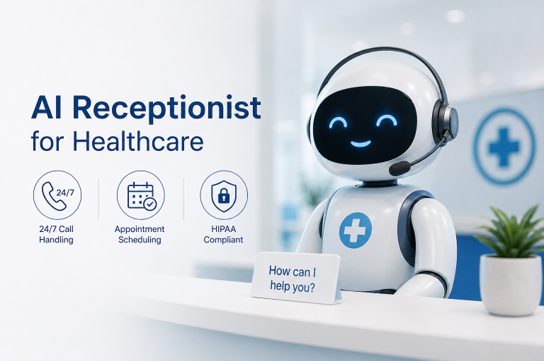
Front offices of healthcare clinics have been subjected to increased pressure due to patient volume increases. In many cases, it is hard for traditional front office receptionists to match the patient volume and respond adequately. This results in missed calls, delays, and other inconveniences that may lead to poor patient experience and lost income opportunities for the clinic. The increase in search for AI receptionist solutions for healthcare practices indicates the need for better reception technology.
Advanced receptionist technology can be used by healthcare practices to ensure better operation. For instance, there are numerous AI receptionist tools available that act as an effective answering machine and an AI-based virtual receptionist system. This will help improve efficiency through the implementation of appointment scheduling automation and improved patient communication.
The AI receptionist in healthcare can be defined as a system that streamlines patient communication through automated conversations, call management, and appointment scheduling. It functions as an advanced AI answering service or virtual receptionist, handling appointment bookings, managing incoming calls, and responding to patient inquiries automatically. This improves the overall efficiency and reliability of patient communication.
In contrast to human receptionists, an AI receptionist can handle incoming calls 24/7 without delays, significantly reducing the number of missed calls. Unlike traditional IVR systems, it offers natural, conversation-like interactions instead of relying on rigid, pre-recorded menu options. This makes the call-handling process more intuitive, user-friendly, and highly scalable. For healthcare organizations aiming to further optimize operations, integrating such systems with advanced analytics tools like best healthcare analytics solutions in 2026 can further enhance decision-making and patient experience.
The security of healthcare records is a very important aspect that must be considered. Therefore, the need for a HIPAA-compliant AI receptionist is important to ensure maximum security when handling communications with patients. The technology enables healthcare facilities to provide a safe means for storing sensitive information exchanged during phone calls, messages, and other communication methods.
A secure and compliant AI receptionist can easily comply with regulations as a result of the application of various secure technologies, such as data encryption and others. As a result, healthcare facilities can safely handle patient records, call data, and other communications.
The main advantage of healthcare automation tools is the compliance of the solutions with industry standards. A HIPAA-compliant system provides additional security and ensures maximum protection of patient information.
The use of an AI receptionist guarantees uninterrupted availability throughout the day. It prevents the possibility of missing a call from a patient or missing out on booking an appointment. The use of an AI answering service in conjunction with AI call handling allows clinics to avoid missing patient visits.
Using appointment booking automation technology, the AI receptionist can book and schedule appointments without the involvement of any human personnel. It acts like a virtual receptionist and helps in minimizing errors and efficiently managing the schedule. It ensures that everything is done smoothly in the patient communication system.
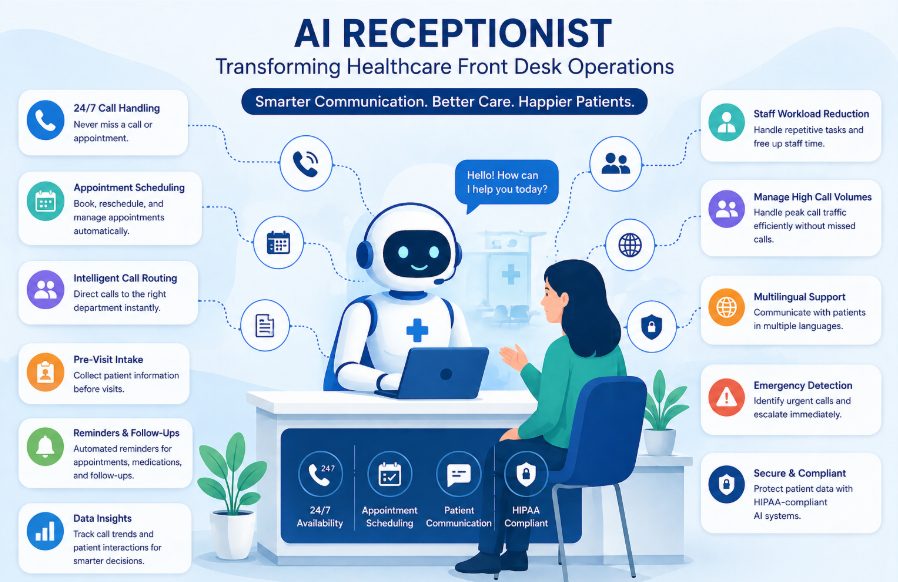
AI call handling technology allows the AI receptionist to determine the intent of the call. Whether the patient wants to book an appointment, pay for a medical bill, or report an emergency, AI call handling will ensure the call reaches the relevant department at once.
AI is used in healthcare automation to take patients’ information before they come for their visits. The process is effective in streamlining the patient communication system and easing workflows within the facility. The intake before the visit helps minimize waiting times and optimize front desk automation.
With an AI receptionist, you can set up follow-up appointments and reminders. It enhances the patient communication system and ensures better patient retention. As part of appointment scheduling automation, it allows the healthcare provider to have a sustained level of contact with the patient. The AI receptionist pricing varies depending on features, call volume, and level of automation.
The AI receptionist makes it easier for the front desk staff to work with reduced stress. In effect, it works as an efficient virtual receptionist that handles the calls and related questions. This leads to enhanced front desk automation.
During peak hours, an AI receptionist acts as an overflow AI answering service, which makes sure that no patient call gets overlooked. An AI receptionist handles calls smoothly and thus provides effective call handling by AI in healthcare by tackling a high volume of calls. Front desk automation thus avoids any missed opportunities for the patient communication system.
The advantage of using an AI receptionist is its ability to provide communication in multiple languages. Being a virtual receptionist, it increases the efficiency of the patient communication system through the removal of linguistic barriers. Thus, healthcare automation becomes more inclusive, patient-friendly, and more effective in the call handling process in healthcare.
The advanced AI receptionist software can identify emergencies during calls and automatically route them for priority attention. Effective handling of AI calls in healthcare is ensured by such an AI receptionist due to its intelligence. Such emergency detection thus ensures patient safety along with efficient front desk automation.
The data provided by the AI receptionist about calls, the behavior of clients, and service needs can be used to make decisions about management practices and staff deployment strategies. When used together with healthcare automation, this AI answering service will boost the performance of the patient communication system.
With the help of a HIPPA-compliant AI receptionist, it is possible to manage all patient-related data securely because of such measures such as encryption. Such a move not only contributes to improving trust in the patient communication system but also makes sure that patients’ personal data will not be exposed to threats. Security-focused healthcare automation allows for ensuring the highest levels of security in the process of front desk automation.
An AI receptionist can help interact with patients quickly thanks to automatic calls made at once. It works just like an ordinary receptionist would do, which contributes to improving the performance of the patient communication system. Effective AI answering services will benefit healthcare organizations.
With the introduction of AI-powered systems, the healthcare sector has experienced some notable changes. There has been an increase in successfully completed appointments, thanks to improved scheduling and reminder systems. On the other hand, the workload of healthcare staff members has decreased considerably, allowing them more time to attend to patients.
Looking ahead at the future possibilities in the context of the front desk of health care services, there is the likelihood that there will be an increased level of integration between AI technologies and other critical components, such as EHR and hospital management platforms. With the development of AI conversational systems, communication will be made more effective.
When healthcare providers evaluate AI receptionists or other digital health tools, decision-making is becoming more data-driven and peer-informed. Platforms like healthcare peer networks help hospitals and clinics review real-world feedback, compare solutions, and reduce the risk of investing in the wrong system.
The rise of AI receptionist solutions for healthcare practices is reshaping how modern healthcare providers manage front desk operations. By combining capabilities like an AI receptionist, an AI answering service, and a virtual receptionist, clinics can achieve seamless front desk automation and more efficient AI call handling in healthcare. These technologies not only reduce missed calls and administrative burden but also enhance the overall patient communication system, ensuring patients receive timely and accurate support.
As healthcare continues to evolve, the integration of healthcare automation tools such as appointment scheduling automation and HIPAA-compliant AI receptionist systems will become essential. Providers that adopt these solutions early can improve patient satisfaction, streamline workflows, and maintain secure, compliant communication. In the long run, AI-driven systems will play a critical role in delivering scalable, reliable, and patient-centric healthcare services.
The definition of an AI Receptionist in healthcare includes an automated system that answers calls from patients, arranges meetings, and makes other relevant inquiries. The system is a kind of an AI answering service which operates around the clock, thus relieving front desk stuff from the work burden.
A 24/7 AI answering service helps ensure that none of the patient calls are missed after regular working hours. The solution allows for managing large call volumes, automating appointments, and responding immediately.
An AI virtual receptionist can be widely employed in hospitals and clinics for automated answering calls, appointment making, patient management, and arranging follow-up calls, among others. Such use can greatly benefit the facilities since many administrative processes will be automated.
There are several advantages of using AI receptionists, including call automation, fewer missed appointments, 24/7 access, more effective patient communication, and front desk automation, among others.
Most of today’s AI receptionist systems are HIPAA-compliant. They have built-in features that ensure safe data exchange with the help of encryption and other security measures. But the level of compliance can depend on many factors.


Rhinoplasty changes the shape of the nose. That is the short version. It can be cosmetic, functional, or both, since a deviated septum and a nasal hump can be corrected in the same sitting. The …
Posted Apr 27, 2026 Cosmetics
Connecting innovation decision makers to authoritative information, institutions, people and insights.

Medigy accurately delivers healthcare and technology information, news and insight from around the world.
Medigy surfaces the world's best crowdsourced health tech offerings with social interactions and peer reviews.
© 2026 Netspective Foundation, Inc. All Rights Reserved.
Built on Oct 14, 2026 at 4:06pm