

Managing Editor
@ShahidNShah
@ShahidNShah
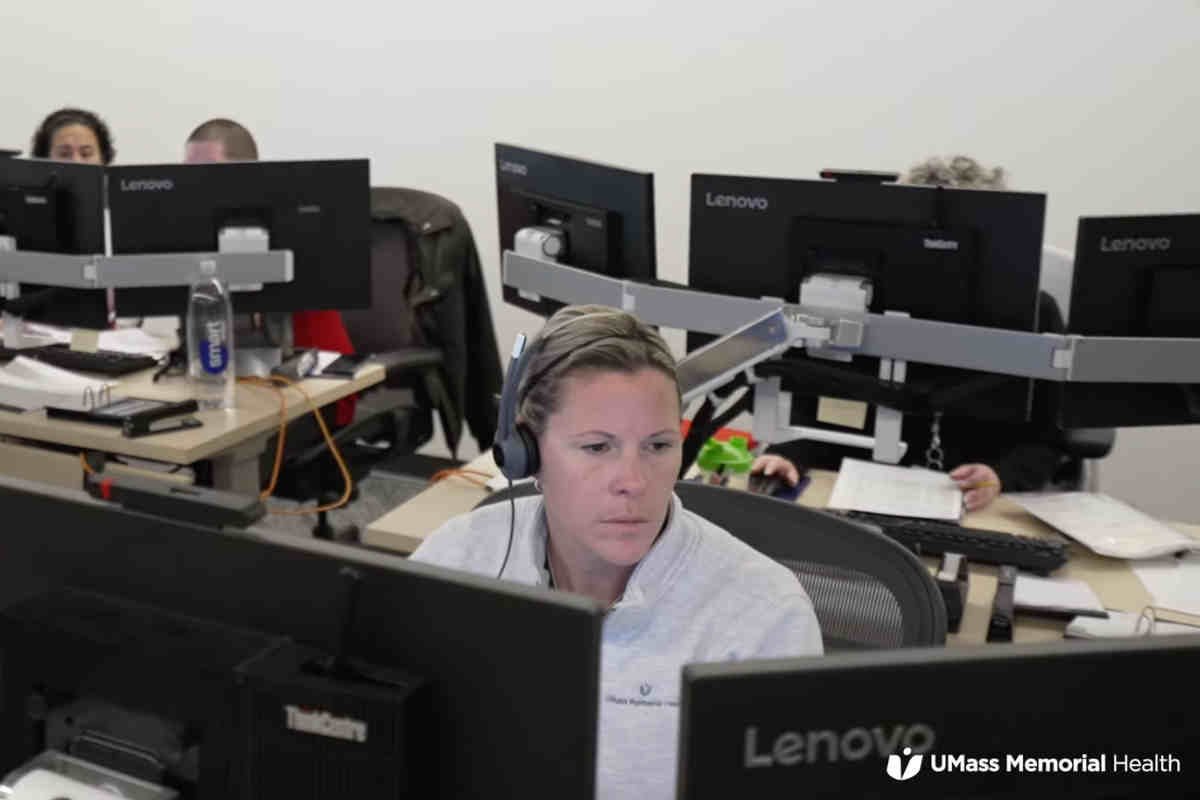
When the University of Massachusetts Memorial Health in Worcester opened its digital hub last fall, it provided a glimpse of what the future of remote care management could look like.
The 20,000-square-foot space, referred to as a “digital hospital,” merged many of the health system’s remote patient monitoring functions into one building. The structure is fully equipped with computers and monitors that allow experts to do remote clinical monitoring of patients in the intensive care units and their homes, keep an eye on patients at risk for falls and other safety concerns, and coordinate transfers of patients in and out of the hospital. It also allows other services like interpretation, and the structure has spaces for meetings and training sessions.
Centralized digital care hubs are transforming remote patient management by combining virtual ICU monitoring, hospital-at-home services, patient safety surveillance, and telehealth coordination into one connected healthcare system. Expanding integrated remote care infrastructure could help U.S. hospitals improve care efficiency, reduce readmissions, and support more scalable home-based healthcare delivery.
Continue reading at healthjournalism.org

The misuse of artificial intelligence chatbots such as ChatGPT, Gemini and Copilot in health care is the most significant health technology hazard for 2026, according to the nonprofit patient safety …
Connecting innovation decision makers to authoritative information, institutions, people and insights.

Medigy accurately delivers healthcare and technology information, news and insight from around the world.
Medigy surfaces the world's best crowdsourced health tech offerings with social interactions and peer reviews.
© 2026 Netspective Foundation, Inc. All Rights Reserved.
Built on Oct 4, 2026 at 5:36pm
