

Managing Editor
@ShahidNShah
@ShahidNShah
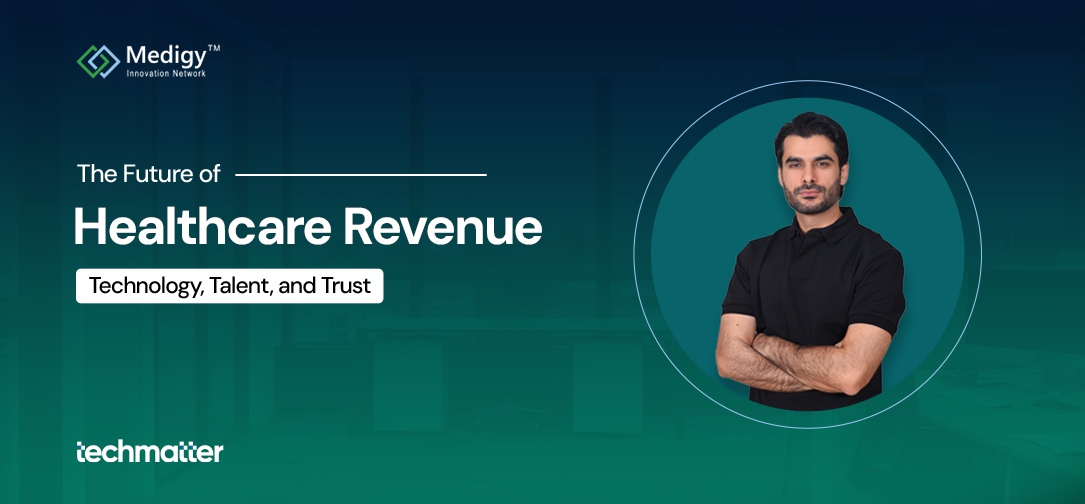
Mubashir Hanif is the Founder and Chief Executive Officer of TechMatter, a global technology company delivering healthcare technology, digital product development, and managed IT solutions across multiple international markets. An operator and systems thinker, Mubashir has built the company into a growing global organization serving healthcare and enterprise clients across North America, Europe, the Middle East, and Asia.
His leadership approach is grounded in disciplined execution and scalable system design, focusing on technology platforms and operational frameworks that strengthen financial visibility, improve organizational performance, and support long-term resilience in complex, regulated industries.
In this interview, Mubashir shares his perspective on the future of healthtech, shedding light on how intelligent systems, evolving workforce roles, and responsible leadership will shape the next generation of healthcare revenue operations.
A lot of it comes down to pressure on the system. Margins are tighter, payer rules keep changing, and healthcare organizations are expected to do more with fewer people.
When you speak with revenue teams today, the common theme is that the work has become more complex, but the structure around it hasn’t changed much. Teams are still spending a lot of time correcting issues after claims are submitted instead of preventing those issues in the first place.
From my perspective, the shift happening right now is that leadership teams want fewer surprises. They want clearer financial visibility and more predictability. That’s pushing organizations to rethink how revenue operations are structured and how technology can support the people doing the work.
The biggest difference happens when technology helps teams catch issues earlier.
One example I’ve seen repeatedly through our work with provider groups is documentation inconsistencies. A small wording issue in clinical notes can create a pattern of denials that goes unnoticed for weeks. By the time someone spots the pattern, the team is already stuck reworking dozens of claims.
When we started building tools like CureAR at TechMatter, the goal wasn’t to speed up billing. It was to help teams see patterns earlier so they could fix the root issue instead of dealing with the same denial again and again.
When that happens, the conversation inside the revenue team changes. Instead of constantly reacting, people start thinking about improving the process itself.
The worry is understandable. Anytime new technology comes in, people naturally wonder what it means for their role.
What I’ve seen in practice is that the work changes more than the headcount. Some repetitive tasks start to disappear, but other responsibilities grow. Someone still needs to review edge cases, interpret payer behavior, and make decisions when something doesn’t fit neatly into a rule.
In teams we’ve worked with through RCMMatter, automation actually pushed people to think more critically about the system they’re managing. They spend less time doing repetitive corrections and more time understanding why certain issues keep appearing.
So it’s less about replacing people and more about changing how their expertise is used.
Because revenue systems affect real financial decisions. If a hospital leadership team doesn’t trust what the system is telling them, they’ll go back to manual checks and spreadsheets very quickly.
We’ve seen that happen before. Organizations adopt advanced tools but still rely on parallel tracking because they want to double-check everything.
The only way to avoid that is transparency. Teams need to understand why a claim is being flagged or why the system is highlighting a certain pattern. When people can see how the system reached its conclusion, they’re much more comfortable relying on it.
Trust takes time, but once it’s there, adoption becomes much easier.
One interesting change is how teams measure success.
Traditionally, revenue departments are recognized for how much work they handle — how many claims they process or how many denials they resolve. But when systems start catching issues earlier, there’s actually less visible “cleanup” work.
That means leadership has to rethink what good performance looks like. Instead of focusing on how many problems get fixed, the focus shifts to how many problems never happen in the first place.
That can take some adjustment, but once teams understand that the goal is stability rather than constant firefighting, the culture starts to shift.
I think they’ll spend less time in crisis mode.
Today, many revenue teams are constantly reacting to issues — payer changes, documentation gaps, sudden denial spikes. It creates a stressful environment where everyone is always trying to catch up.
In the future, I expect revenue teams will operate more like monitoring centers. Technology will surface patterns earlier, and the team will focus on understanding those patterns and improving workflows.
People will still be essential. Healthcare is too complex for everything to be automated. But the work will be less about fixing mistakes and more about keeping the system running smoothly.
And honestly, that’s a healthier place for both the organization and the people doing the work.


The five most important steps to take after food poisoning to protect your legal rights are seeking medical care immediately, documenting your symptoms and food history, preserving evidence like …
Posted Mar 18, 2026 #HealthLaw
Connecting innovation decision makers to authoritative information, institutions, people and insights.

Medigy accurately delivers healthcare and technology information, news and insight from around the world.
Medigy surfaces the world's best crowdsourced health tech offerings with social interactions and peer reviews.
© 2026 Netspective Foundation, Inc. All Rights Reserved.
Built on Apr 8, 2026 at 3:47am