

Managing Editor
@ShahidNShah
@ShahidNShah
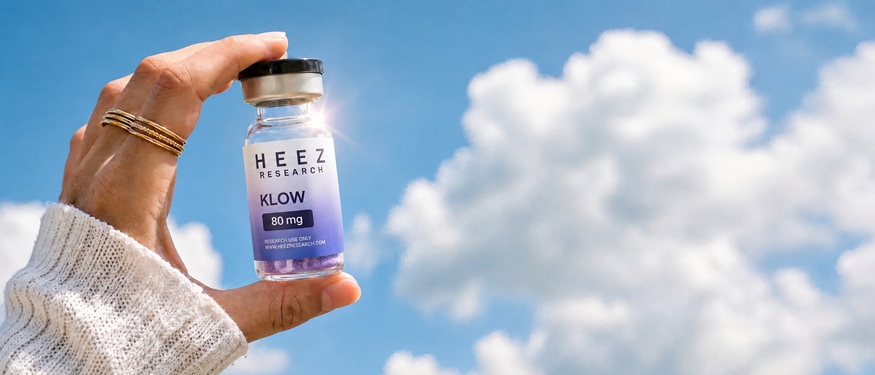
HEEZ Research KLOW research vial held against a blue sky
GHK-Cu runs to just three amino acids. Retatrutide stretches to 39, fatty-acid side chain and all. Two very different molecules, one shared label and that gap between three and 39 is a decent place to start if you want to understand what the word peptide actually covers.
Amino acids themselves are small molecules about twenty of them turn up again and again. Take just a few, linked in a chain that is a peptide. Take hundreds instead, folded up into a shape and you are looking at a protein. Size, really, is the only difference. Take GHK-Cu: three amino acids glycine, histidine, lysine with a copper ion riding along. KPV’s recipe is even shorter: lysine, proline, valine. BPC-157, by comparison, stretches to 15. Because they are small and precise about where they act, peptides tend to home in on particular receptors and one can be designed for a single target, or two, or three, which is exactly the retatrutide trick.
Call them research peptides: synthetic versions, made for lab work. The surprise for most people is what they actually look like. Inside the small glass vial, down at the bottom sits something like a pinch of white powder or a thin dried cake. That is lyophilized peptide freeze-dried in other words. The peptide goes into solution, gets frozen, and then has the water drawn out of it under vacuum; what survives that process is a dry, stable solid, quite happy to travel at room temperature without falling apart. A 10 mg vial, for all that, contains just 10 milligrams. There is barely any powder there to look at.
Every legit label carries the letters RUO as well, short for “research use only.” These are compounds sold to labs as reagents. They are not medicines, they are not intended for human or veterinary use, and they are not made or tested to the standards required for anything that gets given to a person or an animal. A supplier that hints otherwise dosing charts, testimonials promises about how someone will feel has crossed that line. If a site sells peptides the way a supplement store would, leave.
The HEEZ Research catalog contains about 28 compounds, but most of them belong to a few research areas.
Retatrutide leads metabolic research. It’s a triple agonist that acts on the GIP, GLP-1 and glucagon receptors at once. It’s still investigational and not approved anywhere, but the published trial data explains the interest. Jastreboff et al. reported the phase 2 results in the New England Journal of Medicine (2023, PMID 37366315): mean weight reduction of 24.2% at 48 weeks in the highest-dose group. Then came TRIUMPH-1. Reported in May 2026, the phase 3 trial followed more than 2,300 participants over 80 weeks; the 12 mg arm came out at 25.0%, the placebo group at 3.9%. The same corner of the catalog holds MOTS-c, AOD-9604, 5-amino-1MQ and NAD+.
Honestly, the busiest corner of the field, by some distance, is tissue repair. BPC-157 is a fragment of a gastric protein, 15 amino acids in length. The evidence behind it is nearly all rodent evidence and one Croatian group accounts for a big slice of that work. The rat study people keep citing is the Achilles tendon one: Staresinic et al., J Orthop Res 2003 (PMID 14554208). WADA has it on the prohibited list. The FDA, in 2023, also placed it on its list of bulk substances flagged with significant safety concerns where compounding is concerned. TB-500 is a synthetic copy of the active region of thymosin beta-4 a protein involved in actin regulation and cell migration. Malinda et al. (J Invest Dermatol 1999, PMID 10469335) showed that thymosin beta-4 made wounds heal faster in rats. Thymosin beta-4 and its derivatives are banned by WADA as well.
GHK-Cu is a tripeptide that binds copper. It occurs naturally in plasma, and researchers have looked at it in connection with collagen and gene expression. For a sensible first read, there is the 2018 review by Pickart and Margolina in the International Journal of Molecular Sciences (PMID 29986520). KPV is cut from the C-terminal end of α-MSH. Dalmasso et al. (Gastroenterology 2008, PMID 18061177) showed that it gets taken up through the PepT1 transporter and that it reduced intestinal inflammation in mouse colitis models.
Those four also show up mixed together in blends several compounds in the one vial.
| Blend | Components | Size | Price (Oct 2026) |
| Wolverine | BPC-157 + TB-500 (5 mg each) | 10 mg | $89.99 |
| GLOW | GHK-Cu + BPC-157 + TB-500 | 70 mg | $125 |
| KLOW | GHK-Cu + BPC-157 + TB-500 + KPV | 80 mg | $145 |
For GLOW, the usual split is 50 mg of GHK-Cu, with BPC-157 and TB-500 at 10 mg apiece. KLOW usually adds 10 mg of KPV on top, and that’s the whole difference between the two. The KLOW peptide blend is a popular pick for labs studying all four together, and its current lot is tested at 99.87% purity. My guess is the popularity comes down to convenience, because one vial means one lot and one certificate to track instead of four.
A third group covers GHRH analog research. Among them is tesamorelin, which HEEZ lists at $115 for 10 mg. Related entries in the catalog include CJC-1295/Ipamorelin, ipamorelin sold on its own, and IGF-1 LR3. The rest is a mixed bag of Selank and Semax, DSIP, SS-31, glutathione, ARA-290, PT-141, melanotan 1 and 2.
Chemical synthesis is how most research peptides get built: amino acids go on one at a time, the chain growing link by link. It never runs perfectly. A share of chains simply stop early, which leaves the raw product as a mix of the target peptide plus a crowd of close relatives. Purification has to sort that out, and testing is the only proof it worked.
Three measurements matter. HPLC separates the sample and reports purity: the percentage that is one dominant compound. What HPLC cannot say is which compound that actually is, so identity has to be confirmed separately, through mass spectrometry or HPLC against a reference standard ideally on a certificate whose lot number matches the vial. Then there is net content. A vial’s gross weight includes salts and moisture; net peptide content is the peptide on its own. Think of a bag of chips that is half air: gross weight is the bag, net content is the chips. At HEEZ, every lot is sent to a third-party lab for all three measurements, along with heavy metals, sterility and endotoxin screens, and the certificate for the current lot is posted on each product page. Purity runs over 99%.
Storage follows from the chemistry, and everything in this section is about handling material in a lab, not guidance for human use. Lyophilized vials are fairly stable and that stability is why they can ship at ambient temperature. Of course, heat still speeds degradation, so cool, dark storage is the norm once they arrive. Reconstituted peptides powder dissolved back into liquid are much less stable: they need refrigeration and have a limited usable window. So it seems smart to buy sizes a project will actually use, because a large vial works out cheaper per mg only if the material is used before it degrades.
The buyer’s checklist is a short one: a lot-specific certificate showing purity, identity and net content, shipping from inside the US, and a supplier that stays strictly research-only. Ask for all of it.
HEEZ ships from the USA by UPS 2nd Day Air or Overnight, with same-day dispatch on orders placed before 2 PM ET Monday through Friday and before 1 PM ET on Saturday. Checkout requires an institutional email matching the buyer’s organization, buyers must be 21 or older, and all sales are final. Most products use a “buy 2, get 1 free” and “buy 3, get 2 free” ladder, which brings the KLOW five-pack down to $87 per vial. Labs that have settled on what they need can buy research peptides online from the full HEEZ catalog, with the certificate for each lot available before ordering.


Most conversations about telehealth stop at the moment a provider approves a treatment. The approval feels like the finish line, yet for anyone starting a hormone, weight management, or sexual health …
Posted Oct 20, 2026 Telehealth
Connecting innovation decision makers to authoritative information, institutions, people and insights.

Medigy accurately delivers healthcare and technology information, news and insight from around the world.
Medigy surfaces the world's best crowdsourced health tech offerings with social interactions and peer reviews.
© 2026 Netspective Foundation, Inc. All Rights Reserved.
Built on Oct 21, 2026 at 6:05pm