

Managing Editor
@ShahidNShah
@ShahidNShah
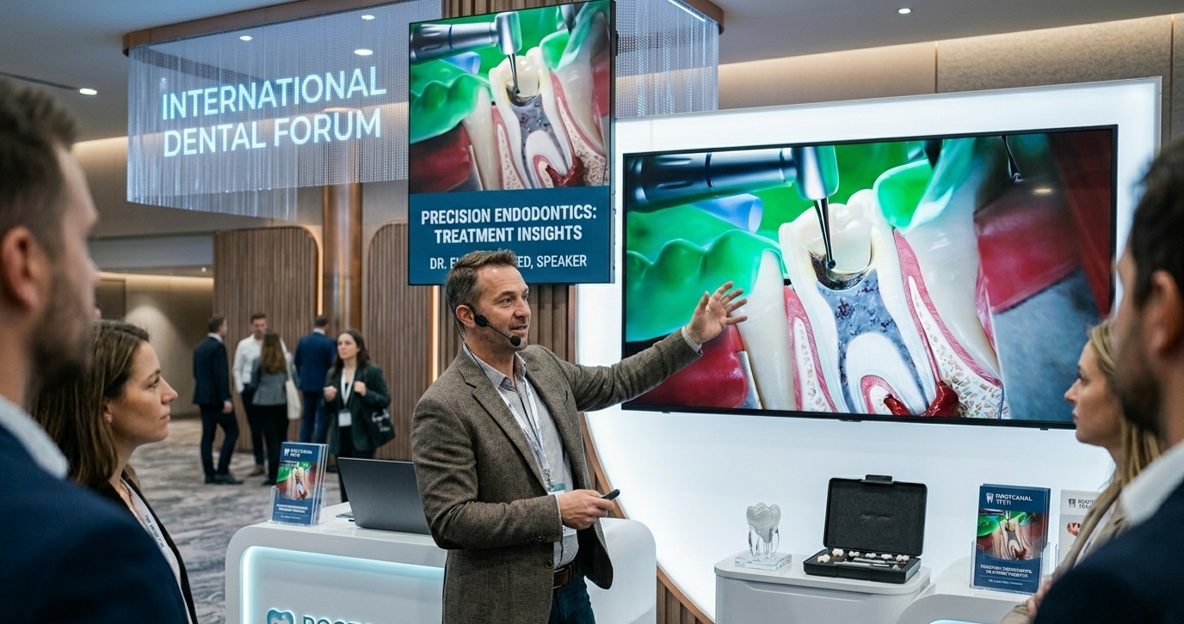
If you’ve ever attended an industry event, whether as a visitor or an exhibitor, you know how competitive these environments are. Medical congresses bring together hundreds of companies, research teams, and innovators, all vying for the limited attention of healthcare professionals (HCPs) and key opinion leaders (KOLs).
After a few hours in crowded exhibition halls with endless slide decks, many attendees reach “conference blindness” when everything just blends together. In this setting, standing out becomes a real challenge.
In this article, we’ll explore how 3D medical animations help exhibitors cut through this noise and make their conference presence far more effective.
Despite being the long-standing standard at medical conferences, traditional presentation formats are increasingly ineffective in today’s high-density information environments. Here’s why they often fail to boost engagement and impact:
Traditional visuals struggle to communicate how things actually work in dynamics. When presenting a mechanism of action (MoA) or disease progression, static slides can’t show movement, interaction, and cause-and-effect relationships. More importantly, they don’t convey spatial relationships: how molecules bind, how pathways activate, or how structures interact in three dimensions. As a result, audiences need to mentally reconstruct intricate processes, which often leads to misunderstanding.
Text-heavy slides, dense graphs, and fragmented visuals place a significant cognitive burden on the audience. Instead of following a clear narrative, attendees should actively decode information: reading, interpreting, and connecting the dots in real time. In fast-paced conference settings, this overload reduces comprehension and retention, especially when multiple presentations compete for attention throughout the day.
At large medical congresses, most presentations follow the same format: slides, bullet points, and static charts. This visual uniformity makes it difficult for any single presentation to stand out. Even valuable or innovative content risks being overlooked simply because it looks and feels like everything else attendees have already seen.
If your presentation relies heavily on spoken explanations and written text, it becomes less accessible to international audiences. At global events, where attendees come from diverse linguistic backgrounds, this creates barriers to understanding. Subtle nuances and complex terminology can further limit how effectively the message is received.
Given the challenges of traditional presentations, 3D medical animations can become a game-changing solution. They transform complex scientific content into dynamic videos and help presenters leave a lasting impression on attendees.
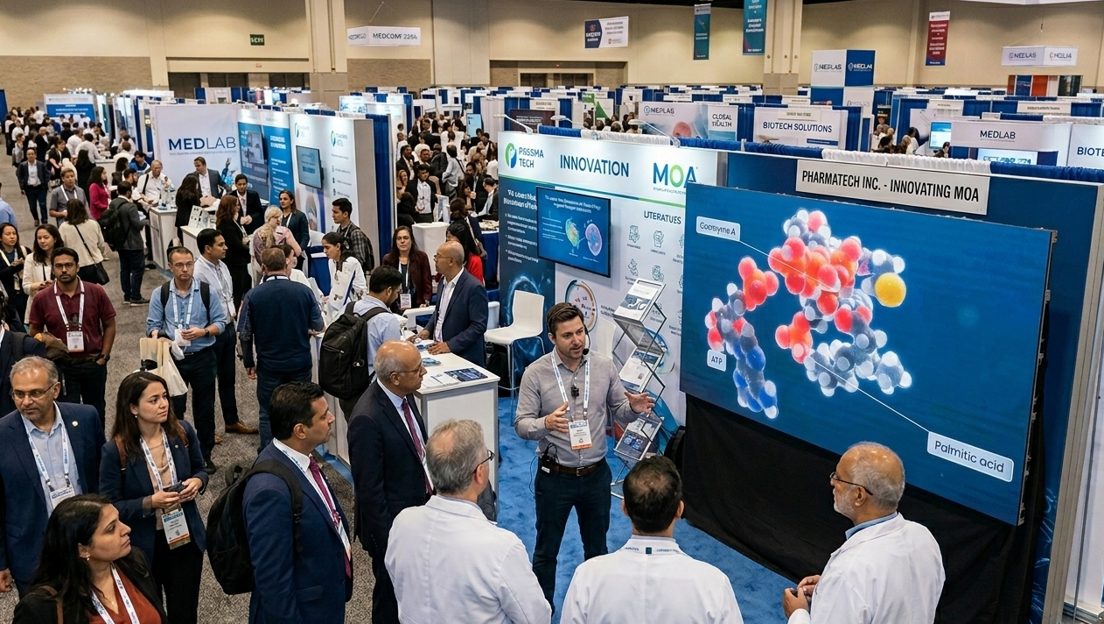
Unlike static charts or bullet-heavy slides, animations show processes, like how a medical device is used in a surgical procedure or how a disease progresses over time. This dynamic presentation helps the audience see cause-and-effect relationships, rather than trying to mentally reconstruct them from text or 2D diagrams, which significantly reduces cognitive strain.
What is more, well-thought-out pacing and motion cues guide viewers through complicated topics step by step. This structured approach improves comprehension during the presentation and increases retention afterward, making it easier for attendees to recall key messages after the conference ends.
At international medical conferences, attendees come from diverse linguistic and cultural backgrounds. Animations communicate visually, using motion, color, and spatial relationships to convey meaning without depending solely on language. This makes even highly technical and scientific concepts, like molecular interactions or MoA, universally understandable.
For KOLs or speakers addressing multinational crowds, this universality can be a major advantage, enabling them to explain complex topics and clinical trial data regardless of language or regional differences.
In crowded conference halls where attendees are constantly bombarded with presentations, capturing and holding attention is hard. But medical animations offer visually compelling experiences that draw the audience in. Motion, color, and narrative structure guide the viewer’s focus, making medical topics memorable.
This heightened engagement translates into stronger credibility, deeper discussions, and better opportunities for follow-up, whether that means new collaborations, investment interest, or meaningful audience interactions at the conference.
If you host a workshop, hands-on training session, or device demonstration, conveying intricate procedures clearly can be a major challenge. Slides or verbal explanations often leave participants confused or needing repeated clarification.
Medical visuals for conferences solve this problem by demonstrating each step of a process, whether it’s a surgical technique, a new therapy protocol, or the operation of a medical device. Motion and sequencing make it easy for learners to follow along, understand intricate details, and see exactly how components interact in real time.
The impact of 3D medical animations doesn’t have to end once the conference session is over. High-quality animations can be repurposed across multiple channels, extending the life and reach of your content. They can be shared on social media platforms to reach broader audiences, integrated into email campaigns, or included in digital sales materials. This multi-channel approach ensures that the effort invested in creating animations delivers value long after the live presentation.
Repurposing animations also helps maintain consistency in messaging and branding. By turning a single animation into a versatile tool, organizations maximize ROI, reinforce key scientific messages, and strengthen audience engagement across the entire healthcare ecosystem.
Capturing attention and communicating science effectively is a serious challenge for healthcare organizations and researchers. 3D medical animations provide a practical, impactful solution, reducing cognitive load, bridging language barriers, boosting engagement, and supporting training and marketing efforts alike.
By replacing static slides with dynamic visual storytelling, your booth has more chances to stand out and maximize the return on your conference appearance. For anyone looking to make a meaningful impression at medical events, animations are becoming essential.


High-acuity neurological care is one of the most demanding environments in modern healthcare. Patients with severe traumatic brain injuries, acute intracranial events, or prolonged disorders of …
Posted Apr 1, 2026 Care Management Artificial Intelligence
Connecting innovation decision makers to authoritative information, institutions, people and insights.

Medigy accurately delivers healthcare and technology information, news and insight from around the world.
Medigy surfaces the world's best crowdsourced health tech offerings with social interactions and peer reviews.
© 2026 Netspective Foundation, Inc. All Rights Reserved.
Built on Apr 2, 2026 at 12:49pm