

Managing Editor
@ShahidNShah
@ShahidNShah

Most healthcare organizations don’t fail at compliance because they lack effort. They fail because their tools weren’t built for the specific demands of HIPAA, HITECH, and CMS requirements. Healthcare Compliance Platforms have to do more than check boxes. They need to hold up across multiple facilities, keep staff training on track, and stay current as federal and state rules shift constantly. After reviewing the leading options in this space, this guide breaks down the five platforms worth seriously considering in 2026.
The research approach for this ranking
Platform options were evaluated by pulling publicly available data from official websites, verified user reviews, product documentation, and third-party review platforms. Only companies with a demonstrated track record in the healthcare compliance space made the cut. -> See the full research breakdown
Choosing the wrong platform doesn’t just slow your team down. It puts your entire organization at risk during an audit.
Keeping pace with constantly shifting federal and state requirements is genuinely hard, and that’s before you factor in managing compliance across multiple facilities or care sites simultaneously. A well-chosen platform brings those moving parts together in one place, which cuts the chance of something slipping through the cracks.
Specialized options also tend to handle the day-to-day tracking that compliance officers actually care about: policy attestation rates, staff training completion, and time to close out audit findings. The right choice leads to measurably better outcomes across all of those areas. And that’s pretty hard to put a price on.
Note: All data in this table is sourced from review platforms and the official websites of the listed companies.
| Company Name | Years Operating | Team Size | Headquartered In |
| ComplyAssistant | Since 2002 | 11-50 | Woodbridge, New Jersey |
| NAVEX | Since 1981 | 1,435 | Lake Oswego, OR |
| Secureframe | Since 2020 | 200 | San Francisco, CA |
| Sprinto | Since 2020 | 316 | San Francisco, CA & Bangalore, India |
| Drata | Since 2020 | 723 | San Diego, CA |
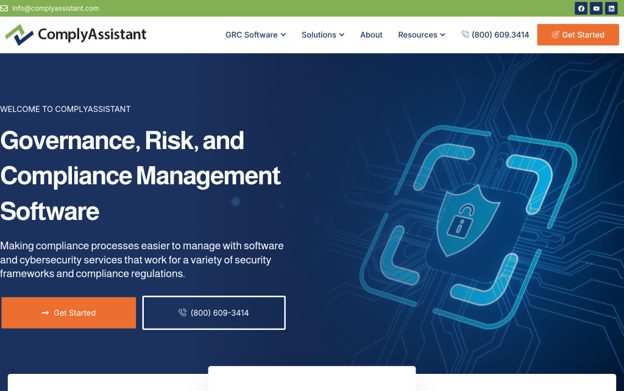
What Does ComplyAssistant Do?
ComplyAssistant has been working exclusively inside the healthcare compliance space since 2002, and that focus shows. Their GRC software covers everything from HIPAA and HITECH to HITRUST, NIST, and PCI standards. The platform includes risk assessments, third-party vendor risk management, and virtual CISO support, which is a combination that’s genuinely rare to find under one roof. Organizations looking for solid healthcare audit management solutions will find that ComplyAssistant’s deep familiarity with the healthcare environment sets them apart from broader GRC tools.
Why ComplyAssistant Stands Out for Healthcare Compliance Platforms:
ComplyAssistant addresses one of the most persistent problems in healthcare compliance: the gap between software that’s technically capable and software that actually understands what a healthcare organization needs on day one. Their endorsement by HASC and client roster of 100+ healthcare organizations, including HackensackUMC Palisades and Cape Regional Health System, reflects real-world confidence from the industry they serve.
Summary of Real User Reviews:
ComplyAssistant earned 2025 GetApp Category Leader recognition in HIPAA Compliance, which isn’t a trivial distinction. Clients consistently respond well to the platform’s usability and the team’s responsiveness when things need to change. That kind of client-driven development approach tends to build long-term loyalty, and the evidence here backs that up.

What Does NAVEX Do?
NAVEX has been in this business longer than most. Founded in 1981 and serving over 14,000 clients across 200+ countries, they cover the full spectrum of GRC needs. Their platform includes policy management, whistleblowing and incident management, third-party risk, and eLearning. NAVEX runs the world’s largest repository of hotline and incident data, and they were the first company to offer whistleblower helplines through their EthicsPoint platform (that’s a legitimate piece of history). For healthcare organizations managing ethics programs alongside HIPAA and fraud prevention, NAVEX brings serious depth.
Why NAVEX Stands Out for Healthcare Compliance Platforms:
NAVEX solves the challenge of managing compliance at true enterprise scale, where a single policy update needs to cascade across dozens of departments or facilities without falling apart. The fact that 95 of the Fortune 100 trust this platform is the kind of track record that matters when you’re defending your compliance posture to a board.
Summary of Real User Reviews:
Public recognition includes Enterprise Company of the Year from the Technology Association of Oregon, which speaks to the organization’s operational credibility at scale. Larger healthcare organizations tend to gravitate toward NAVEX when they need a platform that won’t buckle under volume. The breadth of their toolset does mean there’s more to configure upfront, but the depth tends to justify it.
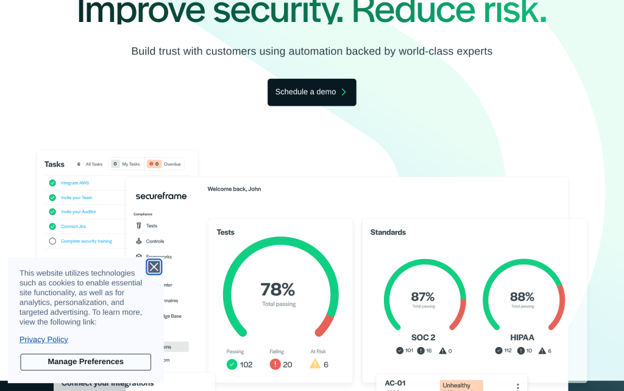
What Does Secureframe Do?
Secureframe automates the compliance process for organizations that need to move quickly without cutting corners. The platform supports HIPAA, SOC 2, ISO 27001, PCI DSS, GDPR, and more, with continuous monitoring and evidence collection built right in. What’s different here is the team behind the software. Their dedicated compliance advisors are former auditors, which means they know exactly what reviewers look for and can guide clients through the process from there. With 100+ connections and AI automation on board, Secureframe is genuinely built for speed.
Why Secureframe Stands Out for Healthcare Compliance Platforms:
Secureframe fills a real need for healthcare-adjacent organizations and fast-scaling health tech companies that need certifications quickly but can’t afford to let accuracy slip. Their early adoption of emerging standards like NIST’s AI Risk Management Framework signals that they’re not just keeping up with regulations. They’re watching where things are heading next.
Summary of Real User Reviews:
Secureframe earned G2 Leader recognition across five categories and took home Cyber Defense Magazine’s “Hot Company – Compliance Automation” award in 2025. Users consistently point to the quality of the compliance advisor relationships as a standout (not just a help desk experience, but actual expert guidance). The Forbes Best Startup Employers listing for two consecutive years also suggests a stable, well-run team behind the product.

What Does Sprinto Do?
Sprinto takes an autonomous approach to compliance management that goes beyond just alerting users to problems. The platform actively detects compliance drift and closes gaps without waiting for someone to manually intervene, which is a meaningful distinction for healthcare teams stretched thin. Sprinto covers 200+ global standards, including HIPAA, SOC 2, GDPR, and PCI-DSS, and connects to over 300 connections. With 3,000+ companies across 75 countries on the platform, they’ve clearly figured out how to scale this without losing reliability.
Why Sprinto Stands Out for Healthcare Compliance Platforms:
Sprinto addresses the ongoing problem of compliance drift, where controls get put in place during an audit cycle and then quietly degrade in the months that follow. Their autonomous remediation approach means healthcare organizations maintain a consistent compliance posture between audits, not just during them. And that’s the kind of conduct change that actually reduces risk.
Summary of Real User Reviews:
Sprinto holds a 4.8-star rating on G2 and landed at #8 on the Inventiva Top 10 Data Security SaaS Startups 2026 list. Clients respond well to the speed of the platform. One customer completed ISO 27001 certification in two weeks, and another achieved SOC 2 compliance in under 30 days. That kind of turnaround is hard to match for organizations under deadline pressure.
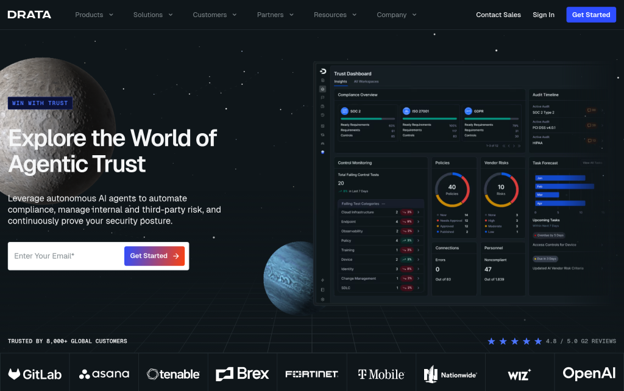
What Does Drata Do?
Drata focuses on the part of compliance that most teams dread: continuous evidence collection and control monitoring. The platform automates the tracking of security controls, employee asset management, and audit readiness across 14+ frameworks, including HIPAA, SOC 2, ISO 27001, and GDPR. With 75+ connections, including AWS, GitHub, and Okta, Drata fits well into the tech stacks most mid-to-large healthcare organizations already use. The company hit a $2B valuation (think enterprise pricing territory), and their 4,000+ customer base includes recognizable names like Notion and Fivetran.
Why Drata Stands Out for Healthcare Compliance Platforms:
Drata removes the manual burden of audit preparation, which is where most compliance teams spend a disproportionate amount of time. Their real-time monitoring setup gives healthcare organizations a live view of their compliance posture, not just a snapshot at audit time.
Summary of Real User Reviews:
Drata earned Leader recognition on G2 across multiple categories, including the Cloud Compliance Grid Report, Momentum Grid Report, and Small-Business Grid Report. Users particularly value how much the platform cuts down on back-and-forth with auditors by organizing evidence automatically. That said, the pricing reflects the platform’s ambition (not cheap, but worth it for teams that need this level of automation).
The process started by building a longlist of platforms active in the healthcare compliance space. Sources included industry directories, SaaS review platforms like G2 and GetApp, published case studies, and the official websites of companies that appeared consistently across multiple sources. The goal was to cast a wide net before narrowing down, so no strong contenders were ruled out early based on name recognition alone.
From the initial pool, platforms without a verifiable presence in the healthcare compliance market were removed. This meant filtering out general-purpose tools with no documented HIPAA or healthcare-specific applications. Review patterns were then examined for authenticity, looking at volume, recency, and whether reviews from actual users addressed healthcare-specific use cases rather than generic GRC functionality. Only platforms with enough verifiable evidence to make a fair evaluation moved forward.
Each company’s stated capabilities were cross-checked against what actual users described in their reviews. Where a company claimed deep knowledge of HIPAA compliance or specific healthcare frameworks, those claims were evaluated against case studies, client references, and third-party recognition. Any platform where marketing language consistently outpaced user-reported outcomes was flagged and, in most cases, dropped from consideration.
Platforms were also evaluated based on their standing within the broader compliance and healthcare industry. This included awards from credible organizations, mentions in industry publications, and recognition from bodies like the Technology Association of Oregon or category distinctions on platforms like GetApp and G2. These signals don’t replace reviews from actual users, but they do indicate sustained performance and peer recognition over time.
The final layer focused on healthcare-relevant evidence. This meant looking for dedicated service pages covering HIPAA, HITECH, HITRUST, and CMS requirements, as well as verified reviews from healthcare organizations. Platforms with documented healthcare client rosters, endorsements from healthcare associations, and case studies involving hospitals, health systems, or healthcare-adjacent businesses were given additional weight. Sprinto’s client results, ComplyAssistant’s HASC endorsement, and NAVEX’s documented work with large-scale health organizations all contributed positively at this stage.
Start by identifying what your organization actually needs before comparing platforms. The right fit depends on your size, regulatory obligations, and where your biggest compliance gaps currently sit.
Picking the right healthcare compliance platform comes down to fit, not just features. Organizations with deep HIPAA needs and limited internal knowledge tend to do well with purpose-built options like ComplyAssistant. Larger enterprises often gravitate toward NAVEX, while fast-moving teams lean toward Secureframe, Sprinto, or Drata for speed and automation. The compliance space keeps getting more involved, and the platforms that keep pace with that added demand are the ones worth building around.


Clinical education has always faced a version of the same problem: how do you teach someone to make life-or-death decisions before they’ve ever had to make one? For decades, the answer was a …
Posted May 6, 2026 Nursing Care
Connecting innovation decision makers to authoritative information, institutions, people and insights.

Medigy accurately delivers healthcare and technology information, news and insight from around the world.
Medigy surfaces the world's best crowdsourced health tech offerings with social interactions and peer reviews.
© 2026 Netspective Foundation, Inc. All Rights Reserved.
Built on Oct 21, 2026 at 5:05am