

Managing Editor
@ShahidNShah
@ShahidNShah
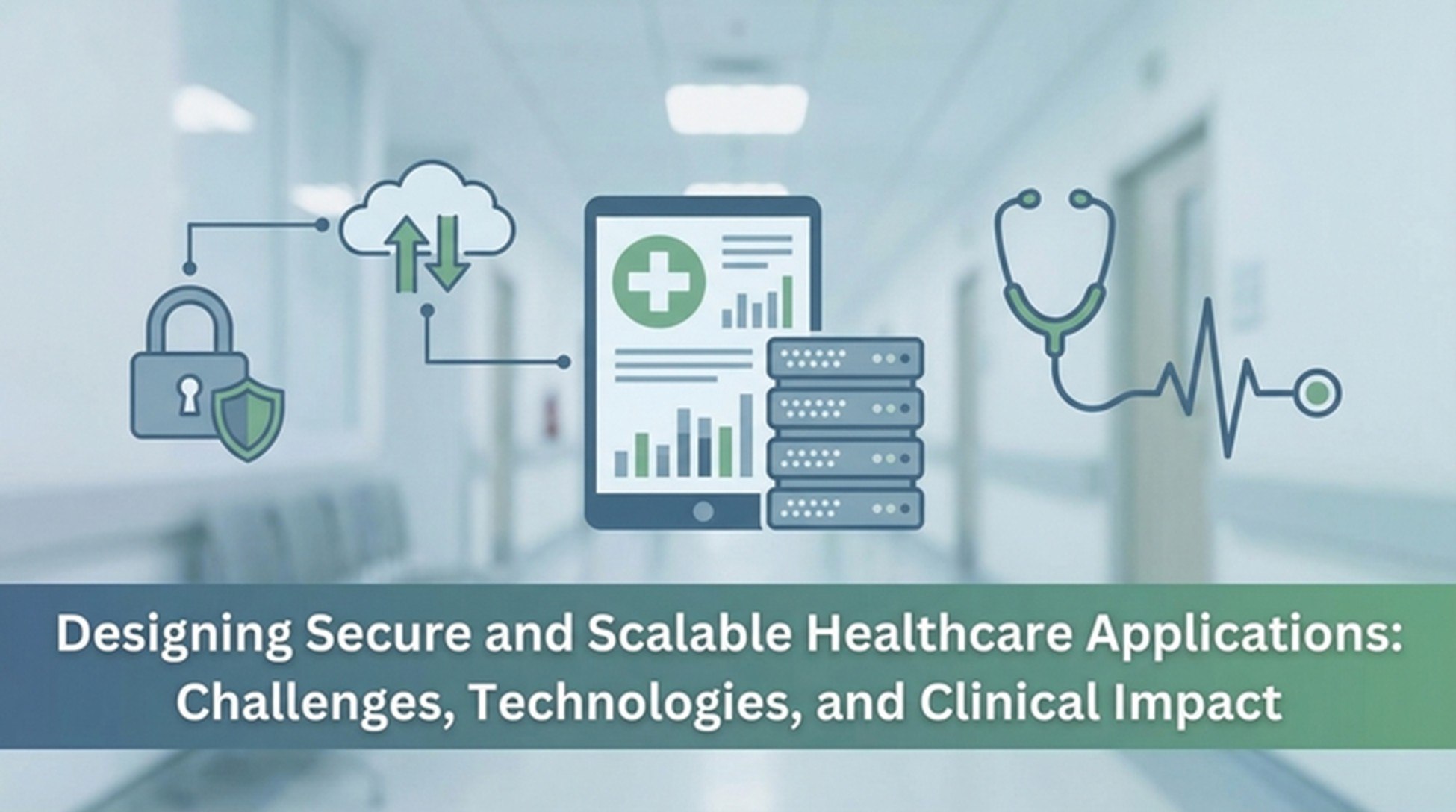
Mobile apps are becoming more and more popular in healthcare systems, and rightfully so. These applications assist in following the health of the patients, managing the medical records, and enhancing the efficiency of the hospitals and clinics. Nonetheless, it is not easy to come up with health apps that are secure as well as scalable. The systems have to ensure that delicate patient data is safeguarded, that they are legal and ethical, and that they are capable of even extending their service in case of high usage. When properly applied, these applications enhance clinical decision-making, facilitate evidence-based care, and streamline operational processes.
In this paper, we will explain the primary issues in healthcare application development. We shall discuss the technologies based on which these applications are secure and scalable. As well, we will discuss development best practices, clinical impact analysis, and propose long-term success strategies.
There are unique problems associated with the development of healthcare applications. To begin with, it is important to secure patient data. Health records are very sensitive data. Any type of access that is unauthorized may have legal, financial, and ethical implications. Therefore, strict compliance with regulations such as HIPAA and GDPR is essential. These rules help prevent unauthorized access and maintain confidence in the system.
Besides, interoperability is also a big issue. Clinics and hospitals usually use many electronic health record systems, laboratory information, and linked medical devices. In the absence of an effective integration, data may end up being disintegrated, hence incomplete or inaccurate records of patients. According to a study conducted by Mandel et al., the implementation of standards, such as SMART on FHIR, enables systems to share data in an efficient manner, where the information received by the clinicians will be used conveniently to make informed decisions.
Scalability and performance are other significant issues. Healthcare apps can often process substantial volumes of data, such as health records, medical images, and data produced by devices. Failure to have a well-designed system might lead to the system slowing down or failing at the point where people are using it. Besides this, applications should be flexible to changing clinical workflows. Hospitals can introduce new treatment procedures, introduce new devices, or increase services, and software has to adapt to these demands without interruption.
There are a number of technologies that are key to the development of robust healthcare applications. Cloud computing offers the ease of centralized data, eliminates maintenance, and enables the expansion of applications as the demand increases. According to Kuo et al., cloud platforms enhance performance and save money while supporting the simultaneous use by many devices.
Technologies of data security are also crucial. Patient records are secure, and sensitive information is only accessed by authorized personnel through encryption and secure authentication. Secure communication protocols and multi-factor authentication make breaches less likely and enhance adherence to the rules.
Software architecture is also very important. Dividing applications into smaller, modular units, also known as microservices, enables developers to either scale or update in a single part, without any impact on the entire system. The method enhances reliability and allows features like telemedicine consultations, analytics dashboards, or an appointment scheduler to operate autonomously.
There is also an emergence of data analysis tools being used in healthcare applications. These instruments are able to detect the trends of patient data, aid in the processes of diagnosis, and monitor patient outcomes. Indicatively, the patterns of imaging scans can be analyzed automatically, thus attracting attention to patterns that could be overlooked during regular scrutiny.
Lastly, interoperability standards play a significant role in making various systems effective in communicating. Adherence to standards such as FHIR enables the application to share information in hospitals, laboratories, and specialized clinics. This connectedness promotes team-based care and minimizes the possibility of medical errors.
Healthcare software requires a systematic way to develop software. It is important to consider security at all levels of development. It encompasses the identification of possible threats, coding with best practices, and testing regularly. Programs with built-in security are not easily vulnerable to attacks and stand a better chance of meeting the changing needs.
It is also important to design applications in a manner that is end-user oriented. The interface needs to be user-friendly and simple to use by clinicians, nurses, and patients. Planned design would minimize errors, save time, and enhance adherence to care guidelines.
It is also necessary to test and validate. The applications must first be tested in terms of functionality, performance, and security. Clinical pilot tests can be used to discover realistic issues and enhance the acceptability of the system. Monitoring and regular updates make sure that the applications will be reliable because features are being upgraded and new devices or data are introduced by a healthcare app development company.
Secure and scalable healthcare applications are an important asset. Remote patient monitoring, such as it, also allows clinicians to monitor vital signs and identify irregularities early. According to Reddy et al., these applications have decreased hospital readmissions and even better patient outcomes because they provide the opportunity to intervene early.
Online medical services increase healthcare accessibility, and in particular in rural or underserved populations. Video consultations can be performed by using scalable applications that will enable serving numerous consultations and still provide a high-quality service and patient protection.
Clinical decision-making is also supported using data-driven tools. Through the analysis of vast amounts of data, applications will be able to inform individual treatment plans, evaluate risk, and aid in diagnosis. This lowers the variation in care and enhances evidence-based decision-making. Moreover, such administrative functions as scheduling, reporting, and billing may be automated, and healthcare professionals may concentrate on patient care, not paperwork.
To make scalable and secure healthcare applications, there is a need to properly plan, pay attention, and focus on clinical requirements. That’s because health applications that are built on a solid architecture, data security, modular design, and uptake of standards-based interoperability can significantly improve patient outcomes, optimize hospital performance, and aid in decision-making. And with the ongoing development in the healthcare sector, quality, affordable, and safe healthcare will still largely rely on well-developed software.


Running a medical practice involves more than patient visits. Phones ring, charts move, and claims travel from the front desk to insurance payers. Money keeps the doors open, yet many physicians feel …
Posted Apr 7, 2026 Claims Management Medical Practice
Connecting innovation decision makers to authoritative information, institutions, people and insights.

Medigy accurately delivers healthcare and technology information, news and insight from around the world.
Medigy surfaces the world's best crowdsourced health tech offerings with social interactions and peer reviews.
© 2026 Netspective Foundation, Inc. All Rights Reserved.
Built on Apr 8, 2026 at 1:06pm