

Managing Editor
@ShahidNShah
@ShahidNShah
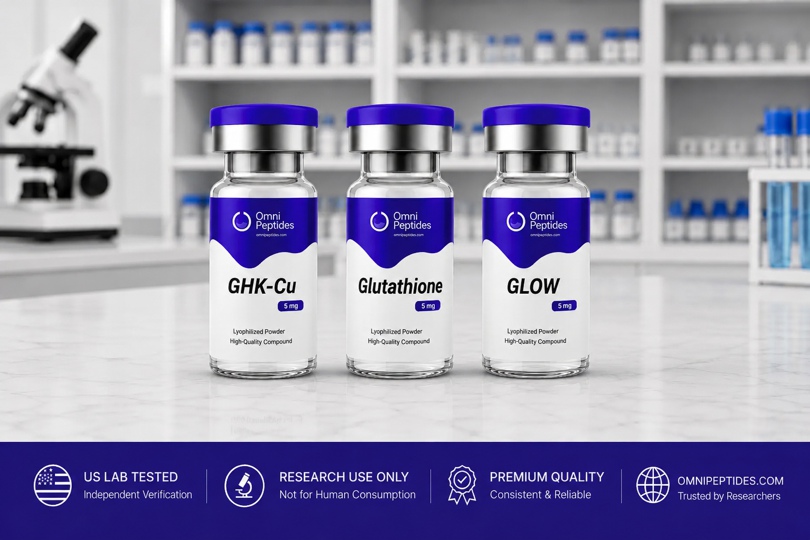
Peptides are one of the most searched and most oversold topics in all of skincare. The encouraging part is that a handful of them have genuinely strong human evidence. The honest part is that many others rest on small or manufacturer-funded studies. This guide walks through seven of the most-discussed skin peptides, what each actually does, and how the research holds up, with GHK-Cu, the copper tripeptide, as the anchor.
One framing makes the whole category easier to navigate: skin peptides work through different mechanisms. Signal peptides tell fibroblasts to build more collagen. Carrier peptides deliver trace elements like copper. Neurotransmitter-inhibiting peptides relax the muscle contractions behind expression lines. Knowing the class tells you what a peptide is actually for.
| Peptide | Class / Mechanism | Skin Evidence | Best For |
| GHK-Cu | Carrier (delivers copper) | Deep mechanism; smaller trials | Collagen, repair |
| Matrixyl (Pal-Pentapeptide-4) | Signal (collagen synthesis) | Strongest cosmetic RCTs | Static wrinkles |
| Argireline (Acetyl Hexapeptide-8) | Neurotransmitter-inhibiting | Split-face studies; modest | Expression lines |
| Collagen Peptides | Ingestible structural precursor | Solid oral RCTs | Elasticity, hydration |
| Glutathione | Antioxidant | Some (tone, oxidative) | Tone, antioxidant |
| GLOW blend | Regenerative repair combo | Rationale-based; preclinical | Barrier, repair |
| Next-gen (Matrixyl 3000, Snap-8) | Signal / neuro variants | Mostly manufacturer data | Combination formulas |
GHK-Cu is a naturally occurring copper-binding tripeptide that our bodies produce less of with age, and it is the most mechanistically studied peptide on this list. It works as a carrier, delivering copper to enzymes like lysyl oxidase that cross-link collagen and elastin. A widely cited gene-expression review found it shifts the expression of more than 4,000 human genes across collagen, elastin, and antioxidant pathways, and controlled skin studies support collagen production and skin repair. The honest caveat: its in-vitro and gene data are exceptional, but large independent cosmetic trials remain limited. It is the most versatile option here, spanning collagen, repair, and antioxidant effects at once.
If GHK-Cu wins on mechanism, Matrixyl wins on replicated human evidence. It is a signal peptide, a fragment of procollagen that tells fibroblasts to build collagen without needing any actual injury to trigger the response. It is the most clinically tested cosmetic peptide there is: a 12-week split-face trial in 93 women found significant improvement in wrinkles and fine lines versus a vehicle control. It works on static wrinkles caused by collagen loss, and like all collagen-signaling peptides, it works on a biological timeline, expect 8 to 12 weeks, not days.
Argireline is the peptide marketed as Botox in a jar, designed to relax the muscle contractions behind expression lines by partially inhibiting neurotransmitter release. Published split-face studies do show measurable reductions in wrinkle depth. But the honest framing matters here: topical penetration to the neuromuscular junction is low, which makes the Botox comparison generous. It is a mild, gradual effect on dynamic lines like forehead creases and crow’s feet, not a needle replacement, and it is best judged by that realistic standard.
The one you swallow rather than apply. Hydrolyzed collagen peptides take a different route entirely, and they have surprisingly solid human data: a controlled trial reported improved skin elasticity and hydration with oral supplementation versus placebo. They do not target a specific wrinkle so much as support the skin’s overall structural matrix from the inside. For elasticity and hydration with genuine randomized evidence behind it, they are hard to overlook.
Glutathione is the body’s master antioxidant, a tripeptide studied for skin tone and oxidative protection, both relevant to how skin ages under environmental stress. Human research exists for its effects on tone and brightening, though a well-known limitation is that oral glutathione is poorly absorbed, which complicates dosing and results. Think of it as an antioxidant support player rather than a structural one, useful for the oxidative side of skin aging.
Some approaches combine peptides to cover more ground. The GLOW blend pairs GHK-Cu with BPC-157 and TB-500, aiming at tissue repair and barrier support. GHK-Cu brings the strong skin data; BPC-157 and TB-500 are studied mainly in wound and tissue-repair models and are largely preclinical where skin specifically is concerned. The combination is built on complementary mechanisms rather than trialed as a single unit, so the rationale is sound but the direct evidence for the blend is thinner than for its best-studied component.
The signal-peptide idea keeps evolving. Matrixyl 3000 pairs a collagen-stimulating peptide with an anti-inflammatory one; Synthe’6 targets six different matrix components; and Snap-8 is a gentler relative of Argireline for expression lines. These show up in many modern serums and are genuinely promising, but as a broader review of topical peptide treatments notes, much of their supporting data is manufacturer-sponsored or small-sample, so effect sizes are best read with a degree of caution.
If you want the strongest evidence, Matrixyl and collagen peptides lead on independent human data, GHK-Cu leads on mechanistic depth and versatility, and Argireline is the realistic choice for expression lines. One caveat runs through the entire category: much of the cosmetic-peptide literature is small-sample or industry-funded, so the honest posture is cautious optimism rather than certainty. In practice, the best results come from matching the peptide’s class to your actual concern, and from consistency over months rather than weeks.
For anyone sourcing these compounds for research rather than off-the-shelf skincare, purity and correct identity matter as much as the peptide itself, since an impure or mislabeled sample undermines any result. Suppliers such as Omni Peptides provide batch-specific Certificates of Analysis and independent third-party testing, the baseline any serious researcher should look for.
It depends on the concern. For collagen and static wrinkles, Matrixyl and GHK-Cu are best supported; for expression lines, Argireline; for elasticity and hydration from the inside, oral collagen peptides.
The best-studied ones (Matrixyl, collagen, GHK-Cu) have real controlled-trial data, but effects are gradual and modest, not dramatic. Peptides work on a biological timeline of weeks to months.
Yes. Because they work through different mechanisms, signal, carrier, and neurotransmitter-inhibiting peptides are often complementary, which is why they are commonly stacked.


Cleaning a controlled environment is a documented process. In sterile compounding suites, ISO-classified rooms, and hazardous drug areas, both the wipe and the way staff use it affect contamination …
Posted Aug 14, 2026 Hospitals, Special
Connecting innovation decision makers to authoritative information, institutions, people and insights.

Medigy accurately delivers healthcare and technology information, news and insight from around the world.
Medigy surfaces the world's best crowdsourced health tech offerings with social interactions and peer reviews.
© 2026 Netspective Foundation, Inc. All Rights Reserved.
Built on Oct 19, 2026 at 5:05am