

Managing Editor
@ShahidNShah
@ShahidNShah

Most ABA practices aren’t struggling because of their clinical skills. They’re struggling because their software can’t keep up. Between managing discrete trial training (DTT) data, chasing prior authorizations, and keeping session notes current in real time, the administrative weight is real. The best ABA software exists to reduce that weight. After reviewing platforms built for behavioral healthcare practices of all sizes, this guide covers the top five options worth considering right now.
How this ranking was put together
Platforms were assessed by pulling publicly available information across user review sites, case study libraries, feature breakdowns, and official product pages. Only options with a documented track record in behavioral healthcare made the cut. → See the full research breakdown
Picking the right platform in behavioral healthcare isn’t just a vendor decision. It shapes how accurately your team captures skill acquisition data, how fast supervisors can act on session trends, and whether your billing holds up under payer scrutiny.
ABA therapy moves fast. Real-time data collection during sessions isn’t optional when treatment decisions depend on what happened 20 minutes ago. Managing high volumes of DTT and naturalistic teaching targets across a growing caseload adds another layer of pressure that most generic systems were never designed to handle.
The right platform changes those outcomes in ways you can actually measure. Practices that invest in purpose-built software tend to see stronger skill acquisition, target mastery rates per quarter, tighter session note completion timelines, and cleaner claims submissions that don’t keep getting kicked back.
Note: All data in this table is sourced from review platforms and the official websites of the listed companies.
| Company Name | Best For |
| Theralytics | Clinical performance and operational results |
| Passage Health | ABA clinical operations |
| Ensora Health | Multi-specialty therapy practice management |
| TherapyPMS | ABA and multi-discipline therapy clinics |
| Raven Health | Practice management and billing systems fortherapy |
How Does Theralytics Operate?
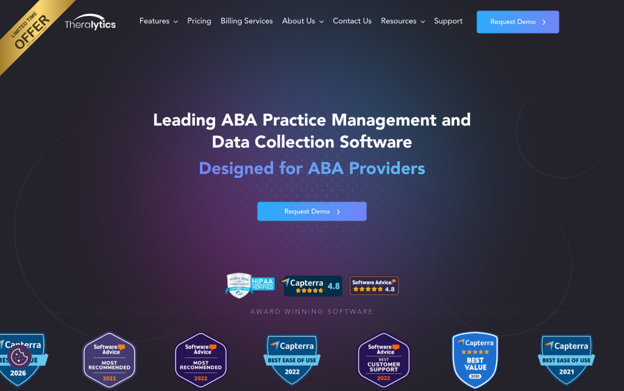
Theralytics brings clinical and operational workflows together inside one platform. BCBAs, supervisors, and clinicians all work from the same synchronized data, which means no more waiting for session notes to catch up before making treatment decisions. Teams relying on ABA management practices depend on the best ABA software to reduce operational friction. Automated graphing, progress monitoring, and scheduling run alongside MFA, AES-256 encryption, and SOC 2 Type II certification, covering security requirements well ahead of 2026 HHS standards.
Why Does Theralytics Stand Out for ABA Software?
Theralytics solves one of the most persistent problems in behavioral health operations: the gap between what clinicians need in the moment and what administrative systems can actually deliver in real time. That kind of synchronized, automated approach is rare and hard to match for growing practices that can’t afford data silos slowing down care.
What Users Are Actually Saying:
From what the reviews show, clinicians tend to get up to speed fast because the interface doesn’t fight them. Users consistently point to the automated insights and real-time sync as the features that actually change how supervisors make decisions. The merging of clinical workflows with administrative processes is what gets called out most, and honestly, that’s the thing most platforms still get wrong.
How Does Passage Health Operate?
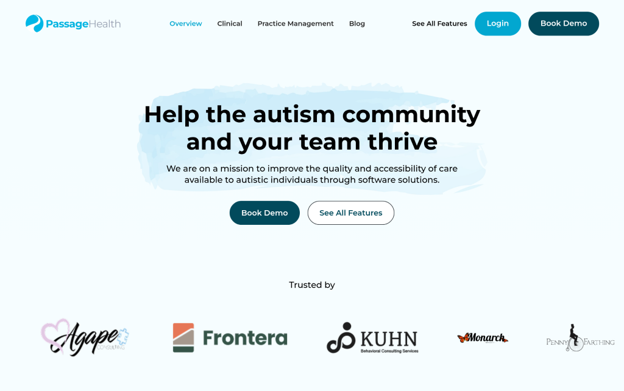
Passage Health is an all-in-one clinical and practice management platform built for ABA and autism-focused behavioral healthcare providers. The platform covers data collection, treatment plan building, supervision tools, and progress monitoring with alerts when treatment outcomes start to slow. What makes it stand out is that it was built collaboratively with over 100 practices and advisors (not just designed in a room and shipped). Real-time syncing, offline functionality, and analytics-driven reporting are all part of the product.
Why Does Passage Health Stand Out for ABA Software?
Passage Health addresses the real gap between generic clinical platforms and the actual supervision and treatment planning demands of ABA therapy. Having built the product alongside more than a hundred practices means the feature decisions came from real-world workflow problems, not guesswork.
What Users Are Actually Saying:
Users consistently mention how little training the platform requires, which matters a lot when you’re bringing on new RBTs or dealing with staff turnover. The offline functionality gets called out for reliability during home and community-based sessions. And from what the reviews show, the dedicated support during setup makes the whole process feel far less painful than it usually is.

How Does Ensora Health Operate?
Ensora Health provides a unified healthcare platform designed to support both mental health practices and ABA/behavioral therapy providers. Instead of separating its offering into multiple disconnected products, it delivers a single integrated system that can be configured for different care settings. The platform combines EHR, practice management, and billing tools to reduce administrative workload and streamline daily operations. Pricing starts at $29 per therapist per month, with additional AI-powered clinical documentation features currently in development.
Why Does Ensora Health Stand Out for ABA Software?
For ABA and behavioral therapy clinics, Ensora Health stands out because it supports multi-service practices that often need both clinical and administrative workflows in one system. Its ability to handle scheduling, billing, and documentation in a unified workflow makes it especially useful for ABA providers working alongside other therapy disciplines. Recognition such as G2 Leader status in mental health software and Fusion’s ranking among top healthcare platforms reflects strong market adoption and trust.
What Users Are Actually Saying:
With over 200,000 providers using the platform, adoption at this scale suggests consistent real-world performance. Users frequently highlight the value of having billing and EHR tightly integrated in one system, along with the predictable per-therapist pricing model that scales well as practices grow.
How Does TherapyPMS Operate?
TherapyPMS is a practice management platform covering ABA, occupational therapy, speech therapy, mental health, pediatric therapy, and physical therapy. The software ties together credentialing, billing, and telehealth tools purpose-built for therapy professionals rather than general healthcare settings. Their accounts receivable services are the headline feature, delivering a 99% success rate in maximizing reimbursements (not cheap to leave that kind of money on the table without it). The platform is SOC-2, HIPAA, and GDPR compliant across both the U.S. and Canadian markets.
Why Does TherapyPMS Stand Out for ABA Software?
TherapyPMS targets the revenue cycle problem that quietly costs therapy practices the most: clean claims and reimbursement recovery. A 99% accounts receivable success rate is a specific, verifiable claim that speaks directly to the billing headaches most ABA practices deal with month after month.
What Users Are Actually Saying:
Trust from over 500 clinics across the U.S. and Canada shows the platform has broad adoption across practice sizes. Testimonials reflect confidence in the specialized approach to practice management, and the reimbursement-focused positioning appeals particularly well to administrators managing cash flow under payer pressure.

How Does Raven Health Operate?
Raven Health builds ABA data collection and practice management software from the ground up for behavioral healthcare providers. The platform covers data synchronization, offline data collection, treatment plans, progress tracking, and billing, with a mobile- and tablet-first design that works in any care setting. The most talked-about part of their build philosophy is that clinicians typically learn the interface in under 15 minutes. Their pricing model is also genuinely different: the software is free, with a small percentage taken from claims collected.
Why Does Raven Health Stand Out for ABA Software?
Raven Health removes the financial barrier to getting started, which matters for smaller ABA practices that can’t absorb large upfront software costs. Tying company revenue to client billing outcomes means their incentives actually point in the same direction as the practices they serve.
What Users Are Actually Saying:
Clients like Crescent Bloom and Pair Tree Autism Services are cited as examples of measurable operational improvement after adopting the platform. The under-15-minute learning curve keeps coming up as a meaningful differentiator, especially for practices with high RBT turnover where retraining is a constant reality.
The process started by pulling together a wide list of ABA and behavioral healthcare software platforms from multiple sources. Therapy-specific software directories, review aggregators, clinical practice publications, and company websites were all tapped to build the initial longlist. The goal at this stage was breadth, capturing as many relevant platforms as possible before any filtering began. Case studies published by the companies themselves were also reviewed to understand how each platform positioned its own results.
From that broad list, platforms without a verifiable presence in behavioral healthcare were removed early. Review pattern analysis played a major role here. Platforms with thin review histories, inconsistent feedback across sources, or a pattern of claims that couldn’t be corroborated were deprioritized. What remained was a tighter group of options where the reviews lined up reasonably well with the feature claims being made on official product pages.
Each shortlisted company was then cross-checked more carefully. Claims made on their websites, such as billing success rates, user counts, and certification details, were compared against what showed up in user reviews and third-party platform listings. Where there were gaps between what a company said about itself and what practitioners were actually reporting, those discrepancies were noted. Platforms that held up well across both sources moved forward.
Attention from reputable review platforms, mentions in behavioral health publications, and third-party awards were factored in as supporting signals. A company ranked as a G2 Leader or included on a recognized top-software list carries weight because those designations reflect aggregated user ratings rather than editorial opinion. Original research published by the companies, such as outcome data or clinical benchmarks, was also reviewed where available.
The final filter focused on behavioral healthcare depth. Platforms that maintained dedicated service pages for ABA workflows, published verified reviews from BCBAs and clinical directors, and could point to relevant case studies involving ABA therapy practices scored higher here. General-purpose practice management tools with thin behavioral healthcare coverage were separated from platforms that clearly built their product around the specific workflows of ABA clinicians. This last step is what produced the final five.
The five platforms covered here each serve behavioral healthcare well, but they don’t all serve the same practice. Here’s what to focus on when making the call for your situation.
Choosing the right ABA software comes down to knowing where your practice actually loses time. Whether that’s clinical documentation, billing accuracy, or supervision oversight, there’s a platform on this list built for that exact problem. Theralytics leads for unified clinical and operational workflows, while Raven Health and Passage Health are strong picks for practices prioritizing ease of use. As behavioral healthcare demand keeps growing, the right software investment pays off in better outcomes and a healthier bottom line.


When people think about rhinoplasty, they often focus on before-and-after photos. It makes sense. Photos seem like an easy way to picture what a new nose might look like. The problem is that noses do …
Posted Jun 3, 2026 Cosmetics
Connecting innovation decision makers to authoritative information, institutions, people and insights.

Medigy accurately delivers healthcare and technology information, news and insight from around the world.
Medigy surfaces the world's best crowdsourced health tech offerings with social interactions and peer reviews.
© 2026 Netspective Foundation, Inc. All Rights Reserved.
Built on Oct 23, 2026 at 4:06pm