

Managing Editor
@ShahidNShah
@ShahidNShah

After February 16, 2026, all programs following the revised 42 CFR Part 2 regulations will need to comply in full, and patients can report directly to HHS. The problem in behavioral health interoperability has moved from the chart to the connection, where most of the issues occur during the transfer of data. The following guide covers the interoperability pitfalls to avoid in order to maintain your 42 CFR Part 2 compliance and interoperability.
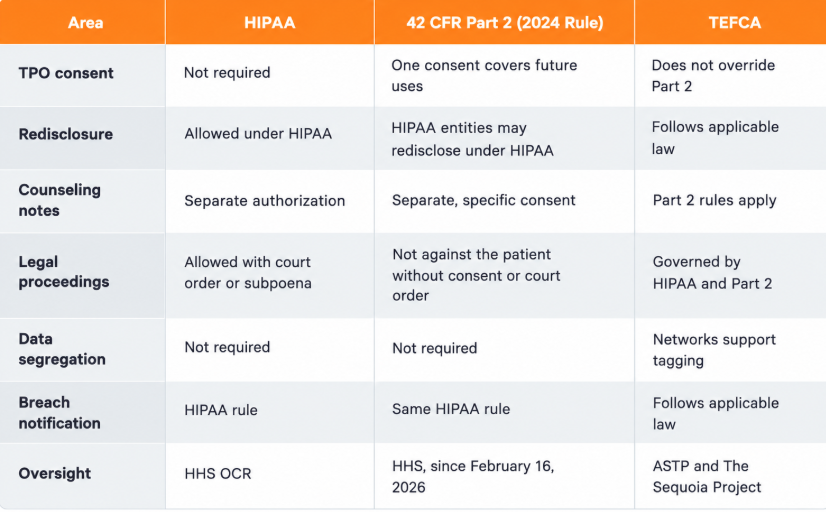
Sharing protected health information for Treatment, Payment, and Operations (TPO) purposes does not require written consent under the HIPAA Privacy Rule. However, under Part 2, more stringent provisions apply to substance use disorder records. The new 2024 rule included a single TPO consent while retaining extra safeguards for SUD counseling records and legal processes. This combination of regulations poses interoperability problems for behavioral health providers, considering that EHRs and HIEs have been developed with HIPAA in mind. It is in this very area that interoperability for behavioral health fails.
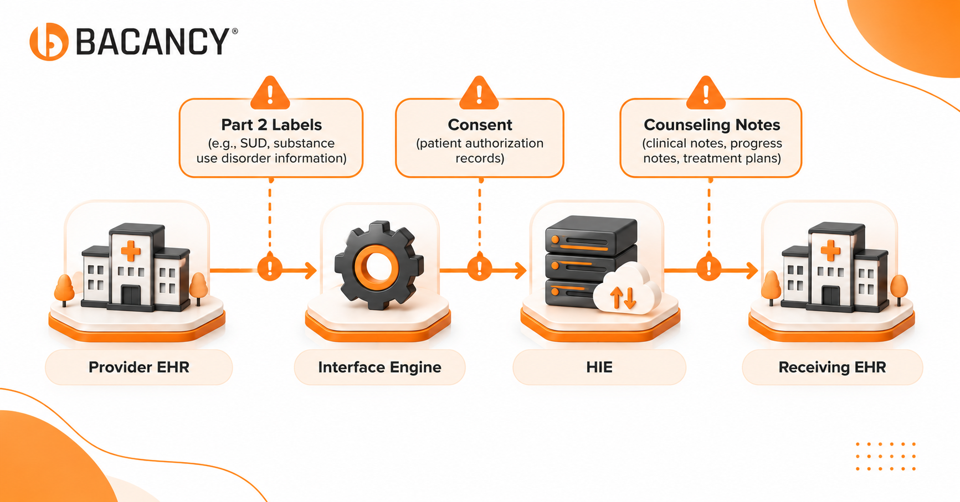
HL7 Security Labels are used to show that particular healthcare information is either sensitive or restricted. These labels are included in both CDA and FHIR transactions. In case the interface engine removes these security labels while translating HL7 v2/CDA into FHIR transactions, then the receiving system will have no idea whether the transferred data is restricted or not. This is why, the interoperability test of Part 2 should include these security labels.
patient data is shared with consent, the receiver needs to know what the patient agreed to and how the data can be used. But some CCDA files and API responses send only the health record, without the consent details. This can leave the receiver unsure about what they are allowed to do with the data. Include the patient’s consent and its scope with every data exchange.
The TPO consent will be stored in PDF format and therefore cannot be read by other systems or determine when it has been revoked. This may pose problems regarding the consent of data sharing. Interoperability in behavioral health is enhanced where consent is stored as structured data and validated prior to data sharing.
SUD counseling notes need specific consent and cannot move under a broad TPO consent. The issue appears when they share a document type with progress notes, so bulk exports include them. Safe substance use disorder data sharing starts with separating these notes in your data model.
The diagram below shows where these three types of Part 2 data usually leak as records move between systems.
Many people think Part 2 data should always be separated. But the HHS final rule says that keeping Part 2 records separate is not required. Blocking all SUD data can make it harder for providers to give complete care. Good behavioral health data exchange shares the information that the law allows.
Some teams block everything and risk information blocking claims under the Cures Act. Others share everything and risk Part 2 violations. The information blocking rule does not require a disclosure another law Does not allow, yet routinely Guiding patients away from sharing can count as blocking. Strong behavioral health interoperability configures both rule sets in one consent engine.
When a patient gives general consent to share their health information, the HIE must keep track of who received that information. If the patient asks for this information in writing, the HIE must provide a list of recipients from the past three years within 30 days. some HIE connections do not properly record these disclosures. Without these logs, the HIE may not know where the patient’s records were sent and may not be able to provide the required information on time.
Coding for SUD treatment is one such code that will show up in 837 files, EOBs, or reports made by the clearinghouse. In this case, confidential behavioral health information could find its way to the claims process despite any privacy setting used in the EHR system. There will be cases where patients will require certain pieces of their information not to be revealed. Therefore, billing and claim processes should have privacy policies built in.
AI writers, analysis software, and CRMs can all access health information through APIs. However, such tools are not always set up with the necessary business associate or qualified service organization agreement. It is crucial to clean the data before applying SUD data to any analysis or to train the AI algorithm. Every tool that comes into contact with your SUD data must be reviewed from privacy, consent, and security standpoints.
While most teams will log when the staff access the records of the patients, not all teams will log API and Interface events. This makes it difficult to follow the trail of how the SUD data flows through automated exchanges of information. With Part 2, the Breach Notification rule of the HIPAA applies to SUD records. In case of any data breach, it is important to know when it occurred and which patients it affected.
You do not need to overhaul all systems to address these problems. Start by mapping out where your data is going and then testing those pathways. Here’s how behavioral health professionals can ensure that they are complying with 42 CFR Part 2 and the interoperability requirements for behavioral health under Part 2:
Behavioral health data sharing under 42 CFR Part 2 works best when these checks run all year.
Part 2 risk now sits in the connections between systems, not inside the record. Lost labels, unreadable consent and missing logs can turn routine data exchange into a reportable breach. Run an interface level audit before your next payer review. If your current system can’t store structured consent or separate counseling notes, it may be time for an EMR built with Part 2 in mind. Bacancy Technology has built healthcare software since 2011 and can help you design consent aware, audit ready behavioral health interoperability from the record up.


You’ve just been told you have lung cancer, and you want treatment to start now. Then the oncologist says something that sounds strange: let’s wait for the biomarker results. That wait has …
Posted Oct 7, 2026 Personalized Medicine
Connecting innovation decision makers to authoritative information, institutions, people and insights.

Medigy accurately delivers healthcare and technology information, news and insight from around the world.
Medigy surfaces the world's best crowdsourced health tech offerings with social interactions and peer reviews.
© 2026 Netspective Foundation, Inc. All Rights Reserved.
Built on Oct 8, 2026 at 6:09pm